Melgund Township Winter Story Library
The Frost-Bound Kingdom - Analysis
by Jamie F. Bell | Analysis
by Jamie F. Bell | Analysis
The frozen block of oats and honey is a dense, unyielding artifact of resistance, a brick of sustenance that refuses to be consumed without inflicting pain. It requires a shattering force to break, sending jolts of agony through the teeth just as the reality of the storm sends shocks of terror through the psyche. In this object, the sweetness of life is locked behind a crystalline barrier of ice, accessible only through a desperate, gnawing persistence that mimics the primal struggle for survival. The act of eating becomes a mirror for the act of living: a painful, mechanical grinding against a world that has hardened into something indifferent and impenetrable, where nourishment is no longer a given right but a battle won by inches.
This narrative operates at the precarious intersection of a survival thriller and a psychological character study, utilizing the framework of a bildungsroman mediated through the lens of video game ludology. The overarching theme is the transmutation of lethal reality into manageable fantasy, exploring how the human mind constructs narrative armor to withstand existential dread. The "Frost-Bound Kingdom" is not merely a setting but an antagonist that actively erodes the protagonist's sense of self, forcing a regression into the structured, rule-bound safety of "Glacier Knight IV." By overlaying the chaos of a blizzard with the binary logic of a video game—quests, health bars, safe zones—the story examines the protective utility of escapism. However, the narrative does not dismiss the fantasy as mere delusion; rather, it elevates the "game" to a vital survival tool, suggesting that the stories we tell ourselves are sometimes the only barrier between resilience and resignation.
The narrative voice is strictly first-person, filtered through Sam’s deeply unreliable and dissociative perception. His view of the world is augmented by a hallucinated user interface; he sees "minimaps" turning to static and "stamina bars" depleting rather than acknowledging the physiological onset of hypothermia. This perceptual limit is crucial because it reveals the depth of his trauma response. The reader is forced to decode the severity of the situation through the cracks in Sam's gaming lexicon. When he describes the wind as a "corrupted audio file," he is distancing himself from the visceral horror of the sound. The narrative relies on this gap between the objective danger—the dropping barometric pressure, the bear tracks—and Sam’s subjective reinterpretation of them as plot points, creating a tension that is both pathetic and heroic.
Ethically and existentially, the story probes the dynamics of shared reality and the moral obligation of care. The winter setting acts as a crucible that strips away social pretenses, leaving only the raw interplay of dependence and leadership. The central moral pivot occurs not when Sam retreats into fantasy, but when Anne chooses to validate it. This act of "playing along" is a profound expression of empathy; she recognizes that stripping Sam of his delusion would likely result in his catatonic collapse. Therefore, the "quest" becomes a shared truth, a pact of survival where the existential void of the whiteout is filled with purpose. The cold does not just freeze the body; it threatens to freeze the will, and the construction of the "Citadel" serves as a physical manifestation of their refusal to succumb to the nihilism of the storm.
Psychological State:
Sam is operating in a state of acute dissociation triggered by life-threatening stress. The "roar of white" overwhelms his sensory processing, causing him to retreat into a "fictional finalism"—a psychological concept where an individual acts according to a fictional goal to reduce anxiety. By converting the chaotic, uncontrollable elements of the storm into the programmed logic of a video game, he attempts to regain an internal locus of control. The "game" is a cognitive shield; if the storm is a level, it can be beaten. If he is a knight, he cannot die a meaningless death.
Mental Health Assessment:
While his coping mechanism appears delusional, it demonstrates a paradoxical resilience. Sam possesses a highly active imagination that he weaponizes against despair. However, his reliance on external structures (the game's rules) suggests an underlying fragility and a lack of confidence in his authentic self. He struggles with direct confrontation of reality, preferring to filter trauma through a dissociative lens. This indicates an avoidant coping style that, while effective in the short term for panic management, suggests a vulnerability to overwhelming stress without a narrative framework to contain it.
Motivations & Drivers:
His primary biological driver is homeostasis and survival, but his psychological driver is the need for narrative coherence. He is motivated by the desire to be the "hero" of his own story rather than a victim of nature. He seeks validation from Anne, casting her as the "Lady" to his "Knight," driven by a need to be useful and competent in her eyes, even if he must invent a fantasy world to achieve that competence.
Hopes & Fears:
Sam’s deepest fear is the "Game Over" screen—a metaphor for the finality of death and the cessation of consciousness. He fears the "static," the emptiness where the map should be, representing a loss of direction and purpose. His hope is anchored in the "quest" structure: the belief that endurance will be rewarded with a "save point" or a victory condition. He hopes that by adhering to the rules of the genre, he can force the chaotic universe to make sense.
Psychological State:
Anne displays a state of hyper-arousal and focused pragmatism, characteristic of a "fight" response that has been intellectualized into problem-solving. Unlike Sam, she confronts the winter reality head-on, reading barometric pressure and wind direction. However, her psychological state shifts from solitary command to cooperative play. She cognitively reframes the situation to accommodate Sam’s breakdown, exhibiting high emotional intelligence. She suppresses her own terror to function as the anchor for both of them.
Mental Health Assessment:
Anne demonstrates robust mental health and high executive functioning. Her ability to pivot from a "no-nonsense" attitude to participating in an elaborate fantasy indicates exceptional cognitive flexibility. She is grounded and resilient, capable of managing not only her own survival needs but also the emotional regulation of a companion. She does not dissociate; she adapts. Her engagement with the fantasy is a calculated strategic move, not a retreat from reality.
Motivations & Drivers:
Her primary motivation is the preservation of life—both hers and Sam's. She is driven by a logical assessment of resources and threats (the bear, the wind, the cold). Her decision to adopt the persona of "Lady Anne" is driven by the realization that Sam is a resource that needs to be managed; a panicked partner is a liability, while a "knight" is a worker. She is motivated by the immediate need for shelter and the long-term goal of rescue.
Hopes & Fears:
Anne fears the loss of agency and the failure of her calculations. The "cracking glass" sound of falling branches represents variables she cannot control. She fears that Sam’s panic will render him immobile, forcing her to make impossible choices. Her hope is simpler and more concrete than Sam’s: she hopes for the dawn, for the storm to break, and for the physical efficacy of the shelter they build.
The emotional trajectory of the chapter moves from the frantic, high-frequency vibration of panic to the low, steady hum of intimacy. Initially, the emotion is characterized by a "shriek" and a "roar"—external chaos that invades Sam’s internal state. The panic is "cold and sharp," a piercing intrusion that threatens to shatter his psyche. As the fantasy takes hold, the emotional texture changes; it becomes performative and rigid, a desperate scaffolding erected to hold back the terror. The dialogue becomes stilted and formal, creating an emotional distance from the reality of their freezing bodies. This performance acts as a containment vessel, holding the panic in check through the ritual of "questing."
Once they enter the snow cave, the emotional architecture undergoes a radical compression. The cessation of the wind creates a vacuum that is filled by a profound, quiet intimacy. The transition from "Sir Samuel and Lady Anne" back to "Sam and Anne" marks the collapse of the defensive narrative. In the darkness, the shared vulnerability creates a warmth that is arguably more vital than the cocoa. The sharing of the thermos and the frozen granola bar becomes a sacrament of connection. The fear does not vanish, but it transmutes from a solitary, screaming terror into a shared, manageable burden.
The final emotional shift occurs with the dawn. The terror of the night is recontextualized as awe. The "world on fire" and the "chandeliers of diamond" evoke a sense of the sublime—that mixture of beauty and terror described by Romantic poets. The relief of survival is tinged with a lingering haunting; the realization that the game was "finally real" suggests that the emotional impact of this near-death experience has permanently altered Sam’s landscape. The arrival of the rescue helicopter introduces a jarring, mechanical note that signals the end of this liminal emotional space, bringing with it a complex mix of salvation and the loss of the profound connection forged in the dark.
The environment in this story is not a passive backdrop but an active psychological agent that mirrors the disintegration of Sam’s reality. The "friendly brown snake" of the trail dissolving into "ghostly gray shapes" reflects the loss of cognitive grounding. The whiteout functions as a sensory deprivation tank that paradoxically overloads the mind, erasing the "minimap" of the known world and forcing the psyche to project its own internal geography onto the void. The "endless, featureless void" strips away the markers of civilization and identity, reducing the characters to biological entities fighting against entropy.
The construction of the snow cave, or the "Citadel," represents a reclamation of space. By digging into the snow, they are not just creating shelter; they are carving out a womb-like niche within the hostile entity of the winter. The spatial dynamics of the cave—cramped, dark, forcing physical contact—necessitate a psychological closeness. The "muffling blanket" of silence inside the cave creates a stark boundary between the chaotic "outside" and the ordered "inside." In this confined space, the vast, indifference of the Ice King’s domain is held at bay, allowing the human element to reassert itself. The environment shifts from an expanse that swallows them to a cocoon that incubates their survival.
The story’s prose is defined by a clash of registers: the modern, digital vernacular of the gamer and the archaic, elevated diction of high fantasy, all set against the brutal, sensory language of hypothermia. The narrator juxtaposes "corrupted audio files" and "minimaps" with "elven steel" and "frost-serpents." This linguistic friction symbolizes the conflict between the modern mind and the primal, ancient threat of the elements. The "stilted tone" they adopt serves as a rhythmic counter-spell to the chaotic "shriek" of the wind. The sentences describing the storm are often long and breathless, mimicking the rush of the wind, while the dialogue within the fantasy is measured and declarative, imposing order on the chaos.
Symbolically, the "ice" serves a dual function: it is both the "armor" of the enemy and the "jewels" of the morning. The "frozen granola bar" is a potent symbol of the harshness of their reality—sustenance that hurts to consume. The "bear tracks" function as a checkmate to the fantasy; they are the intrusion of a biological reality that cannot be fought with imaginary swords. The transformation of the forest into "crystal and glass" at the end signifies the crystallization of memory; the trauma has been frozen into something beautiful and dangerous, a permanent "level" in Sam’s psychological history.
The recurring motif of the "screen" or "interface" is central to the story's imagery. Sam views the blizzard as a "blank screen" or a "critical error." This digital imagery highlights the generational filter through which he processes the world. The transition from the "gray" of the storm to the "luminous blue" of the dawn and finally the "orange" of the sun traces a color palette that moves from the color of static and death to the colors of life and fire. The "cracking glass" sound of the trees foreshadows the fragility of their own bodies and the potential shattering of their mental states.
The narrative leans heavily on the Quixotic archetype, reinterpreting Cervantes’ Don Quixote for the digital age. Sam plays the role of the Knight of the Sorrowful Countenance, imposing a layer of romance onto a mundane (albeit deadly) reality. Anne initially occupies the role of Sancho Panza, the grounded realist, but the story subverts this dynamic when she actively enters the delusion, becoming a co-author of the fantasy rather than just a witness. This interplay also echoes the "Magic Circle" concept from game studies (Huizinga), where a distinct boundary is drawn within which special rules apply. In this case, the snow cave becomes the physical manifestation of the Magic Circle, a temporary autonomous zone where they are heroes rather than victims.
The story also draws upon the rich tradition of "Winter as Death" found in mythology and literature, from the Norse Fimbulwinter—the prelude to Ragnarok—to the White Witch’s eternal winter in C.S. Lewis’s Narnia. The "Ice King" Sam invokes is a pastiche of these archetypal figures, a personification of the entropy that seeks to halt all life. The "dark woods" they traverse invoke the Dantean selva oscura, a place of being lost and facing the self. However, unlike Dante, who is guided by Virgil, Sam is guided by the rules of Glacier Knight IV, suggesting a cultural shift where pop culture narratives have replaced classical mythology as the primary framework for understanding the hero’s journey.
Furthermore, the story engages with the contemporary cultural conversation around "gamification" and the screen-mediated life. It asks whether the skills and mindsets learned in virtual worlds have transferability to the real one. Sam’s "gamer brain" scans for patterns and objectives, which actually aids in their survival (looking for resources, identifying the cave). This suggests a validation of the gamer archetype, moving beyond the stereotype of the detached escapist to present a mind trained in problem-solving and persistence, even if that mind requires a user interface to function under pressure.
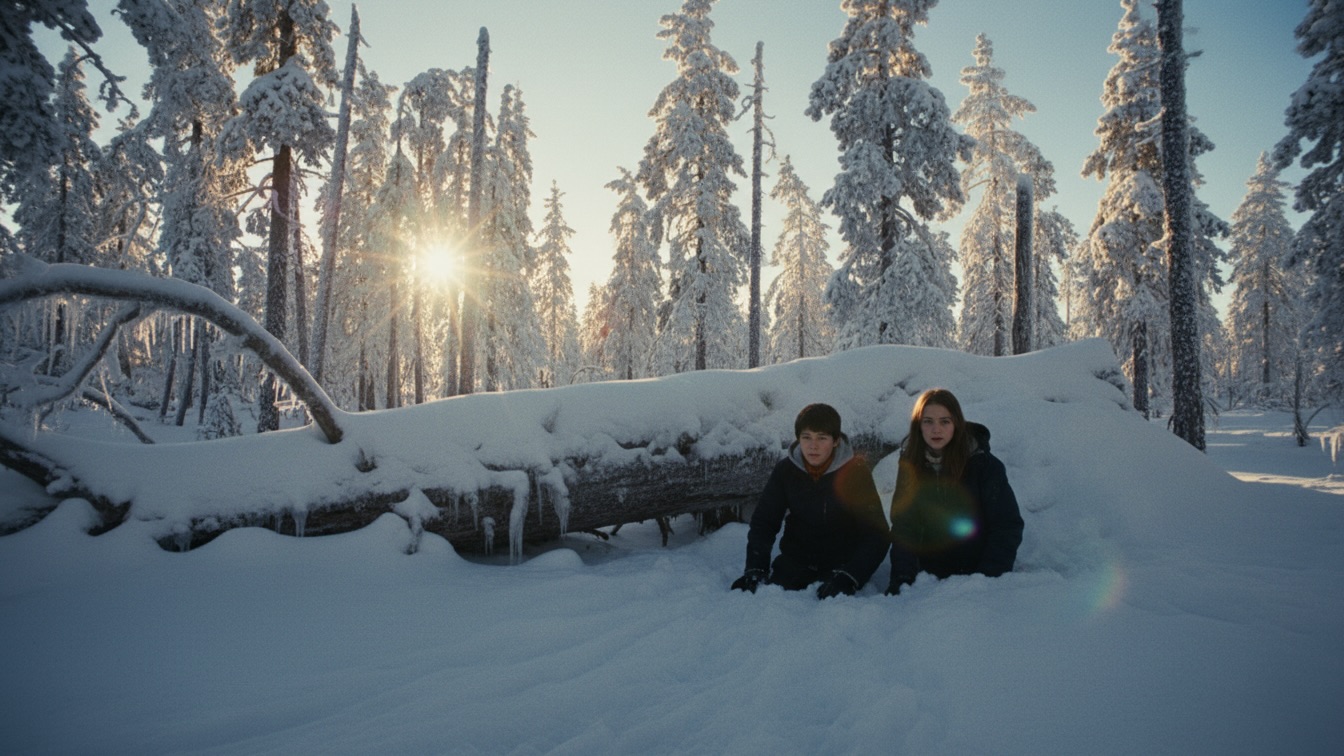
What remains after the storm clears is not the triumph of the quest, but the haunting fragility of the human body against the indifference of the cold. The story leaves the reader with a visceral sense of the thinness of the veil between civilization and primal survival. The image of the two teenagers huddled in the dark, chewing on frozen oats to keep their internal fires burning, lingers as a testament to the stubbornness of life. It prompts a reflection on the narratives we all construct to navigate our own personal winters—the small fictions we tell ourselves to get out of bed, to face difficult tasks, to endure pain.
The beauty of the ice-encased forest at dawn complicates the emotional resolution. It prevents the story from being a simple tale of "man vs. nature" where nature is purely villainous. The "landscape of crystal and glass" is breathtaking, suggesting that the very forces that tried to kill them are also capable of creating unparalleled beauty. This duality leaves an unsettling aftertaste; the world is not malicious, it is simply intense, and that intensity can manifest as a lethal blizzard or a glittering sunrise. The indifference of the "Ice King" is what makes the morning so spectacular.
Finally, the relationship between Sam and Anne resonates with a quiet power. The transition from the high drama of "Sir Samuel" to the hushed confession in the dark highlights the difference between performative heroism and genuine connection. The story asks the reader to consider the nature of bravery: is it the booming voice of the knight facing the dragon, or the quiet voice in the dark keeping a friend awake? The lingering question is how this shared trauma will reshape them. They have survived the "level," but the game has become real, and the safety of the screen has been permanently shattered.
The helicopter’s rhythmic chopping is not a fanfare of rescue, but a violent intrusion of the mechanical world upon a sacred, frozen silence. It signifies the end of the "Frost-Bound Kingdom," dissolving the magic circle that Sam and Anne had constructed with snow and desperation. While it brings safety, it also brings a mournful closure to the temporary reality where they were arguably their most essential selves. The "Citadel," that humble burrow of body heat and whispers, will be left behind to melt into the anonymous earth, a forgotten monument to a kingdom that existed only as long as the danger lasted.
In the end, the ice does not melt immediately; it holds the world in a suspended breath, a glittering pause before the return of the mundane. The memory of the cold will likely remain in Sam’s bones longer than the warmth of the rescue, a phantom chill that no amount of indoor heating can fully dispel. He has learned that the "Game Over" screen is not static or black, but a blinding, beautiful white, and that the only true save point is the hand of another human being reaching out in the dark.