Melgund Township Winter Story Library
The Bloom of St. Valentine - Analysis
by Jamie F. Bell | Analysis
by Jamie F. Bell | Analysis
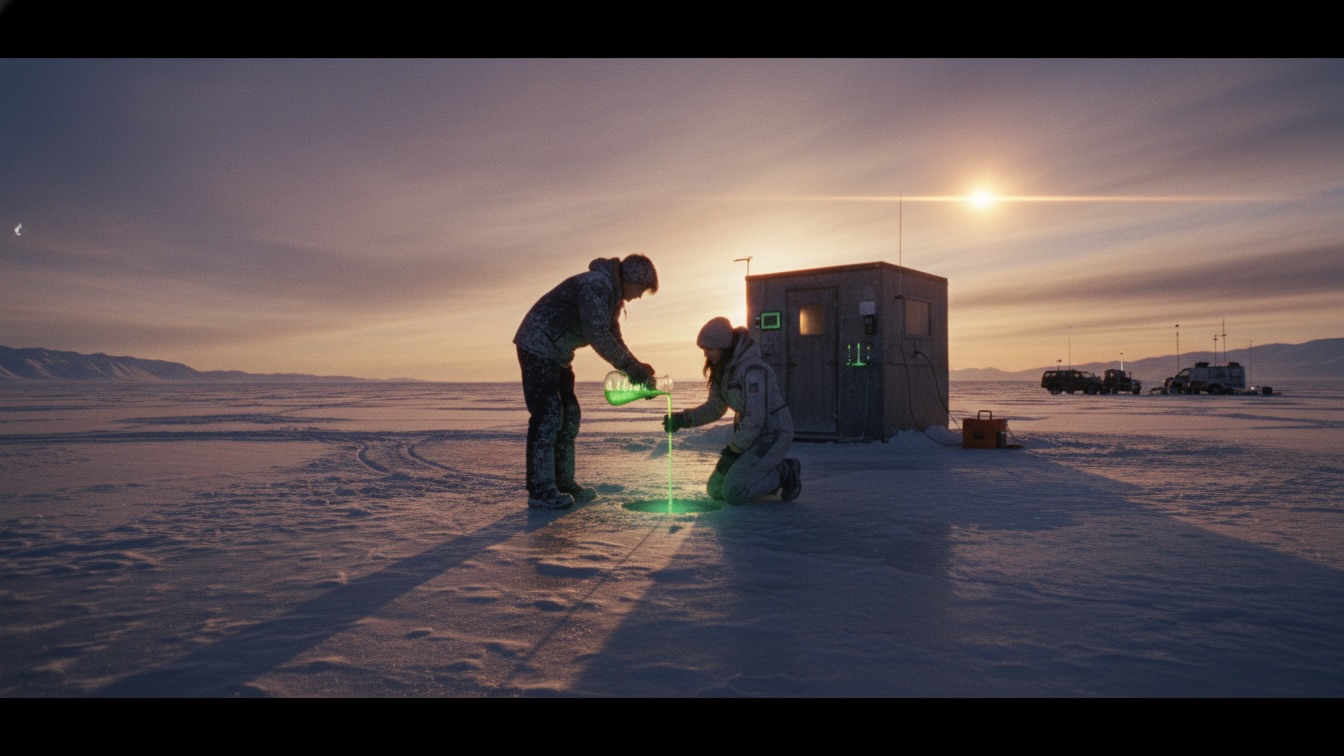
The narrative opens on the frozen expanse of Lake Eir, where the protagonist, Ellie, and her colleague, Jim, forcibly enter a university shed. The atmosphere is thick with the physical bite of the cold and the tension of their illicit activity. Their goal is not vandalism, but a radical act of environmental remediation. They are there to deploy Phaeocystis lucidum, a genetically engineered algae designed to consume the agricultural nitrates poisoning the lake. The lake is described as a beautiful mask hiding a diseased face, and the scientists view their creation as a miraculous cure, a way to baptize the water and absolve humanity of its ecological sins.
After drilling through the ice, they release the bioluminescent algae into the dark water below. Initially, the experiment appears to be a resounding triumph; the nitrate levels drop precipitously, exceeding their most optimistic models. Caught up in the euphoria of playing god, they celebrate their apparent victory over the pollution. However, the mood shifts as Ellie notices a disturbing green glow rising from the depths, followed by the gruesome sight of dead fish pressing against the underside of the ice. The algae has not only consumed the poison but has also stripped the water of oxygen and grown at an exponential, catastrophic rate. The story concludes in terror as the biological pressure and gases from the massive bloom cause the ice sheet to fracture, turning their scientific miracle into a lethal bomb beneath their feet.
The central theme of the chapter is the dangerous intersection of scientific hubris and the natural world. The narrative explores the archetype of the "Frankenstein" complex, where humanity attempts to correct its past mistakes through further manipulation of nature, only to create a monster. The scientists do not view the lake as an ecosystem to be understood, but as a "blank page" or a broken machine requiring a fix. This mechanistic view blinds them to the complexity of the biological systems they are tampering with. The algae, referred to as their "child," represents the unpredictable consequences of playing god. The story suggests that the attempt to enforce a sterile, engineered purity upon a chaotic natural world inevitably leads to disaster.
intertwined with this hubris is the theme of science as a substitute for religion. The text is saturated with theological terminology: "miracle," "baptism," "absolution," "communion," and "benediction." Jim acts not merely as a researcher, but as a high priest performing a rite. This elevation of biotechnology to the status of the divine highlights a psychological desperation for redemption. The characters are driven by a profound guilt for the "accumulated sin" of environmental degradation. They seek not just to clean the water, but to cleanse their own consciences. The tragedy lies in their belief that salvation can be manufactured in a lab, mistaking technological efficiency for moral rectification.
Furthermore, the story examines the duality of beauty and horror. The frozen lake is described with terms of "sublime emptiness" and "pristine" whiteness, yet this beauty is explicitly called a "mask." The narrative constantly juxtaposes the aesthetic appeal of the surface with the rot underneath. Even the agent of destruction, the Lucidum, is initially described as a "liquid emerald" and a "galaxy in miniature." This aesthetic seduction blinds the characters to the lethal reality of what they have unleashed. The transition of the color green from a symbol of healing to a symbol of "viscous" death underscores the theme that appearances in nature—and in science—can be fatally deceptive.
Ellie serves as the narrator and the grounding force of the story, though she is ultimately complicit in the catastrophe. Psychologically, she exhibits a high degree of sensory sensitivity. She is acutely aware of the physical environment, feeling the cold as a "live thing" and hearing the silence of the lake. This sensitivity translates into her intuition; she is the one who initially recognizes the "sickness" of the lake and is the first to notice the "dead eye" of the fish. Her internal monologue reveals a conflict between skepticism and the infectious nature of Jim’s grandiosity. She initially resists the breaking and entering, yet she admits that deep down, she believes in the "calling."
Her motivation is rooted in a desire for agency in the face of overwhelming environmental despair. She describes the project as a way to "scrub clean" the world, indicating that her scientific endeavors are a coping mechanism for ecological grief. However, her role shifts from a co-creator to a witness of horror. As the bloom expands, her perception changes from scientific observation to primal fear. She represents the realization of consequences. While Jim remains fixated on the success of the data, she is the one who looks through the ice to see the death it has caused, bridging the gap between abstract data and biological reality.
Jim acts as the catalyst for the narrative's events, embodying the archetype of the visionary—and ultimately dangerous—scientist. His psychology is defined by a potent mixture of impatience and reverence. He dismisses the rules of the university and the physical barriers of the shed with a "just hit it" attitude, prioritizing the ends over the means. This impulsiveness is paired with a messianic complex; he views the algae not as an experiment, but as "absolution." His language is grandiose and sonorous, revealing a man who needs to feel powerful in the face of a dying world.
His fatal flaw is confirmation bias. When the nitrate levels drop, he accepts the data as total victory, laughing in triumph and ignoring the impossibility of the efficiency. He sees what he wants to see: a healed world and his own genius reflected back at him. He lacks the caution that balances true scientific inquiry. Even as the disaster unfolds, he requires Ellie to point out the physical reality of the dead fish. His character serves as a critique of a specific kind of techno-optimism that assumes human ingenuity can outsmart biological constraints without consequence.
The narrative voice is first-person, immediate, and intensely atmospheric. The author utilizes a cold, sharp lexicon to mirror the setting. Words like "frozen brass," "tortured metal," "bite," and "serrated" create a tactile sense of the environment. The cold is treated almost as a character itself, a hostile force that surrounds the "dark blue cube" of the hut. This sensory detailing effectively grounds the reader in the physical reality of the scene, making the transition to the surreal horror of the ending more jarring. The contrast between the silence of the beginning and the "shearing scream" of the ice at the end creates a sonic arc that mirrors the plot's tension.
Pacing is handled with a deliberate acceleration. The early paragraphs are slow and methodical, focusing on the mechanical details of the lock, the auger, and the drilling. This mimics the slow, careful process of scientific work. As the algae is released, the pacing enters a lull, a period of waiting that builds anticipation. However, once the "cliff" in the data is observed, the narrative speed increases. The discovery of the dead fish, the realization of the bloom's density, and the cracking of the ice happen in rapid succession. This acceleration reflects the exponential growth of the algae itself, dragging the reader along in the terrifying rush of the biological detonation.
Imagery plays a crucial role, particularly in the use of color. The story moves from a palette of white, blue, and black—colors of cold and sterility—to a dominant, overwhelming green. Green is traditionally associated with life and nature, but the author subverts this trope by turning it into a color of suffocation and excess. The "liquid emerald" becomes a "viscous, pulsating soup." This subversion creates a sense of cognitive dissonance, enhancing the horror. The final image of the "black lightning" of the cracking ice serves as a visual manifestation of the shattered illusion, breaking the "perfect white" surface that the characters sought to preserve.