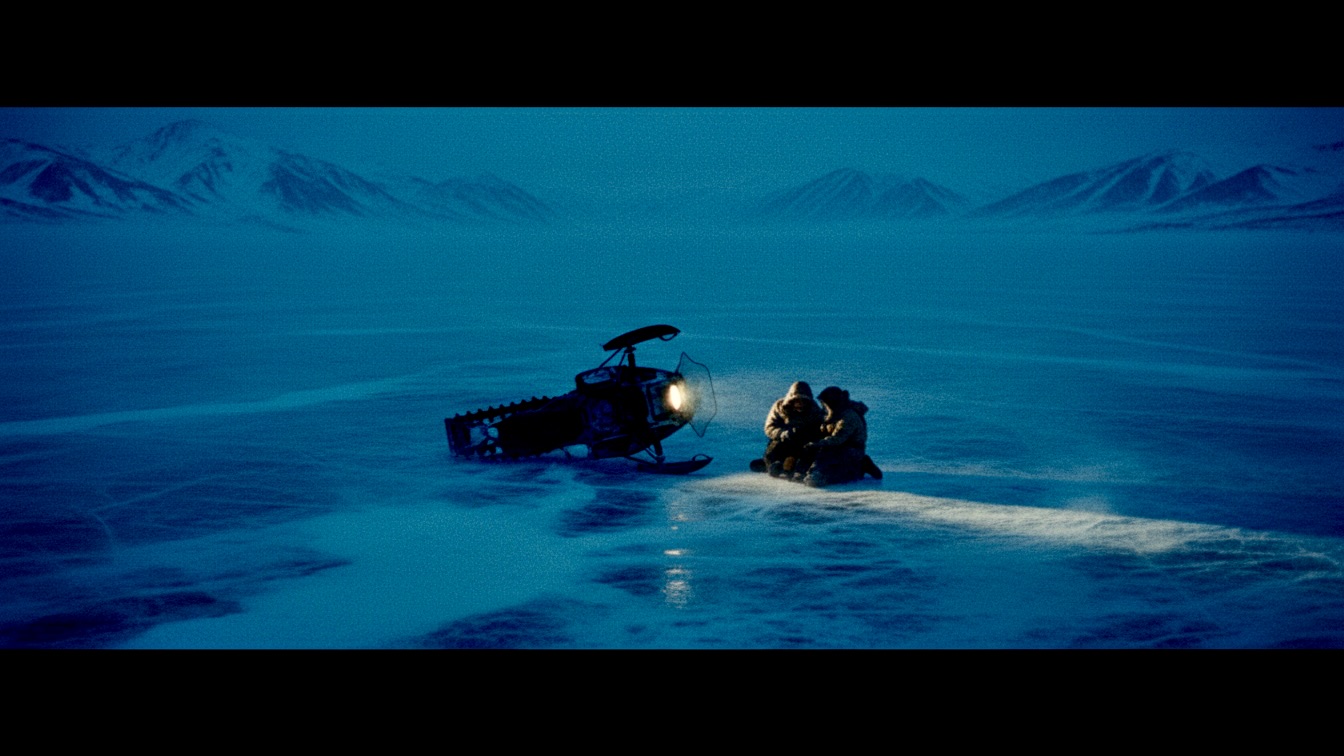
Ida and Paul, two desperate activists, attempt to secure video evidence of illegal toxic dumping by a local factory using a submersible drone beneath a frozen lake. Their mission is jeopardized when the drone becomes snagged on underwater debris just as corporate security forces arrive on the scene. Forced to abandon their equipment and the incriminating footage, the pair attempts a frantic escape across the ice on a dilapidated snowmobile. They are pursued by the guards, who utilize superior machinery to ram and disable their vehicle. The confrontation ends in a violent crash that leaves Paul with a broken leg. In a chilling act of calculated cruelty, the security agents destroy the pair's communication equipment and abandon them to the freezing elements and an approaching storm.
The narrative is driven by a stark, overwhelming disparity of power, illustrated through the contrast between the protagonists' equipment and that of their adversaries. Ida and Paul rely on "cheap plastic" controls, a "half-cocked" plan, and a sputtering, twenty-year-old snowmobile that screams in protest. This machinery represents their socioeconomic standing; they are the underdogs fighting a battle they cannot afford, motivated by the visceral reality of poisoned children and a dying town.
In opposition, the corporate entity is represented by sleek, black machines and faceless enforcers who move with effortless power. The security forces do not need to be frantic; they are described as "assessors" rather than mere guards, implying a bureaucratic approach to violence. This technological imbalance serves as a metaphor for the futility of the individual's struggle against entrenched corporate interests. The corporation owns the landscape, the machinery, and ultimately, the fate of the trespassers.
Furthermore, the environment itself acts as a secondary antagonist, reflecting the bleakness of the protagonists' situation. The setting is not merely a backdrop but an active participant in their suppression. The "black ice" and "dark water" mirror the toxic sludge spewing from the pipe, suggesting that the corruption has seeped into the very geography of the place. The cold is a physical weight, described as a "heavy stone" in Ida's stomach, emphasizing that their battle is not just against human greed, but against the indifference of the natural world.
Finally, the story explores the theme of the "hemorrhage," both literal and metaphorical. The toxic sludge is described as a "slow-motion hemorrhage," a wound in the earth that refuses to heal. This bleeding extends to the characters' lives, as they pour their savings and safety into a cause that drains them dry. The ending, with the red taillights vanishing into the white snow, leaves the reader with a sense of finality, suggesting that the truth, like the protagonists, will be buried under the ice.
Ida functions as the psychological anchor of the narrative, burdened by a profound sense of responsibility and guilt. From the opening lines, she internalizes the failure of the mission, viewing the snagged drone not as bad luck, but as a direct result of her own greed for the "perfect shot." This self-blame manifests in her "useless mantra," revealing a mind trying to impose control over a chaotic situation through sheer will. She is driven by a need for justice that outweighs her self-preservation, evidenced by her reluctance to cut the tether and lose the evidence.
Her psychological state shifts rapidly from focused determination to panic, and finally to a traumatic clarity. During the chase, she is reduced to a passenger, forced to trust Paul, which heightens her sense of helplessness. By the end of the chapter, stripped of her agency and physically battered, she becomes the witness to their doom. Her observation of the guards—noting they are "assessors" and not medics—shows a shift from frantic hope to a cold, cynical realization of their fate. She understands the language of violence even when no words are spoken.
Paul represents the pragmatic survival instinct clashing with desperate idealism. His initial reaction to the headlights is visceral fear; his face is "raw," and his voice is tight, indicating that he understands the physical danger far sooner than Ida does. He is the one who recognizes the necessity of cutting their losses, prioritizing their lives over the mission. His urgency acts as a foil to Ida’s hesitation, grounding the narrative in the immediate physical threat rather than the abstract goal of exposing the corporation.
Despite his fear, Paul exhibits a protective masculinity and physical courage. He takes the helm of the snowmobile, placing himself in the position of responsibility for their escape. His actions during the chase—veering, correcting the skid, and screaming warnings—demonstrate a high-stakes competence born of adrenaline. However, his breaking point is physical rather than mental. The broken leg symbolizes the crushing of his agency; the driver is rendered immobile, transforming him from a protector into a burden, a tragic inversion of his role throughout the escape.
The narrative pacing is masterfully constructed to mirror the escalating heart rate of the protagonists. It begins with a claustrophobic, static tension inside the tent, focusing on minute movements like the nudging of a joystick and the pluming of breath. This slow, agonizing build-up creates a sense of dread, emphasizing the fragility of their operation. The pacing shifts abruptly with the arrival of the headlights, transitioning into kinetic chaos. The sentence structures shorten, becoming punchy and breathless to match the roar of the engines and the speed of the chase.
The author employs a gritty, sensory-heavy tone that immerses the reader in the physical discomfort of the scene. The descriptions are tactile and auditory: the "whine" of the drone, the "guitar string" tension of the tether, and the "jarring crunch" of the collision. The use of color is particularly effective, contrasting the "murky green" and "rust-brown" of the polluted water with the stark white of the snow and the ominous "sleek black" of the security machines. This visual palette reinforces the grim, noir-like atmosphere of the piece.
Narrative voice is strictly third-person limited, adhering closely to Ida’s perspective. This choice restricts the reader’s knowledge to what Ida sees and feels, heightening the suspense. We do not know the guards' thoughts or their specific orders; we only see their "tinted visors" and their silent, efficient violence. This lack of omniscient insight makes the antagonists appear more monstrous and impersonal. The ending slows the pacing down to a terrifying crawl, contrasting the high-speed violence with the quiet, lingering horror of abandonment, leaving the reader in the freezing silence alongside the characters.