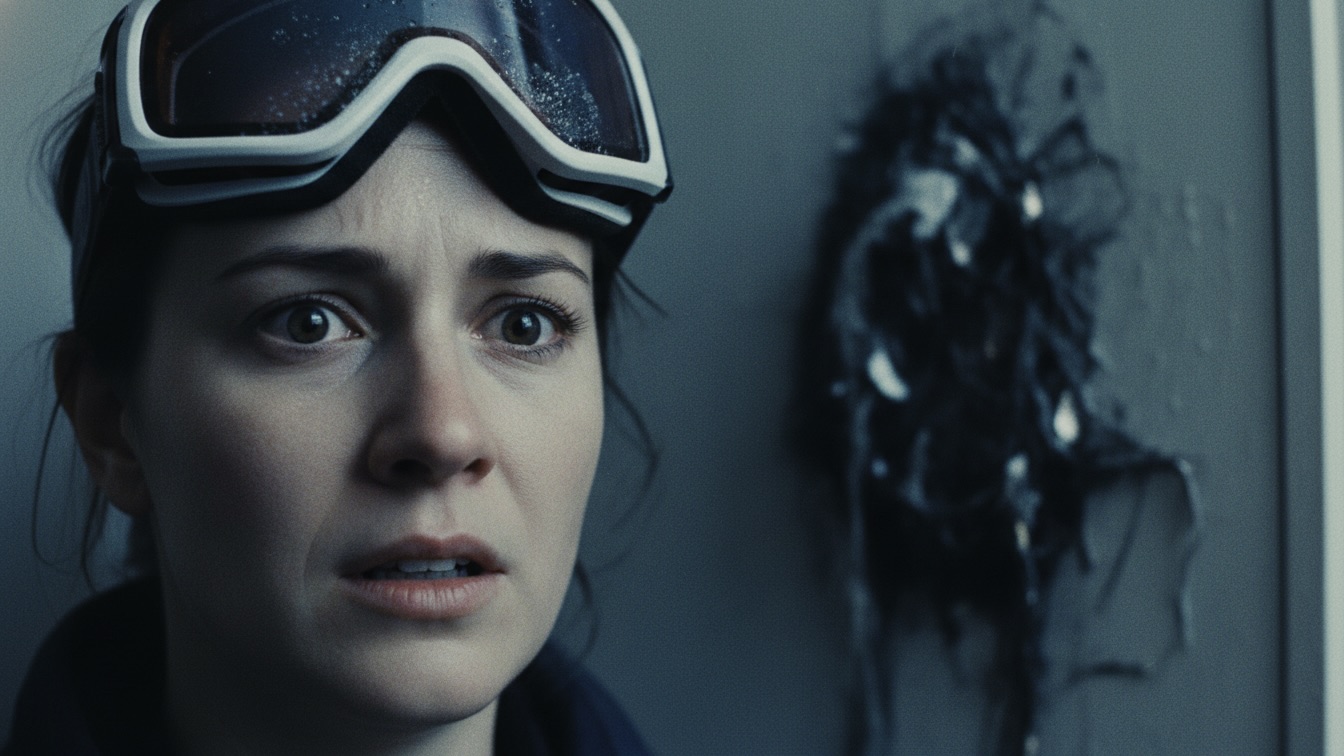
In the chapter "Frozen Echoes," a four-person team—Paul, Megan, John, and Sam—exploring a remote, derelict Arctic station, struggles to open a heavy, rusted metal door. Their initial efforts, led by Paul's brute force, prove futile, creating tension within the group. The more methodical John, using calculated leverage, manages to create a small opening. This breach reveals not an empty room, but a grotesque, fibrous biological mass interwoven with skeletal remains, blocking their path. As they grapple with the horror of their discovery, Sam's scanner detects, and then abruptly loses, an active thermal signature behind the growth. The chapter culminates in a terrifying climax when a fast, segmented appendage strikes out from the darkness, narrowly missing Paul and confirming the active, hostile presence lurking just beyond the threshold.
The chapter masterfully explores the theme of the threshold as a psychological and physical barrier between the known and the unknowable. The door is not merely a physical obstacle; it is a seal on a forgotten history, a gateway to a reality that defies their scientific and rational understanding. The act of forcing it open is a transgression, a violation of a space that was meant to remain undisturbed. This act of hubristic curiosity, a core tenet of human exploration, is immediately punished, suggesting that some frontiers are not meant to be crossed. The "fatal magnetism" Paul feels is the siren call of the abyss, the dangerous human compulsion to see what lies in the dark, even at the cost of one's sanity or life.
Furthermore, the narrative establishes a powerful conflict between the modern, technological human and a primal, ancient horror. The team is outfitted with advanced gear—Gore-Tex, headlamps, handheld scanners—symbols of humanity's attempt to conquer and comprehend hostile environments. Yet, this technology proves woefully inadequate. The door resists their physical force, and more significantly, Sam's scanner, their window of rational analysis, is rendered useless at the critical moment. The creature is not something to be scanned and categorized; it is a force of nature so alien that it shorts out their instruments. This failure of technology underscores the fragility of human order and the terrifying realization that some horrors exist outside the realm of scientific explanation, tapping into a much deeper, more instinctual fear.
Finally, the setting itself becomes a thematic amplifier, exploring the concept of isolation as a catalyst for terror. The Arctic wasteland is a desolate, indifferent void, a place where the characters are utterly cut off from civilization and aid. This external isolation mirrors their growing internal isolation as fear begins to fracture their group dynamic. The station, a dead husk of human endeavor half-buried in snow, is a tomb-like space where the silence is "a weighty, oppressive thing." This profound silence makes every sound—the groan of metal, a dry cough, the final chitinous scratching—resonate with terrifying significance. The environment is not just a backdrop; it is an active antagonist, its oppressive cold and silence pressing in on them, ensuring that there is no escape from the nightmare they have just unlocked.
Paul is a character defined by his ego and a desperate need for physical assertion. His immediate response to the door is brute force, a direct and uncomplicated approach that reveals his impatience and frustration. When his efforts fail and John succeeds with a more calculated method, Paul experiences a "sour taste," a psychological sting of inadequacy and competitive resentment. This suggests his self-worth is deeply tied to his perceived strength and competence. His final action, reaching for the door even after the horrifying reveal, is not born of simple bravery but of a "terrible, fatal magnetism." This psychological drive to confront and dominate the unknown, even when his survival instincts are screaming retreat, marks him as the group's catalyst for disaster, the one whose pride will likely push them all over the edge.
Megan functions as the group's sensory and emotional barometer, the character most attuned to the creeping dread of their environment. While the men focus on the physical problem of the door, her attention is drawn to the atmospheric details: the "nervous" dance of her headlamp, the "prickle of static electricity," and the oppressive weight of the silence. She is the first to voice caution and the first to identify the true horror of the obstruction, recognizing the bones as "ribs." Her reactions are visceral and instinctual—a gasp, disgust, a desire to flee. Psychologically, she represents the voice of primal fear and self-preservation, a warning system that the others, driven by ego and analytical curiosity, choose to ignore. Her mounting terror serves as an authentic reflection of the escalating stakes.
John embodies the archetype of the stoic pragmatist, a grounding force against Paul's volatile impulsiveness. He moves with a "quiet, efficient power," approaching the door not with anger but with logic and leverage. His calm demeanor and practicality, exemplified by his immediate resort to a multi-tool, establish him as the group's anchor. However, the true measure of his character is revealed when that stoicism begins to crack. The flicker of "genuine fear" in his eyes and the dropping of his tool are powerful indicators of the threat's magnitude. His shift from a confident problem-solver to a man ready to "fight, or to run" demonstrates the profound psychological impact of the encounter, showing that even the most grounded individual can be unmoored by a sufficiently incomprehensible horror.
Sam is the intellectual of the group, a man who navigates the world through data and analysis. His initial demeanor is "clipped and efficient," and he attempts to impose order on the unknown by reducing it to schematics and thermal signatures on his scanner. His reliance on technology is his primary coping mechanism, a way to maintain emotional distance. The critical moment for his character occurs when this tool fails him. The scanner going "dark" symbolizes the collapse of his rational framework, leaving him intellectually and psychologically defenseless. His flat, shocked pronouncements and trembling hand reveal the terror of an analyst stripped of his ability to analyze, forced to confront a reality that cannot be quantified or understood.
The author employs a masterful control of pacing to build and sustain an atmosphere of escalating dread. The chapter begins with a slow, grinding rhythm centered on the physical, repetitive struggle with the door. This deliberate pacing establishes a sense of gritty realism and allows tension to accumulate gradually. The narrative then accelerates sharply with the door's partial opening, shifting from a man-versus-environment conflict to one of dawning horror. The final paragraphs are a cascade of shocking reveals and rapid actions—the scanner's failure, the scratching sound, the creature's explosive strike—culminating in a moment of frozen, breathless terror. This carefully controlled rhythm, moving from a slow burn to a sudden conflagration, is profoundly effective at manipulating the reader's emotional state.
The narrative voice is deeply immersive, utilizing a close third-person perspective that filters the experience through the characters' senses and internal monologues. We are privy to Paul's burning frustration, Megan's creeping anxiety, and Sam's intellectual shock. This technique forges a strong connection between the reader and the characters, making their fear palpable. The prose is rich with potent sensory details that bring the claustrophobic environment to life. The "dull thud" of the door, the "sickly sweet" smell of decay, the sight of "ghostly motes" of dust, and the "wet and chitinous" scratching sound all combine to create a visceral and unsettling tableau. This sensory assault ensures the horror is not just witnessed, but felt.
Finally, the story is layered with subtle but effective foreshadowing that enhances its literary depth. The smell of "old blood and ozone" hints at a violent, unnatural event long before any creature is seen. The station's silence is described not as empty but as "thick with unspoken history," priming the reader for a dark revelation. The title itself, "Frozen Echoes," suggests a past horror that is not truly dead but preserved, waiting to be reawakened. This stylistic choice elevates the narrative beyond a simple monster reveal, imbuing the station with a sense of haunted history and suggesting that the characters have stumbled into the final act of a tragedy that began long ago.