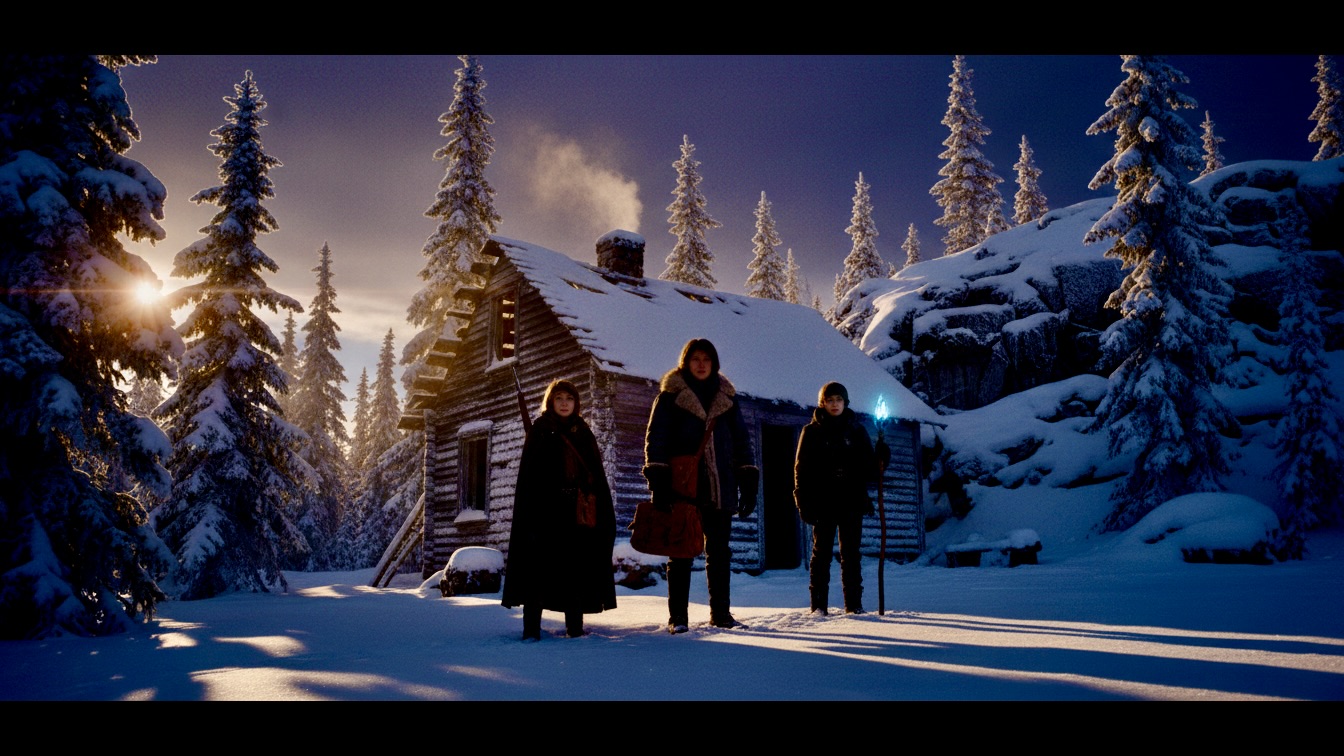
The narrative opens in the immediate aftermath of a catastrophic failure, where a snowmobile accident leaves three travelers stranded in a desolate, frozen wilderness. Kai, the driver, reacts with volatile anger and denial as he confronts the irreparable damage to the machine’s ski, a disaster caused by his own reckless decision to take an uncharted shortcut. Lena, the pragmatic navigator, quickly assesses the gravity of their situation, realizing that the vehicle is useless and that their survival depends on reaching shelter before the weather worsens. Finn, the third member of the group, begins to succumb to the early stages of hypothermia and panic, serving as a vocal barometer for the group's deteriorating physical state.
Under Lena’s guidance, the trio abandons the snowmobile and embarks on a grueling trek through deep snow toward a vague landmark indicated on an ancient map. The journey is physically punishing and psychologically taxing, with the freezing wind and deepening twilight compounding their misery. Kai wrestles with intense guilt over his role in their predicament, while Lena maintains a stoic, forward-focused momentum to keep the group moving. After hours of struggle, they discover a dilapidated trapper’s cabin, offering a momentary sense of salvation that is quickly dampened by the discovery that the stove is non-functional. However, a hidden survival cache revealed by Kai provides a flint, a blanket, and a more detailed map, shifting their goal from mere survival to a dangerous but necessary expedition toward a distant supply depot.
The primary theme dominating this narrative is the brutal, indifferent antagonism of nature, juxtaposed against human fragility. The environment is not merely a setting but an active, predatory force. The author personifies the cold and the wind, describing the cold as a "fist clenching" in the gut and the wind as a "vicious enemy." The landscape is described in terms of violence and bodily harm, with the sky "bruised purple" and the broken ski resembling a "broken bone." This imagery establishes a psychological reality where the characters are trespassing in a domain that actively seeks to extinguish them. The wilderness strips away the veneer of civilization, leaving the characters to rely on primal instincts and diminishing physical reserves.
Interwoven with the theme of survival is the heavy psychological burden of guilt and responsibility. Kai represents the archetype of the flawed leader whose hubris leads to ruin. His internal landscape is as tumultuous as the storm brewing outside; his anger is a defense mechanism masking a profound sense of failure. The narrative explores how guilt can manifest as a physical weight, heavier than the pack on his shoulders. This theme elevates the story beyond a simple survival thriller into a character study of redemption. Kai’s motivation shifts from saving his own skin to preserving the lives of those he endangered, transforming his guilt into the fuel necessary to push through the exhaustion.
Furthermore, the story examines the duality of hope and despair. The narrative structure oscillates between moments of crushing defeat and sparks of optimism. The discovery of the cabin serves as a false climax; it offers shelter but lacks the essential element of heat, symbolizing a "frozen hope." This pattern repeats with the discovery of the cache. The supplies offer a lifeline, but the accompanying map reveals a terrifyingly long journey ahead. The text suggests that true survival is not about finding a safe haven immediately, but about the psychological resilience to accept a harder path. Hope is presented not as a guarantee of safety, but as the resolve to delay death for one more day.
Kai serves as the narrative’s emotional fulcrum, embodying the volatile intersection of masculine pride and crushing insecurity. Initially, he projects his internal failure outward through aggression, lashing out at the inanimate snowmobile and his companions. This reaction is a classic defense mechanism intended to deflect the unbearable reality that his impulsiveness has doomed the group. As a male figure who seemingly prides himself on competence and strength, the realization of his error causes a fracture in his self-image. He is not the hero of this expedition, but the villain of his own story.
As the chapter progresses, Kai’s psychology shifts from reactive anger to a brooding, penitent determination. The physical struggle through the snow becomes a form of penance for him. He endures the burning in his lungs and the weight of his pack as deserved punishment. However, the discovery of the survival cache marks a turning point in his agency. By finding the hidden supplies, he reclaims a fraction of his utility to the group. His final decision to march toward the depot is an attempt to regain his status as a protector, transitioning from the man who got them lost to the man who might lead them out.
Lena acts as the stabilizing superego to Kai’s reckless id. She is characterized by high conscientiousness and emotional regulation. While Kai explodes and Finn crumbles, Lena compartmentalizes her fear, channeling her energy into solvable problems like navigation and pacing. Her silence is described as "dangerously calm," suggesting that she is repressing a significant amount of terror to maintain the group's cohesion. She understands that panic is a contagion more deadly than the cold, and she refuses to let it infect her decision-making process.
Her leadership style is understated but absolute. She does not command through volume or physical imposition but through competence and clarity. By focusing on the map and the compass, she provides an external structure to the chaos surrounding them. However, her disappointment regarding the stove reveals her vulnerability. It is the one moment where her practical armor cracks, showing that her hope was pinned on a specific, logical outcome. Her rapid recovery upon seeing the new map demonstrates her adaptability, reinforcing her role as the group's intellectual anchor.
Finn represents the raw, unadulterated vulnerability of the human animal in a hostile environment. He lacks the physical fortitude of Kai and the mental discipline of Lena, making him the surrogate for the reader’s own fears. His fixation on his physical symptoms—the numbness in his toes, the cold in his bones—highlights the immediate biological threat of their situation. He is the first to voice the reality that they might die, breaking the social contract of optimism that usually governs such groups.
Psychologically, Finn is in a state of regression. His whimpering and "pathetic little dance" to warm his feet strip him of adult dignity, reducing him to a child-like state of dependency. He looks to Kai and Lena not as peers, but as parental figures who are supposed to fix the situation. His tears are described as a "testament to pure, animalistic will," suggesting that while his conscious mind is overwhelmed by panic, his subconscious survival instinct is still driving his body forward. He serves as the emotional stakes of the story; if Kai and Lena fail, Finn is the first who will perish.
The narrative voice creates a claustrophobic and oppressive atmosphere through the use of sensory-laden, third-person limited narration. The author focuses intensely on somatic experiences—the stinging wind, the burning muscles, the numbness of extremities—to ground the reader in the physical misery of the characters. The prose is tactile and visceral. Phrases like "sickening crunch," "ragged sound of their own breathing," and "scent of frozen iron" engage multiple senses, ensuring the cold feels pervasive and inescapable. The environment is rendered with a grim, monochromatic palette of whites, greys, and bruised purples, reflecting the bleak internal states of the characters.
Pacing is utilized effectively to mirror the characters' energy levels and psychological states. The chapter begins with the sharp, staccato burst of the accident and Kai’s shouting, mimicking the adrenaline of the crash. As the group begins their trek, the pacing slows down, becoming laborious and repetitive, mirroring the "lift-and-drag motion" of walking through deep snow. The sentence structures become longer and heavier, burdened by clauses just as the characters are burdened by the snow. This deliberate sluggishness makes the sudden discovery of the cabin feel like a genuine release of tension, a gasp of breath after being underwater.
The tone is consistently serious and foreboding, avoiding melodrama in favor of a gritty realism. The dialogue is sparse and functional, stripped of pleasantries, which underscores the severity of their predicament. When characters do speak, it is often breathless or snapped, highlighting their fraying patience. The ending of the chapter strikes a balance between despair and determination. It avoids a deus ex machina resolution; instead of being saved, the characters are merely given a chance to work harder for their survival. This stylistic choice reinforces the central theme that in this frozen world, nothing is given freely; every moment of life must be earned with suffering.