The fabric is a borrowed husk, oversized and redolent with the scent of woodsmoke and labor. It hangs loosely, a checkered shield against the biting reality of academic rejection and the encroaching arctic twilight. Within this woven enclosure, the wearer finds a surrogate courage, wrapping himself in the tactile evidence of another’s survival to ward off the ghost of his own fragility. This second skin does not merely provide warmth; it acts as a physical manifestation of a partnership that has transmuted trauma into a functioning ecosystem.
The narrative operates within the sphere of literary fiction, heavily textured with elements of survivalism and domestic romance. The overarching theme centers on the concept of healing through radical isolation, juxtaposing the clinical sterility of academic bureaucracy against the visceral reality of the Yukon wilderness. The text explores the idea that true sanctuary is not found in a location, but in the construction of a shared "habitat" amidst chaos. The contrast between the "industrial resistance" of the past location, Blackwood, and the "honest mortar" of the current cabin suggests a rejection of modernity's harsh edges in favor of a more primitive, yet forgiving, existence.
The narrative voice is anchored firmly in Yuki’s perspective, offering a third-person limited view that is deeply introspective and colored by his anxiety. His perception of the world is filtered through a lens of vulnerability; he sees the environment as a "study in greyscale" and the sky as "bruised," projecting his own internal fragility onto the landscape. However, this perspective is reliable in its emotional honesty. The narrator does not shy away from Yuki’s dependence on Kaito, nor does it romanticize the danger of their situation. The winter setting acts not just as a backdrop, but as a clarifying agent, stripping away the superfluous distractions of civilization and leaving only the essential elements of survival and connection.
Morally and existentially, the chapter delves into the indifference of the natural world and the human response to insignificance. The "low, resonant thrum" of the wind serves as a reminder of their smallness, yet this realization is framed as comforting rather than terrifying. The story suggests that there is an ethical purity in facing the elements directly, a stark contrast to the "clinical currency" of the grant proposal. The characters find meaning not in conquering the wild, but in enduring it together. Their existence is validated not by the government's budget, but by the syncopated rhythm of their snowshoes on the ice, asserting life in a kingdom of dormancy.
Psychological State:
Yuki presents a psychological profile defined by high-functioning anxiety that is slowly being tempered by environmental exposure therapy. His nervous habits, such as running his thumb over the table's grooves and adjusting his glasses, indicate a baseline of nervous energy. However, the wilderness has shifted the source of his stress from existential dread to practical survival. He uses the environment as a grounding mechanism, finding comfort in the routine of the cabin despite the looming threat of the cold.
Mental Health Assessment:
His mental health appears to be in a state of fragile recovery. The reference to "lingering trauma" and the "ghost of the accident" at Blackwood suggests he is suffering from Post-Traumatic Stress Disorder, or at least a significant acute stress reaction that he is actively managing. His reliance on Kaito’s clothing as a "second skin" points to a need for external regulation of his emotional state. Yet, his ability to work, to engage in banter, and to venture out into the freezing twilight demonstrates a resilience that is hardening, much like the landscape around him.
Motivations & Drivers:
Yuki is driven by a dual necessity: the intellectual need to secure the grant, which validates his identity as a scientist, and the primal need to maintain the safety of their shared sanctuary. The winter environment intensifies these motivations; failure to secure funding has immediate, physical consequences in this harsh setting. He seeks to bridge the gap between the "clinical" requirements of his profession and the "heart" of his lived experience, striving to translate their survival into data that justifies their existence.
Hopes & Fears:
His core fear is a regression to the helplessness he felt at Blackwood, symbolized by the "failing protocols" of the past. He fears the loss of the precarious balance they have struck, knowing that their independence is tethered to a fragile financial thread. Conversely, his hope is rooted in the "ecosystem" they have built. He yearns for a stability where he can buy a vegetable without calculation, a simple domestic desire that represents a future where survival is no longer an hourly struggle.
Psychological State:
Kaito embodies a psychology of protective competence and optimistic endurance. He functions as the physical anchor of the pair, his mental state seemingly buoyed by the tangible tasks of survival—chopping wood, checking straps, navigating snow. The cold does not appear to distress him; rather, he treats it with a reverence and a humor that suggests a deep integration with the environment. His trauma, while acknowledged as a "shadow that had trailed him," has been effectively metabolized by the physical demands of the North.
Mental Health Assessment:
Kaito displays a robust mental constitution, characterized by high adaptability and strong coping mechanisms. He utilizes humor and acts of service to manage stress and maintain morale. His "overcompensation" with firewood is a rational, adaptive response to past trauma, turning a fear of freezing into a proactive, life-affirming ritual. He appears grounded and present, his fatigue described as "deep, physical" rather than existential, indicating a healthy engagement with his reality.
Motivations & Drivers:
His primary motivation is the physical and emotional welfare of Yuki. Every action he takes—from the "practiced backward thrust" of the door to kneeling to adjust Yuki’s gaiters—is an act of preservation. He is driven by the role of the provider and protector, a role that the winter environment necessitates and reinforces. He seeks to create a buffer between Yuki and the harshness of the world, both the natural elements and the bureaucratic ones.
Hopes & Fears:
Kaito’s fears are less articulated but evident in his hyper-vigilance regarding safety protocols. He fears a lapse in judgment that could lead to injury or death in the unforgiving cold, evidenced by his reminder about the "scree field." His hope is simple and immediate: to keep the fire burning, to keep Yuki warm, and to maintain the "brilliant" desperation of their current life. He finds satisfaction in the "black" of the ledger, however barely, hoping to sustain their autonomy against the odds.
The emotional trajectory of the chapter moves from solitary tension to shared fortitude. It begins in the quiet, pressurized atmosphere of Yuki’s internal world, where the blinking cursor represents a judgment he cannot escape. The entry of Kaito disrupts this static anxiety, introducing a chaotic, physical energy that breaks the tension. The transition is marked by the violent intrusion of the wind, a release of pressure that allows the emotional climate of the room to shift from academic worry to domestic intimacy.
Emotion is transferred primarily through touch and temperature. The stark contrast between the "overheated" room and Kaito’s "tropical minus twenty" exterior creates a sensory bridge between the two men. When Kaito places his cold hands on Yuki’s warm neck, it is a shock that grounds Yuki in the present moment. The melting snowflake falling from Kaito’s hair onto Yuki’s scalp serves as a potent vehicle for emotional connection—a dissolution of the barrier between the harsh outside and the safe inside, merging their experiences into a singular sensation.
The winter atmosphere acts as a crucible that compresses and intensifies these emotions. The lethal cold outside forces a radical closeness inside; there is no space for emotional distance when physical survival depends on mutual reliance. The anxiety of the grant proposal is tempered by the immediate comfort of the coffee and the fire. This compression turns the mundane acts of dressing and drinking into profound rituals of love and solidarity, elevating the domestic to the heroic.
The cabin acts as a psychological extension of the characters' relationship, a "habitat" that mirrors their internal reconstruction. Unlike the "industrial resistance" of Blackwood, which fought against nature, the spruce cabin works in concert with it. The disorder within—boots, maps, mismatched mugs—is reframed not as failure, but as organic growth. The space is small and intimate, forcing the characters into each other's orbit, thereby preventing the isolation that could lead to psychological fracturing. The warmth of the stove stands in direct opposition to the "bruised purple" sky, creating a binary world of safety and danger that simplifies their psychological landscape.
Outside, the environment serves as a vast, indifferent mirror that reflects the characters' insignificance, yet paradoxically strengthens their resolve. The "study in greyscale" and the "panic" of the fluttering papers emphasize the hostility of the setting. However, the landscape is not malevolent; it is merely present. By stepping out into the "vast, terrifying canvas," Yuki and Kaito are not conquering the space but accepting their place within it. The "broken glass" quality of the air wakes Yuki’s nerve endings, suggesting that the harsh environment is essential for his psychological awakening, shocking him out of his academic stupor and into a state of vital existence.
The prose utilizes a tactile and sensory lexicon to ground the abstract themes of the story. Words like "timbre," "thrum," "scarred," and "bruise" create a texture that is rough and physical, mirroring the environment. The author employs a rhythmic variance that mimics the characters' movements: the slow, contemplative sentences of Yuki’s writing process give way to the "heavy thud" and "deafening clatter" of Kaito’s arrival. This shift in cadence underscores the disruption of the cerebral by the physical, a central tension in the narrative.
Symbolism is woven tightly into the fabric of the setting. The "blinking cursor" represents the indifference of the societal systems Yuki is trying to appease, a digital echo of the indifferent landscape. The "flannel shirt" serves as a recurring motif of protection and identity transfer, a physical manifestation of Kaito’s care enveloping Yuki. Furthermore, the "melting snow" acts as a symbol of transition—the solid, dangerous ice becoming harmless water through the warmth of human contact.
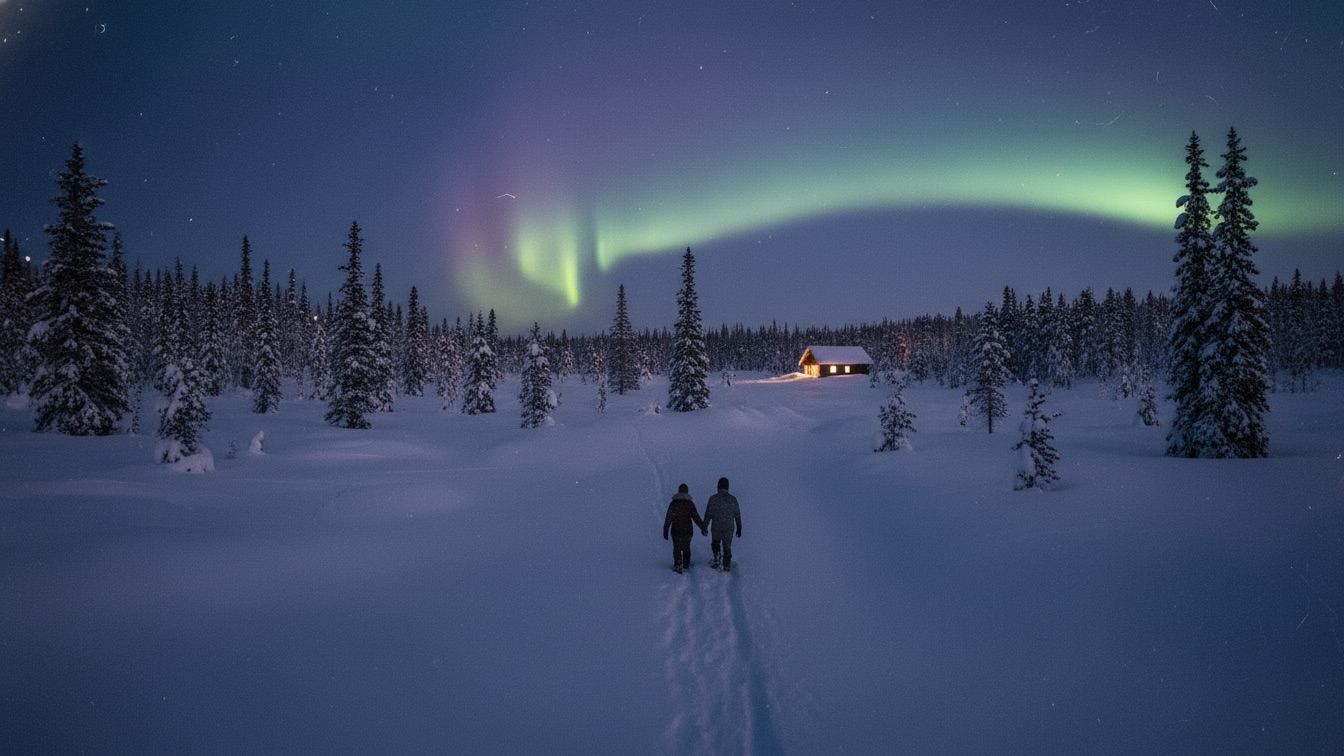
The winter motif is employed not just as a setting, but as a stylistic device to heighten contrast. The "blue-white" twilight and the "ghostly shimmer" of the aurora provide a stark, ethereal backdrop against which the warm, "amber light" of the cabin is juxtaposed. This chiaroscuro effect highlights the fragility of their sanctuary. The "syncopated step" of the snowshoes at the end serves as a final rhythmic symbol of their partnership—two distinct beats moving in a unified, forward motion against the silence.
The story resonates with the long literary tradition of the "retreat to the wild," echoing the transcendentalist ideals of Thoreau, where stripping away civilization reveals the essential facts of life. However, it subverts the typically solitary, masculine archetype of the frontiersman by centering a queer, domestic partnership. The "rugged outdoorsman" trope is acknowledged and playfully deconstructed by Kaito himself, who admits to "pretending," thereby modernizing the myth and allowing for vulnerability within the archetype.
There are echoes of the "survival against the elements" genre, reminiscent of Jack London’s naturalism, where the indifference of the "White Silence" is a central character. Yet, unlike the fatalism often found in such works, this narrative infuses the cold with a generative power. The reference to the "Porcupine Caribou herd" grounds the story in real ecological concerns, linking the fictional narrative to contemporary conversations about climate change and conservation, adding a layer of urgency to their scientific mission.
The imagery of the "snowman come to life" draws upon folklore and childhood myth, but repurposes it to signify resilience rather than transience. The concept of the "aurora" and the "frozen dark" taps into the sublime aesthetic, where beauty and terror coexist. This duality places the story within a romantic tradition that finds the sublime in the overwhelming power of nature, suggesting that the characters’ love is forged and validated by the very scale of the void that surrounds them.
The story leaves a lasting impression of warmth persisting in a void. The intellectual impact stems from the juxtaposition of the "grant proposal"—a symbol of distant, structured society—against the immediate, chaotic reality of survival. It forces the reader to question the value of bureaucratic validation in the face of raw existence. The image of the two men as "specks of heat" in a "kingdom of ice" lingers as a powerful visual representation of human resilience.
The emotional resonance is carried by the quiet, non-verbal intimacy shared between the characters. The act of lacing boots, the sharing of a flannel shirt, and the hand-holding through thick mittens speak to a love that is utilitarian and essential. The reader is left with a sense of the fragility of this happiness, yet also its strength. The "ghost of the accident" remains an unanswered question, a shadow that adds depth and history to their current peace, suggesting that their contentment is hard-won and therefore more precious.
Ultimately, the winter imagery evokes a sense of clarity. The cold strips away pretense, leaving only what is true: the heat of the stove, the taste of the coffee, the grip of a hand. The story suggests that while the world may be "massive" and "indifferent," the meaning of life is created in the small, defiant acts of warmth we generate against the cold. It remains a testament to the idea that a "habitat" is not given, but built, log by log and breath by breath.
The narrative concludes not with an arrival, but with the rhythm of continuation. The "crump, crump, crump" of the snowshoes does not signal a conquest of the landscape, but rather a negotiation with it. In this frozen silence, the sound of their movement becomes a heartbeat for the desolate ridge, a temporary, syncopated assertion of existence that the wind will eventually scrub away. The impermanence of their tracks does not diminish their journey; instead, it elevates the present moment, making the "clumsy, vital connection" of their palm-to-palm grasp the only coordinate that truly matters.
There is a distinct absence of fear in the final image, replaced by a crystalline awareness of the "beautiful, frozen dark." The cold, previously a threat to be managed, transforms into the medium through which they understand their own vitality. They are no longer hiding in the cabin; they are stepping into the void, transformed from survivors into witnesses. The aurora teasing the sky offers no promise of salvation, only a ghostly illumination of the path ahead, suggesting that in the vast indifference of the North, the only heat that endures is the one they carry between them.