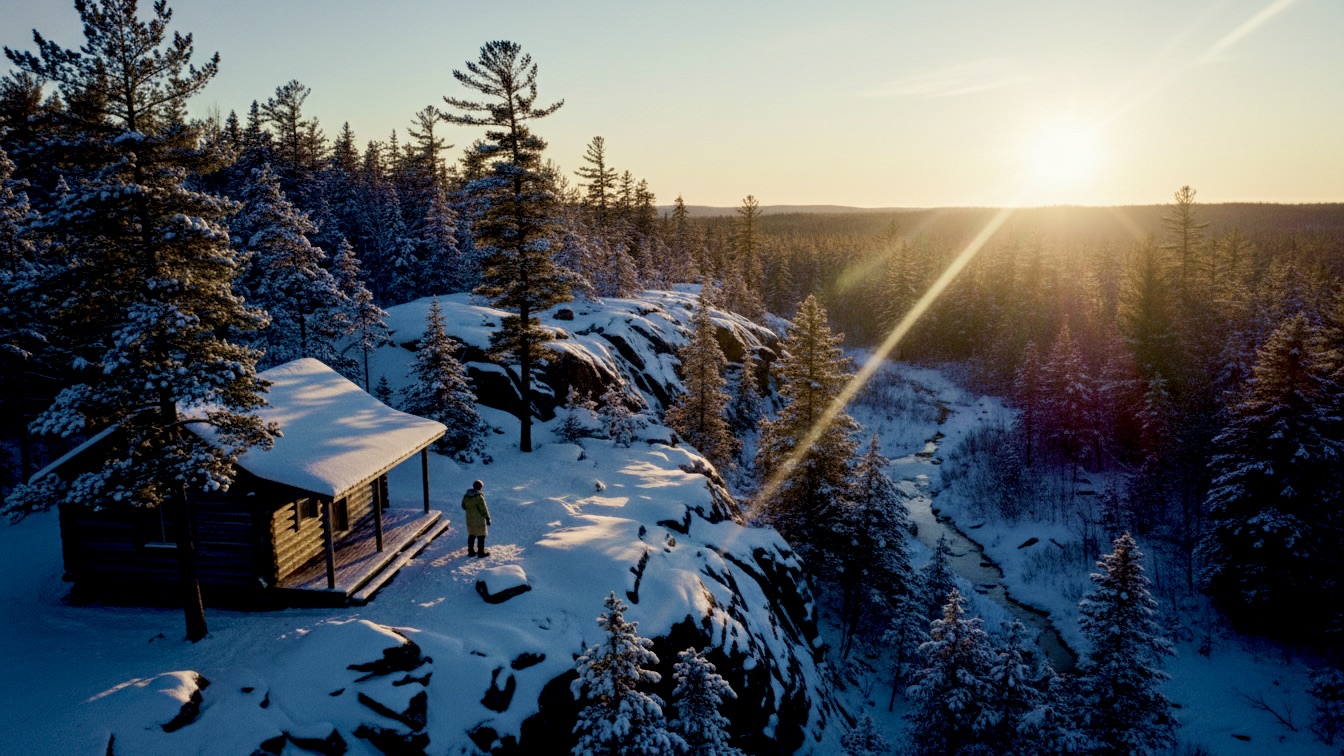
The narrative centers on Tom, a climate scientist stationed in a remote cabin in the Algoma District, who is monitoring environmental data during a bizarre January thaw. Physically struggling with the warped door of his cabin, he steps out into a world that feels miraculously rejuvenated rather than catastrophic. Despite his scientific training and grim projections warning of ecosystem collapse, the sensory experience of the warm air and melting snow seduces him into a state of irrational optimism. He interprets the unseasonal warmth not as a death rattle, but as evidence of systemic resilience, a "self-correction" of the boreal ecosystem.
Driven by this surge of desperate hope, Tom drafts and submits a report to the NorthStar Foundation that frames the anomaly as a positive event, downplaying the alarmist trends. However, his euphoria is shattered when he subsequently downloads global atmospheric data. The visualization reveals that the polar vortex has not shifted but shattered, indicating an irreversible climatic hemorrhage rather than a recovery. Before he can retract his erroneous report, he receives a reply from his superior, Karen. She enthusiastically informs him that his optimistic findings have justified the defunding of his research station in favor of a luxury winter spa, cementing his professional and existential failure amidst a beautiful, apocalyptic sunset.
The story profoundly explores the psychological lethality of hope when it functions as a mechanism for denial. The central theme revolves around the conflict between objective data and subjective desire. The protagonist is not merely battling the elements; he is battling the crushing weight of despair that comes with foreknowledge of doom. The "False Spring" is a potent metaphor for the cognitive dissonance experienced by humanity in the face of climate change. The warmth is physically pleasant but intellectually terrifying, and the protagonist’s tragedy lies in his decision to prioritize the physical sensation of relief over the intellectual burden of truth.
Furthermore, the text critiques the commodification of science and the fragility of truth in a corporate structure. The relationship between the scientist and the NorthStar Foundation highlights how institutions selectively interpret data to serve economic interests. Tom’s report is accepted not because it is accurate, but because it is convenient. It provides the "counter-narrative" required to justify a pivot from preservation to exploitation. This underscores a cynical theme regarding the intersection of capitalism and environmental crisis: the system will monetize the apocalypse until the very last moment.
Finally, the story examines the alienation of the expert. Tom is isolated, both geographically in the Canadian wilderness and intellectually by his knowledge. The tragedy is heightened by his regression from a rational observer to a desperate human being seeking comfort. The "beautiful heresy" he commits is a betrayal of his role as a witness. The narrative suggests that the burden of constant vigilance is too heavy for the human psyche to bear indefinitely, leading to catastrophic lapses in judgment where the desire for a future overrides the reality of the end.
Tom functions as a tragic figure whose fatal flaw is his vulnerability to emotional exhaustion. As a scientist, he is defined by rigor and observation, yet the opening paragraph establishes his physical and mental fatigue. The stuck door serves as a physical manifestation of his struggle against the environment, while his "grunting" and stumbling suggest a man at the end of his tether. His psychological state is primed for a break; after eighteen months of cataloging death and decline, his defense mechanisms crumble. He projects his own need for healing onto the dying forest, engaging in a classic case of confirmation bias where he selects data that supports the outcome he emotionally requires.
His motivation shifts rapidly from objective reporting to self-soothing. The "stupid, irrational, unscientific hope" he feels is a defense against the trauma of watching the world die. By framing the thaw as "resilience," he is subconsciously attempting to save himself from despair, not just the forest from the cold. The euphoria he feels while typing the report—feeling "brilliant" and "flying"—is the mania of a man who believes he has cheated fate. It is a psychological break from reality, a frantic attempt to rewrite the narrative of extinction into one of survival.
However, the realization of his error breaks him completely. When the global data reveals the shattered polar vortex, Tom is forced to confront not only the death of the planet but his complicity in obscuring it. The irony of his position is devastating: he is the watchman who signaled "all clear" as the enemy breached the gates. His final moments on the porch are defined by a paralyzing helplessness. He is no longer a scientist or a savior; he is a "fool" and a "Pollyanna," stripped of agency by his own hand. The guilt he experiences is total, as he realizes his moment of weakness has been weaponized by the very forces accelerating the collapse.
The narrative employs a tightly controlled first-person perspective that effectively immerses the reader in the protagonist's fluctuating mental state. The pacing mirrors the character's psychological trajectory: it begins with the slow, tactile struggle of the stuck door, accelerates into the manic, fluid energy of the writing phase where words "pour out," and then comes to a jarring, heart-stopping halt with the visualization of the atmospheric data. This structural shift from fluidity to stasis emphasizes the shock of the revelation. The sudden transition from the internal warmth of the cabin to the cold, hard reality of the screen creates a jarring juxtaposition that heightens the horror.
Sensory details are used masterfully to create an atmosphere of deceptive beauty. The descriptions of the "soft" air, the "chuckling" streams, and the "scent of soil" are rendered in lush, inviting prose that contrasts sharply with the underlying reality of the event. The author uses this sensory overload to trick the reader, much like the weather tricks Tom. The "woodpecker," initially described as "industrious," transforms into a "funeral drum" by the end, demonstrating how the context of the data alters the perception of the environment. The imagery shifts from the biological to the pathological; the thaw moves from being a "release" to a "hemorrhage" and a "stroke," grounding the planetary crisis in visceral, bodily horror.
The tone of the ending is particularly effective in its use of dramatic irony. The visual splendor of the sunset—"on fire with oranges, and pinks, and deep, impossible purples"—is aesthetically pleasing but scientifically damning. The author uses the beauty of the scene to underscore the ugliness of the truth. The "user-friendly colors" of the death model and the "painterly light" of the sunset converge to suggest that the end of the world will be visually spectacular, even as it is fatal. This aestheticization of disaster serves as a final critique of the human tendency to prefer a beautiful lie over a stark, survival-dependent truth.