Melgund Township Winter Story Library
A Shelter of Wind and Folly - Analysis
by Tony Eetak | Analysis
by Tony Eetak | Analysis
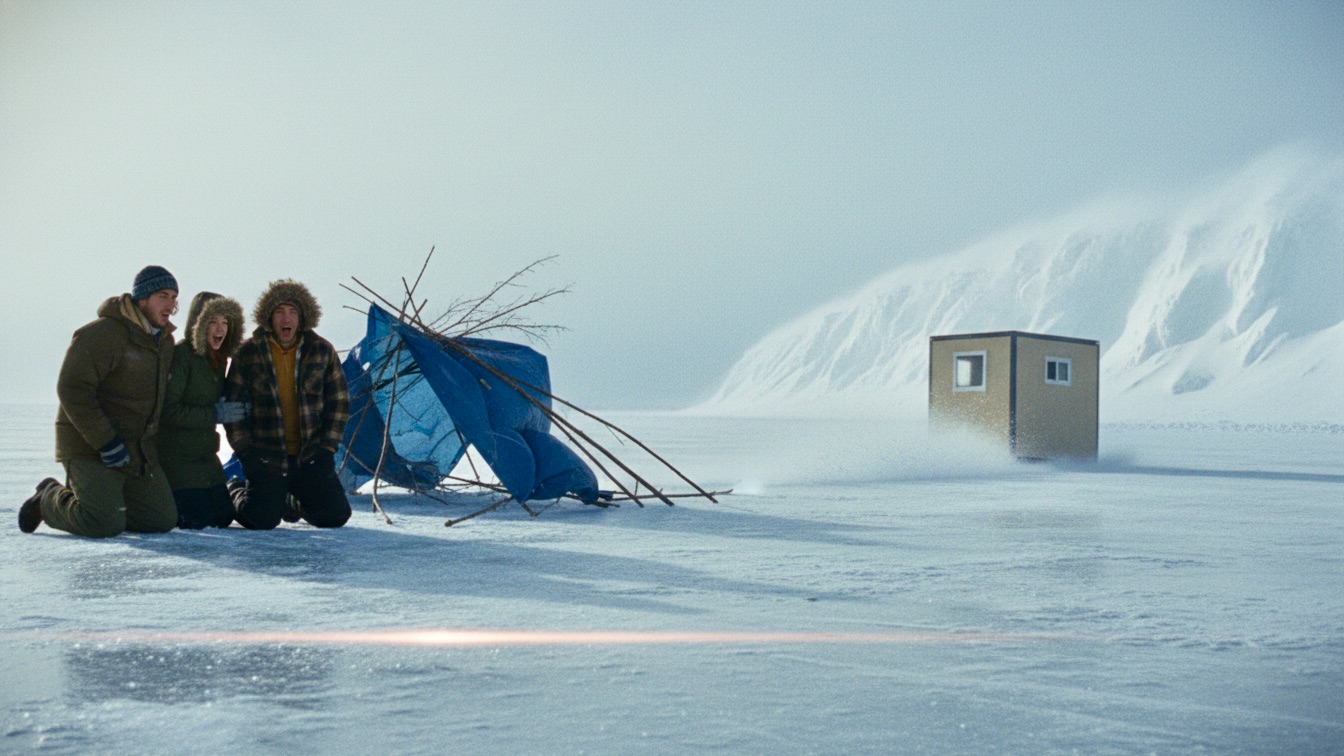
The narrative opens on a frozen lake where three friends—Matt, Andy, and Shawnie—are trapped in a state of existential ennui within a rental ice-fishing shanty. The atmosphere is heavy with unspoken frustrations regarding their stagnant lives, symbolized by the oppressive silence and the artificial warmth of their plastic shelter. Driven by a desire to escape this "soulless" experience, Andy convinces the group to step out into the bitter cold to construct a "poetic" shelter from driftwood and a discarded tarp.
This act of absurdity serves as a catalyst for emotional release, transforming their boredom into genuine, childlike joy as they bond over the incompetence of their creation. However, the mood shifts violently with the arrival of a sudden, severe squall. The storm instantly destroys their makeshift structure, proving the futility of their romanticized struggle against nature. In a terrifying climax, the wind rips the rental shanty from its anchors—taking their keys, phones, and heat source with it—and sends it sliding into the whiteout, leaving the trio exposed and helpless against the lethal elements.
The central theme of the chapter is the conflict between the artificial comforts of modern existence and the indifferent brutality of the natural world. The rental shanty represents a sanitized version of nature, a "transactional" experience where safety is purchased and the elements are kept at bay. The characters initially resent this safety because it mirrors the monotony of their daily lives—the kitchen renovations, the office jobs, and the scrolling through social media. They crave a "primal" connection to the landscape to validate their existence, believing that struggle will imbue their lives with meaning.
However, the story deconstructs the romanticization of nature. Andy’s desire for "poetry" and "struggle" is revealed to be a dangerous affectation. When they build their driftwood shelter, they are engaging in a form of play, a psychological regression to childhood to escape the pressures of adulthood. For a brief moment, this works, allowing them to reclaim a sense of agency and joy. They successfully manufacture a moment of triumph, believing they have imposed their will, however clumsily, upon the landscape.
The climax serves as a brutal reality check, asserting the theme of nature’s absolute indifference to human narrative. The storm does not care about their "poetic" shelter, nor does it respect the technological safety of the rental unit. By destroying both the romantic hovel and the modern sanctuary, the narrative strips the characters of all illusions. The ending suggests that civilization is a fragile veneer; once the "plastic box" is removed, humanity is left small, fragile, and utterly at the mercy of a chaotic universe that offers no shelter, poetic or otherwise.
Matt functions as the grounding force and the primary observer of the group's psychological state. He is deeply attuned to the oppressive nature of the environment, personifying the silence as a "heavy, monolithic thing." His internal monologue reveals a man who is resigned to the mediocrity of his circumstances, viewing the fishing trip not as a leisure activity but as another "perfect, wasted Saturday." He possesses a cynical pragmatism, recognizing the absurdity of Andy's ideas yet lacking the will to oppose them.
Psychologically, Matt acts as the enabler of the group's collective delusion. He agrees to build the fort not because he believes in Andy’s vision, but because he understands the social utility of "letting the madness run its course." He seeks to manage the group's anxiety by participating in the distraction. However, his awareness remains sharp; he is the first to notice the shift in the weather, transitioning from a participant in the fun back to the alert survivalist. His realization at the end—that the "real problem" has just begun—marks a shift from existential dread to immediate, primal fear.
Andy is the archetype of the dreamer, raging against the dying of the light. He projects his internal dissatisfaction with his "thinning hair" and suburban life onto the environment, declaring the rental shanty to be "soulless." His behavior exhibits traits of manic defense; he uses grandiose ideas and impulsive actions—like building a trebuchet or a driftwood shelter—to distract himself from the creeping suspicion that he has reached his peak. He requires external validation and a sense of narrative importance to function.
His quest for "poetry" is a psychological attempt to reframe his life as a heroic struggle rather than a mundane decline. He is the catalyst for the chapter's events, his charisma pulling the others into his orbit. Even in the face of their terrible construction, he finds "genuine pride," indicating a desperate need to create something, anything, that feels authentic. His devastation at the loss of the rental shanty is not just about safety; it is the shattering of the illusion that he could control the terms of his engagement with the world.
Shawnie represents the modern coping mechanism of dissociation. Initially, she is physically present but mentally absent, escaping the "burnt dust" smell of the shanty by immersing herself in the digital curation of "other people’s better lives." Her cynicism serves as a protective armor; she uses sarcasm and whiskey to distance herself from the vulnerability of hope or sincerity. She is the realist who points out the statistical probability of the shelter collapsing, yet she participates nonetheless.
Her transformation during the building process is significant. The physical act of breaking branches and the absurdity of the situation break through her digital dissociation, allowing her to be present in the moment. She transitions from a passive observer of screens to an active participant in reality. However, this newfound connection to the present becomes a liability when reality turns hostile. By the end, stripped of her phone and the artificial warmth, she is forced to confront the immediate, physical terror she had been trying to ignore.
The narrative voice employs a distinct shift in sensory focus to mirror the psychological trajectory of the characters. In the beginning, the prose is dominated by auditory descriptions of silence and stagnation. The "soft, metallic lullaby" of the heater and the "slushy circle" of the water emphasize a suffocating, womb-like safety that breeds contempt. The author uses listless, heavy imagery—"flat grey sky," "charcoal sketch"—to reflect the depressive state of the group. The pacing is deliberately slow and sluggish, mimicking the passage of time for a bored mind.
As the characters step outside, the style becomes more kinetic and tactile. The description of the cold as a "physical blow" and the "rhythmic protest" of boots on snow signals a shift from passive observation to active engagement. The prose during the construction scene is lighter, punctuated by "giggles" and "roars" of laughter, matching the manic energy of their play. The author uses personification effectively here, giving the wind a "nagging" quality and describing the minnow as frozen in a "silent scream," foreshadowing the violence to come.
The final transition to the storm is marked by an aggressive acceleration of pacing and violent imagery. The wind transforms from a "sighing presence" to a "battering ram" and a "freight train." The sensory details become overwhelming; the cold is a "sander" against skin, and the visual field is "deleted" by the whiteout. The personification of the rental shanty—performing a "pirouette" and a "clumsy, absurd dance"—adds a layer of grotesque surrealism to the disaster. This stylistic choice emphasizes the helplessness of the characters, reducing their drama to a small, silent observation amidst a roaring, indifferent chaos.