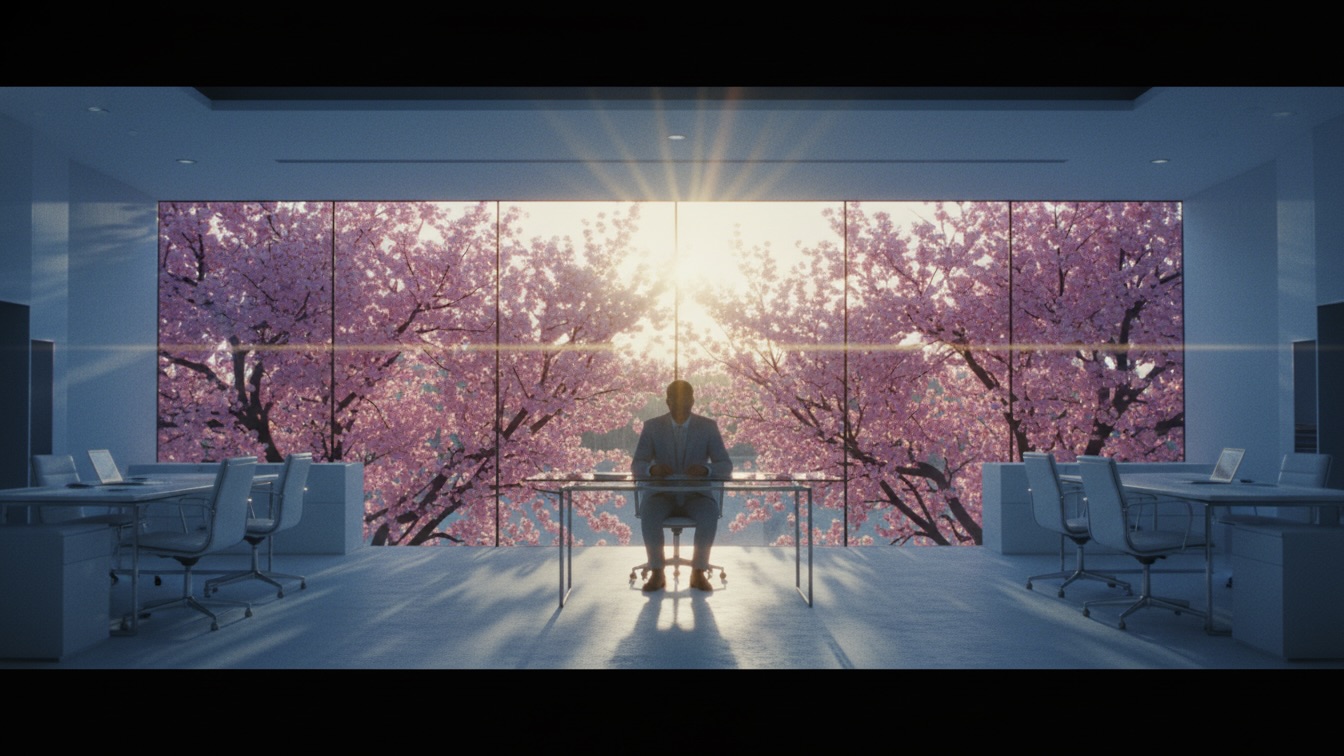
Format: Short Film / Episode | Est. Length: 10-12 minutes
Imagine a near-future anthology series titled The Harmony Grid, where every human emotion is tracked, logged, and regulated by the Ministry of Wellness to ensure global economic stability. Each episode explores a different "glitch" in the system—individuals whose authentic feelings threaten the curated, biometric peace of the state. The series follows the internal rot of a society that has traded genuine human connection for a high "Harmony Rating," focusing on the bureaucrats who enforce happiness and the citizens who refuse to perform it.
Len, a weary Vibe Consultant, stares at a jagged red line on his dashboard representing forty thousand heartbeats of "Dissatisfaction" while his own wristband pulses with a frantic stress warning. Outside, the cherry blossoms bloom with a chemically forced, aggressive pink, serving as a silent reminder that even nature is under state-mandated optimization.
A government "Vibe Consultant" tasked with medicating a non-compliant citizen must choose between his career and his remaining humanity. When he attempts to hide his own dissent behind a chemical veil, he discovers that the system monitors the intent behind the emotion, not just the feeling itself.
The primary theme explores the dichotomy between authenticity and performance in a surveillance-heavy digital age. It examines how a "participatory democracy" can devolve into a system of forced echoes, where silence is viewed as a threat and "sharing the glow" is a survival mechanism rather than a social choice. The narrative questions whether a life without pain is a life at all, or merely a hollow simulation designed to protect market interests.
Secondary themes focus on the environmental cost of perfection and the psychological weight of complicity. The "Grey Weight" Len feels represents the moral injury of those who maintain oppressive systems to protect their own middle-class stability. Maeva’s character serves as the antithesis to this, representing the "dirt under the fingernails" reality that the Ministry seeks to pave over with synthetic joy and nitrogen-heavy fertilizers.
For Len, the stakes are existential and professional; a drop in his "Civic Engagement" score results in the loss of his livelihood, his home, and eventually his autonomy through "mandatory wellness retreats." For Maeva, the stakes are her very identity, as she faces "Involuntary Recalibration" which would effectively erase her personality to turn her into a compliant, smiling drone. On a societal level, the "Harmony Rating" determines global investment, meaning the price of a single person’s authentic sadness could be the economic collapse of an entire sector.
The central conflict is a three-way struggle between Len’s fading conscience, Maeva’s defiant authenticity, and Director Richards’ cold, systemic enforcement. Richards represents the ultimate antagonist: the faceless bureaucracy that views human beings as "nodes" and "glitches" to be harmonized or deleted. Internally, Len battles the "Grey Weight"—a crushing depression born from the realization that he is the architect of his own cage—while Maeva faces the external pressure of a state that criminalizes her quietude.
In the year 2026, Len works as a Vibe Consultant, monitoring the real-time biometrics of Sector 4 to ensure the population remains "harmonized." When a young gardener named Maeva shows a dangerously low "Civic Engagement" score despite healthy vitals, Len is ordered by his superior, Director Richards, to force-prescribe "Social-Harmonizers"—heavy-duty antidepressants designed to flatten her into a state of active joy. Richards warns Len that his own stress levels are spiking and that any failure to "fix the glitch" will result in Len himself being investigated for dissent.
During their session, Maeva refuses the medication, arguing that her refusal to "perform" happiness is the only thing keeping the truth alive in a world of digital lies. Caught between his pity for her and the terrifying surveillance of his own Vibe-Band, Len chooses self-preservation and logs the prescription, but Maeva leaves the pills behind in a final act of silent disappointment. Panicked by a "Cognitive Breach" warning on his own monitor, Len consumes the pills himself to mask his fear. He achieves a hollow, synthetic peace just in time for Richards to return and reveal that the system has already flagged the intent behind his spike, proving that in the Ministry of Wellness, even a drugged smile cannot hide a traitorous heart.
Len: A middle-aged bureaucrat who has spent years "harmonizing" others while his own soul withers under the "Grey Weight." He starts the episode as a man clinging to the remnants of his morality but ends as a hollowed-out vessel of the state, having literally swallowed the poison he was meant to dispense. His arc is a tragedy of cowardice, illustrating how the fear of losing one's "score" leads to the total loss of self.
Maeva: A 19-year-old gardener who represents the last vestige of unmonitored human experience. She is calm, observant, and refuses to wear the Vibe-Band or participate in the "Share the Glow" digital culture, making her a "dead zone" in the social network. She begins and ends the story with her integrity intact, though her physical freedom is sacrificed to the "Wellness Teams" by the final act.
Director Richards: A high-level enforcer who appears to have transcended human emotion entirely, moving with silent precision and speaking in flat, optimized tones. He functions as the personification of the algorithm, seeing people only as data points and "liabilities" to be corrected. He is predatory and perceptive, using Len’s own biometrics as a weapon to ensure total compliance.
The episode opens in Len’s sterile office, where he watches a jagged red line of sector-wide anxiety spike on his dashboard while his own Vibe-Band warns him of an impending stress incident. Director Richards enters, looming over Len to demand the "harmonization" of Maeva, a gardener whose lack of digital participation is creating a "vacuum" in the social grid. The tension is established through the contrast between the aggressive pink cherry blossoms outside and the cold, grey atmosphere of the Ministry.
Maeva arrives for her appointment, appearing strikingly grounded and "real" compared to the plastic environment, and she immediately challenges Len’s metrics by talking about the health of the soil rather than her engagement score. Len attempts to use the "Social-Harmonizers" to save her from a worse fate, but Maeva’s refusal forces him to confront the fact that his "democracy" is actually a system of forced echoes. The midpoint shifts when Len realizes Richards is monitoring his keystrokes in real-time, turning the office into a high-stakes pressure cooker.
In the climax, Maeva walks out, leaving the blue pills on the desk as a silent indictment of Len's complicity. Terrified by his own biometric "Cognitive Breach" warning, Len swallows the pills to hide his dissent, feeling his consciousness dissolve into a synthetic, "nice" haze. The final twist occurs when Richards returns, revealing that the system recorded the spike before the drugs took effect; Len’s forced smile is now a permanent mask as he realizes he is no longer a consultant, but a subject under investigation.
The episode begins with a sense of Clinical Paranoia, characterized by the rhythmic ticking of clocks and the pulsing of biometric alerts. As Maeva enters, the mood shifts to Melancholic Yearning, as her authentic presence highlights the artificiality of Len’s world. The climax is a descent into Suffocating Dread, which abruptly snaps into a Synthetic Euphoria once the pills are taken. The final scene leaves the audience with a feeling of Cold Horror, realizing that the protagonist’s "peace" is actually his total erasure.
If expanded, the season would follow the "Involuntary Recalibration" of Maeva as she becomes the face of a new, even more aggressive "Glow" campaign, while a drugged and hollow Len is forced to act as her handler. The narrative would explore a growing underground movement of "Silents"—people who have learned to hack their Vibe-Bands to broadcast fake "Harmony" while plotting to sabotage the nutrient-release systems that control the city’s mood.
The thematic escalation would move from individual dissent to systemic collapse, as the Ministry realizes that the "Social-Harmonizers" are creating a population so passive they can no longer maintain the infrastructure of the city. The season finale would center on a massive "Blackout," where the biometrics of the entire city go offline, forcing millions of people to feel real, unmedicated grief and rage for the first time in decades.
The visual style is "Sterile Futurism" meets "Artificial Pastoral." Interiors should be shot with cold, clinical lighting, utilizing matte greys and whites to make the bright, synthetic blue of the pills and the jagged red lines of the HUDs pop with unnatural intensity. The exterior world should look "too perfect," with hyper-saturated colors that feel slightly "off," like a high-contrast photograph that has been over-edited.
The tone is a blend of the bureaucratic dread found in Severance and the neon-tinged social commentary of Black Mirror. The camera work should be steady and restrictive during Len’s office scenes to evoke a sense of being trapped, only becoming handheld and fluid when Maeva speaks about the garden. The sound design will be crucial, featuring a low-frequency hum that represents the "Grey Weight," which is replaced by a shimmering, ethereal drone once Len consumes the Harmonizers.
The target audience is adults aged 25-45 who enjoy high-concept psychological thrillers and social science fiction. It appeals to viewers interested in the intersection of technology and mental health, as well as those who follow "prestige" anthology dramas. The episode’s focus on workplace surveillance and the pressure to "perform" happiness will resonate particularly well with the modern "burnout" generation.
The pacing is a "Slow Burn" that accelerates into a frantic, claustrophobic climax. The first five minutes are dedicated to world-building and establishing the atmospheric pressure of the Ministry. The middle five minutes focus on the philosophical and emotional tug-of-war between Len and Maeva. The final two minutes are a rapid-fire sequence of the "Cognitive Breach" and the chilling aftermath, ensuring the episode ends on a sharp, haunting note.
The production requires a high-quality HUD (Heads-Up Display) overlay to represent the Vibe-Band data and the dashboard metrics, which must feel integrated into the characters' reality rather than a post-production afterthought. The "Social-Harmonizer" pills should be a specific, custom-made shade of "Electric Blue" to ensure they look distinct and chemically "wrong" against the office’s neutral palette.
Practical effects should be used for the cherry blossoms to ensure they look "aggressive" and forced, perhaps using oversized or hyper-colored silk flowers mixed with real branches. The office set should be designed with minimal furniture to emphasize the "vacuum" that Richards describes, making the small pill bottle the most significant physical object in the room. Special attention must be paid to the sound design of the "Vibe-Band" alerts to ensure they are intrusive enough to stress the audience without being grating.


