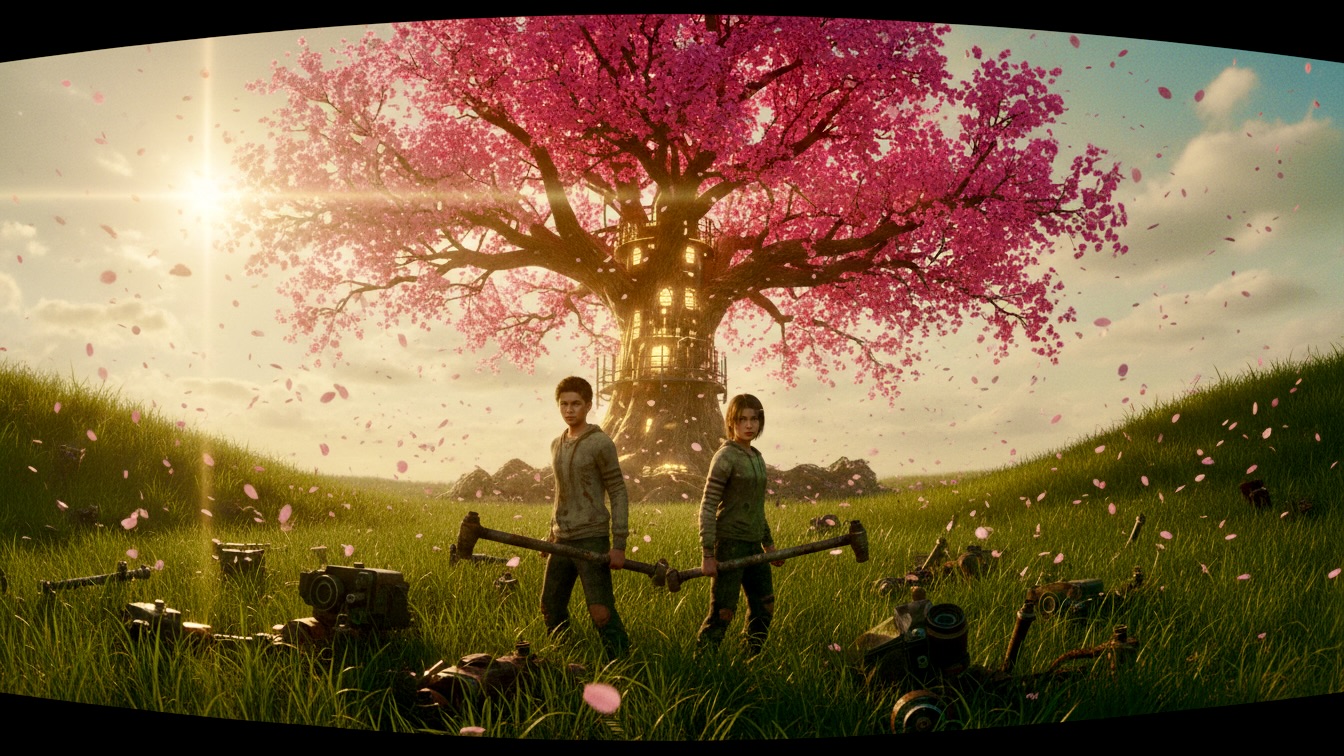
Format: Short Film / Anthology Episode | Est. Length: 10-12 minutes
This episode serves as a visceral entry in an anthology series titled The Algorithm’s Edge, which explores a near-future society where social survival is dictated by real-time viewership metrics. Each episode focuses on different "players" trapped in corporate-controlled arenas, highlighting the brutal intersection of entertainment, surveillance, and the desperate human need for autonomy in a world that treats existence as a monetized commodity.
Tarek and Art are sprinting through a synthetic, pollen-choked forest while a sleek, predatory drone hovers inches from their faces, waiting for the exact moment of Art’s emotional breakdown to broadcast her "deletion" to millions. The tension peaks when Art’s wrist-cuff hits the 1.4 "red zone," signaling that the corporate algorithm has officially deemed her unworthy of airtime and is initiating her physical termination.
When his best friend is marked for deletion by a ruthless broadcast algorithm, a trending contestant chooses to revolt against the system rather than secure his own survival. He must destroy the arena’s central infrastructure to save her, turning a televised game of survival into an act of open insurrection.
The episode explores the dehumanizing nature of the attention economy, where personal identity is reduced to a number and tragedy is manufactured for profit. It contrasts the artificiality of the "perfect" corporate-sponsored environment with the raw, brutal reality of human resistance and the reclamation of agency.
Beneath the action-heavy surface, the story examines the cost of loyalty in a society designed to reward betrayal. It questions whether true freedom can exist within a system that monitors every heartbeat, suggesting that the only way to win a rigged game is to physically dismantle the board.
The stakes are absolute: failure means immediate execution by the "fixers" and total erasure from the public record, effectively turning the protagonists into "dead air." Success, however, risks triggering a wider systemic crackdown, as the act of destroying broadcast property is a capital offense that threatens the very foundation of the corporate-controlled world.
The primary conflict is man versus system, manifested through the relentless, cold calculation of the broadcast drones and the unseen, omnipotent producers who view the players as mere content. Tarek’s internal conflict—the temptation to abandon Art to secure his own 5.0 rating—is constantly pressured by the wrist-cuff’s psychological manipulation, while the external force of the security drones represents the violent enforcement of the status quo.
Tarek and Art are contestants in the "Spring Equinox Gauntlet," a high-stakes survival game where their lives are literally tied to their viewership engagement metrics. When Art’s ratings dip into the lethal red zone, Tarek is faced with the choice of abandoning her to maintain his own popularity or risking everything to defy the producers.
Rejecting the script, Tarek uses a piece of rusted rebar to smash a broadcast drone, an act of rebellion that triggers a security response. Together, the pair fights their way through the synthetic landscape, eventually reaching the "Maypole"—the central tower that powers the entire arena—to cut the signal and blind the corporate overlords.
Tarek begins the episode as a survivalist playing by the rules, defined by his high engagement metrics and internal struggle between self-preservation and empathy. By the end, he evolves into an insurgent, shedding his "tragic hero" persona to become a catalyst for systemic collapse, fueled by a newfound, unyielding rage.
Art starts in a state of defeatist resignation, having internalized the algorithm's verdict that she is "dead air" and no longer worth saving. Through Tarek’s intervention, she undergoes a psychological shift from victim to combatant, finding renewed purpose in the shared goal of destroying the tower and reclaiming her autonomy.
The opening beat establishes the suffocating environment of the Gauntlet, where Tarek and Art struggle to survive while the drone captures Art’s descent into the red zone. The midpoint occurs when Tarek makes the impulsive decision to shatter the drone with a piece of rebar, shifting the episode from a survival game to an active revolt against the production. The climax culminates at the base of the broadcast tower, where Tarek and Art engage in a desperate, chaotic assault against the security swarm to physically sever the fiber-optic cables and kill the signal.
The emotional trajectory moves from suffocating anxiety and manufactured sweetness to high-octane adrenaline, finally settling into a haunting, uncertain silence. The audience experiences a shift from the voyeuristic discomfort of watching a "game" to the visceral intensity of a real-world struggle, ending on a note of defiant, dark liberation.
If expanded, the season would track the ripple effects of Tarek and Art’s actions, showing how their "broadcast blackout" inspires other players in different arenas to rebel. The overarching narrative would focus on the slow, violent unraveling of the corporate broadcast network as the "fixers" attempt to contain the contagion of dissent.
Character evolution would involve Tarek and Art transitioning from hunted contestants to symbols of a burgeoning revolution. The series would escalate from individual survival stories to a broader, clandestine war as the protagonists move from the arenas into the "upper rings" to confront the architects of the system.
The visual style contrasts the hyper-saturated, artificial beauty of the "Spring Equinox" arena—all blooming flowers and perfect lighting—with the gritty, rusted, and decaying reality of the infrastructure hidden beneath. The tone is kinetic and claustrophobic, utilizing handheld camera work to mirror the protagonists' desperation and the intrusive, predatory nature of the drone cinematography.
Comparable works include the high-tension, dystopian aesthetic of Black Mirror and the visceral, anti-establishment energy of The Running Man or Battle Royale. The lighting should shift from the "golden hour" artificiality of the broadcast to the harsh, flickering, and eventually pitch-black reality of the arena’s collapse.
The target audience is viewers aged 18-35 who enjoy high-concept dystopian science fiction, social commentary, and character-driven action. It is designed for streaming platforms that favor fast-paced, visually striking narratives with strong thematic undercurrents regarding technology and social control.
The pacing is relentless, starting at a sprint and maintaining a high tempo through the use of short, punchy scenes that mirror the rapid-fire nature of social media feeds. The narrative structure follows a traditional three-act progression, with the first act establishing the rules, the second act breaking them, and the third act focusing on the destructive climax.
The production will require a heavy reliance on practical effects for the "synthetic" nature of the forest, using a mix of vibrant, artificial-looking flora and decaying, rusted industrial props to create a sense of uncanny valley. The drone sequences must be shot with a distinct, clinical visual language—fixed, wide-angle lenses for the broadcast drones versus shaky, frantic handheld movement for the protagonists—to emphasize the difference between the "show" and the "reality."


