Format: Short Film / Anthology Episode | Est. Length: 10-12 minutes
This story is envisioned as a cornerstone episode for a psychological anthology series where the architecture of trauma becomes a literal, sentient landscape. Each installment explores a different protagonist navigating the "Mind-House" of their past, using high-concept horror and magical realism to visualize the process of emotional liberation.
The series, titled Internal Geographies, is an anthology where each episode centers on a character waking up inside a physical manifestation of their most profound psychological burden. These "Mind-Houses" are built from the sensory debris of past traumas—smells, sounds, and specific architectural failures—that the protagonist must dismantle through an act of radical self-assertion. While each episode is a standalone narrative, a subtle overarching arc hints at a liminal "Architect" who constructs these spaces as a final trial for souls seeking to break cycles of generational or domestic stagnation.
Sixty-two-year-old Lee-Anne wakes on the freezing floor of a decaying Victorian mansion that reeks of her ex-husband’s cheap cologne and finds the walls literally bleeding black ink. She is not in her apartment; she is trapped inside the physical embodiment of her thirty-four-year marriage.
A sixty-two-year-old woman must confront the physical manifestation of her toxic thirty-four-year marriage within a rotting, sentient mansion. To escape the "trapdoor" of her past, she must find the spark to burn her psychological prison to the ground.
The primary theme is the reclamation of agency after decades of emotional labor and domestic suppression. The mansion serves as a metaphor for the "mental load" and the exhausting process of managing a partner's volatile moods, illustrating how a person can become a ghost within their own life.
A secondary theme explores the concept of "forever" as a weaponized sentiment rather than a romantic ideal. The episode deconstructs the traditional marriage vow, reframing "better or worse" as a cycle of endurance that can only be broken by a transformative, even destructive, act of will.
The stakes are Lee-Anne’s soul and her hard-won peace; if she accepts the shadow beast’s "apology roses," she will be permanently absorbed into the house’s architecture of regret. Failure to act means remaining a perpetual caretaker for a manifestation of her own trauma, losing the quiet, independent life she has built for herself in reality.
The external conflict is the Shadow Beast, a manifestation of her ex-husband Arthur’s entitlement and manipulative silence, and the house itself, which uses sensory triggers to paralyze her. Internally, Lee-Anne battles thirty-four years of conditioned compliance and the somatic fear that her body still holds, requiring her to transmute her exhaustion into a singular, decisive anger.
Lee-Anne wakes in a grand, decaying Victorian foyer where the walls are lined with suffocating maroon velvet and the air is thick with the scent of her ex-husband’s cheap musk cologne. She realizes the house is built from the "mud of passive aggression" and the "long, silent dinners" of her thirty-four-year marriage, with black ink seeping from the walls like unpaid bills and angry letters. As she navigates the dim corridors, she finds a yellow Bic lighter in her pocket—a small, grounded relic of her independence—just as the temperature drops and a terrifying shadow beast emerges from the darkness.
The beast, a shifting mass of silence and resentment, offers her a bouquet of dead, black roses and speaks in a hollowed version of her husband’s voice, claiming that "forever is a trapdoor." Recognizing the transactional nature of his apology, Lee-Anne refuses to be called "babe" or to continue managing his moods. She strikes the lighter, igniting the dead roses and the flammable ink on the walls, causing the entire manifestation to incinerate. As the house collapses, she wakes in her sunlit apartment, the heavy weight of her past finally burned to ash, leaving her to enjoy her coffee in peace.
Lee-Anne (62): At the start, Lee-Anne is physically weary and reactive, her body still vibrating with the "somatic panic" of her former life. Her psychological arc is one of rapid crystallization, moving from a state of survival-based fear to a state of authoritative anger and eventual liberation. By the end, she has shed the "invisible backpack" of her marriage, standing as a woman who has finally reclaimed her own narrative.
The Shadow Beast (Arthur): A manifestation of Lee-Anne’s ex-husband, this entity is a dense, shifting mass of "absolute lack" that moves with a "dragging entitlement." It represents the manipulative core of a toxic partner who uses guilt and tradition to maintain control. It does not have a character arc; it is a static force of stagnation that must be destroyed for the protagonist to grow.
Lee-Anne wakes on the freezing floorboards of a rotting Victorian mansion, immediately recognizing the suffocating scent of her ex-husband’s cheap cologne and the bleeding black ink on the walls. She realizes the house is a physical construction of her thirty-four-year marriage, built from silent dinners and compromised boundaries, and discovers a yellow Bic lighter in her pocket. This small, plastic object serves as her only anchor to reality as she begins to navigate the warped, velvet-lined corridors that echo with the ghosts of past domestic conflicts.
As the temperature plummets and the ink pools at the baseboards, a towering shadow beast composed of silence and resentment emerges from the darkness to offer her a bouquet of dead, black roses. The creature speaks in a distorted, hollowed version of Arthur’s voice, calling her "babe" and demanding she accept the "trapdoor" of their forever. Lee-Anne feels the familiar somatic panic of his moods, but as she stares at the transactional flowers, her fear solidifies into a sharp, cleansing anger that overrides her impulse to flee.
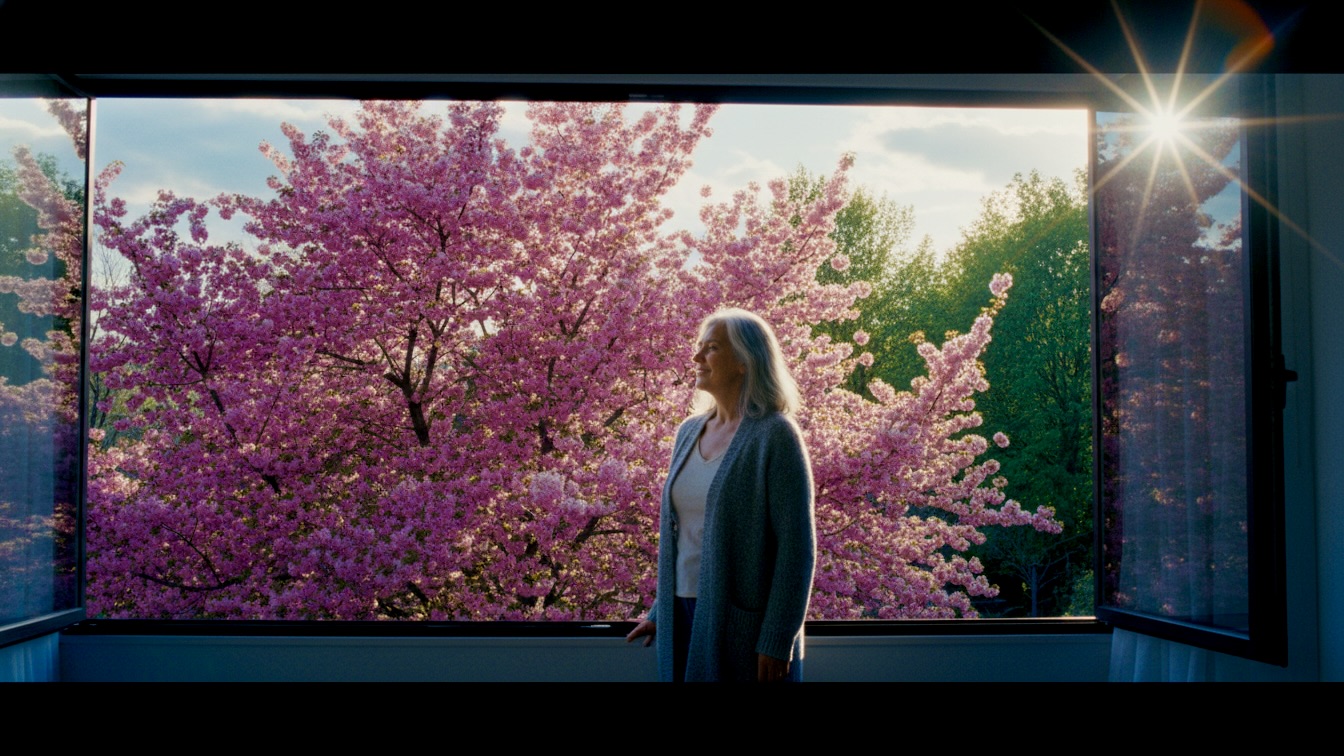
Rejecting the cycle of emotional management, Lee-Anne strikes her lighter and thrusts it into the center of the dead bouquet, triggering a supernatural fire that feeds on the resentment and cheap cologne in the air. The shadow beast melts into ash and the mansion’s structural integrity shatters as the fire consumes the maroon velvet and the fungal plaster ceiling. She wakes up in her own quiet, sunlit apartment, watching the cherry blossoms outside her window as she realizes the invisible weight of her past has finally been burned away.
The episode begins with a cold, claustrophobic sense of dread and physical discomfort, emphasizing the "structural ice" of Lee-Anne's trauma. As she moves through the house, the mood shifts into a tense, psychological standoff characterized by sensory overload—the smell of musk, the stickiness of ink, and the oppressive silence. The climax provides a visceral, high-energy catharsis through fire, ending on a note of serene, golden-hour tranquility that leaves the audience feeling a profound sense of relief and closure.
In the broader context of Internal Geographies, Lee-Anne’s story serves as an early-season success, establishing the rules of the "Mind-House" and the possibility of escape. Subsequent episodes would feature characters who fail to ignite their "lighters," becoming permanent fixtures of their own internal ruins, thereby raising the stakes for the mid-season.
The season-long narrative would gradually introduce a mysterious figure known as "The Inspector," who observes these psychological trials from the periphery. The finale would see Lee-Anne and other "survivors" returning to the liminal space to help a new protagonist navigate their house, suggesting that the ultimate cure for internal trauma is the community found in shared experience.
The visual style is defined by a sharp contrast between the "jaundiced, yellowed" light of the mansion and the "clear, golden" light of Lee-Anne’s real-world apartment. Inside the house, the cinematography should be claustrophobic and tactile, focusing on the "gritty" dust, the "bleeding" ink, and the "crushed maroon velvet" to create a sense of sensory entrapment. The Shadow Beast should be rendered as a dense, ink-like void that absorbs the light around it, making it feel like a hole in reality.
The tone is elevated psychological horror that transitions into triumphant magical realism. It draws influence from the domestic surrealism of The Haunting of Hill House and the visceral metaphors of Pan's Labyrinth. The fire sequence should not feel like a disaster, but like a cleansing, rhythmic event—a "hot shower" of light that purifies the screen.
The target audience is adults aged 30-65, particularly those who gravitate toward character-driven dramas and elevated genre fiction. It appeals to viewers who enjoy metaphorical storytelling and "prestige" anthology series like Black Mirror or The Twilight Zone, specifically those interested in themes of late-life empowerment and the complexities of long-term relationships.
The pacing is a deliberate "slow-burn" for the first seven minutes, allowing the sensory details of the house to build a sense of mounting pressure. The encounter with the Shadow Beast at the eight-minute mark triggers a rapid acceleration in tempo, leading to a high-intensity climax of fire and collapse. The final two minutes serve as a "cool-down" or coda, utilizing long, steady shots of Lee-Anne’s apartment to emphasize her new, unhurried reality.
The "bleeding walls" should be achieved through practical effects using a viscous, non-toxic black liquid to ensure a realistic, "greasy" texture that interacts with the set. The Shadow Beast requires a combination of a tall physical performer in a textured suit and digital shadow-warping in post-production to maintain its "shifting mass" quality without losing its physical presence.
The transition from the burning mansion to the apartment is a critical match-cut that requires precise lighting alignment. The fire itself should be a mix of controlled practical flames and CGI enhancement to show it traveling specifically along the "ink lines" and "scent trails" described in the script. The cherry blossom tree in the final scene should be a vibrant, practical element to provide a stark, organic contrast to the fungal plaster of the mansion.


