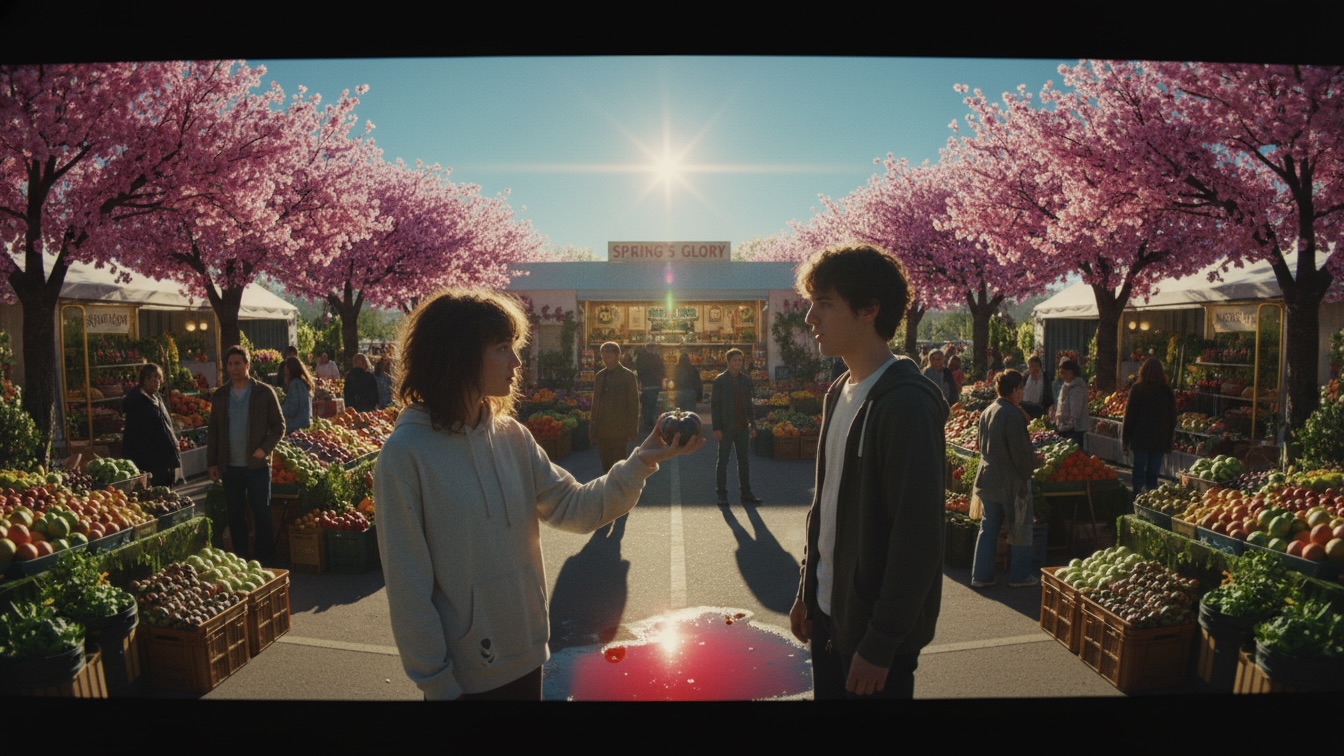
Format: Short Film / Anthology Episode | Est. Length: 10-12 minutes
This story serves as a foundational episode for a speculative anthology series titled Glitch in the Garden, which explores the subtle, creeping dissolution of reality in modern urban spaces. The series follows various protagonists who begin to perceive the "seams" of their simulated or fractured world, suggesting that the manicured perfection of contemporary life is merely a thin veneer over a decaying, non-linear reality.
Leo stands in a hyper-saturated farmer’s market, struggling to reconcile the aggressive, artificial brilliance of the sun with the reality that his own perception is glitching. As he tries to maintain the facade of a normal Saturday with his enigmatic companion, Sloane, he realizes that the world around them is literally failing to render correctly.
A man struggling with his crumbling grip on reality attempts to navigate a seemingly perfect Saturday at a farmer’s market with an observant woman who knows his secrets. As the environment around them begins to show signs of digital and physical corruption, he must decide whether to embrace the breakdown or fight to maintain his sanity.
The episode explores the theme of alienation in an age of hyper-curated digital existence, where the boundary between the authentic and the artificial has vanished. It examines the psychological toll of living in a world that feels increasingly like a stage set, focusing on the anxiety of being "observed" by those who see through our defensive masks.
Furthermore, it touches upon the fragility of human connection when the shared reality itself is in question. The contrast between the "ugly" reality of a bruised tomato and the "shiny" lies of the market reflects the internal struggle to find truth in a life defined by performance and constant, intrusive connectivity.
Leo faces the total collapse of his psychological stability, as his inability to ignore the "glitches" threatens his relationship with Sloane and his connection to the outside world. If he cannot reconcile his perception with the shared reality, he risks becoming completely isolated, potentially losing his grip on his identity as the world around him continues to degrade.
The primary conflict is internal, manifesting as Leo’s deteriorating mental state and his desperate attempt to suppress his awareness of the world’s instability. Externally, he is pitted against the environment itself—a reality that is actively malfunctioning—and the persistent, invasive pressure of his father, who represents the rigid, demanding expectations of the life he is trying to escape.
Leo and Sloane navigate a farmer's market that feels increasingly artificial, with Leo struggling to ignore the sensory overload and the subtle, flickering errors in the digital world around him. While Sloane pushes him to embrace the "realness" of imperfect objects, Leo is haunted by the persistent, unwanted contact from his father and his own mounting physical symptoms of distress.
As the day progresses, the environment begins to show overt signs of decay, such as impossible reflections and erratic technology, forcing Leo to confront the possibility that his reality is failing. The episode culminates in a tense moment of intimacy where the pressure of his secret knowledge and the physical presence of Sloane collide, leaving him at a breaking point.
Leo is a man on the edge of a nervous breakdown, characterized by his hyper-awareness and his tendency to retreat into his own mind when overwhelmed. He begins the episode in a state of rigid denial, attempting to perform "normalcy," but ends in a state of fragile vulnerability as his defenses are stripped away by Sloane’s scrutiny.
Sloane is the catalyst and the observer, possessing an unnerving ability to see through Leo’s pretenses and the world’s artifice. She is grounded in a cynical appreciation for the "ugly" and "real," acting as both a comfort and a threat to Leo’s fragile psyche. She remains consistent in her sharp, perceptive nature, forcing Leo to confront the truths he is trying to hide.
The opening scene establishes the hyper-saturated, surreal atmosphere of the market, highlighting Leo’s sensory discomfort and his fixation on the "perfect" but fake environment. The midpoint occurs when the digital price tags begin to flicker and the environment exhibits a visual anomaly in a puddle, confirming to Leo that his perception is not a hallucination. The climax arrives when Sloane presses him about his twitching eye and his phone, forcing a moment of raw, physical intimacy that shatters his ability to maintain the act of being normal.
The emotional trajectory moves from a state of repressed, high-functioning anxiety to a state of quiet, existential dread. The audience is invited to experience the world through Leo’s sensory overload, shifting from the bright, aggressive colors of the market to a darker, more claustrophobic internal space as the realization of the world's instability settles in.
If expanded, the season would follow Leo as he discovers that the "glitches" are not isolated incidents but part of a systemic decay affecting the entire city. Each episode would introduce new characters who are beginning to notice the same anomalies, slowly building toward a realization that their reality is a controlled experiment or a failing simulation.
The overarching arc would track the characters' attempts to find the "source" of the corruption, leading to an eventual confrontation with the forces—be they technological, corporate, or metaphysical—that are maintaining the illusion. The evolution of the characters would move from passive victims of their environment to active agents seeking to break the cycle.
The visual style employs high-contrast, over-saturated color palettes to create a sense of unease, utilizing "uncanny valley" cinematography where the lighting feels too deliberate and the depth of field too shallow. The tone is psychological thriller meets surrealist drama, drawing inspiration from the works of Charlie Kaufman and the unsettling, domestic dread found in The Twilight Zone.
The camera work should be intimate and handheld to emphasize Leo’s subjective experience, occasionally cutting to static, wide-angle shots that frame the market as a sterile, artificial stage. The sound design will play a crucial role, using subtle, high-frequency hums and distorted ambient noise to signal the "glitches" in the environment.
The target audience is viewers aged 18-35 who enjoy speculative fiction, psychological thrillers, and character-driven narratives that challenge perceptions of reality. It is designed for streaming platforms where viewers appreciate slow-burn, atmospheric storytelling that rewards close attention to visual detail.
The pacing is deliberate and rhythmic, mirroring the "hum" of the market while allowing for moments of sudden, jarring tension. The narrative structure is a tight, single-act progression that builds in intensity, ensuring the 10-12 minute runtime is packed with sensory information and escalating psychological stakes.
Practical production will rely heavily on color grading to achieve the "saturated" look, with careful attention paid to the practical props—such as the E-ink tags—to ensure they look authentic yet slightly "off." The use of subtle, practical visual effects for the environment’s glitches will be prioritized over heavy CGI to maintain a grounded, tactile feel.
The casting of Sloane is critical; she must possess a naturalistic, grounded presence that contrasts with the surreal nature of the setting. Locations should be scouted for their ability to look both "wholesome" and "sterile," utilizing natural sunlight to create the high-contrast aesthetic required for the episode’s unique visual language.


