Format: Short Film / Anthology Episode | Est. Length: 10-12 minutes
This episode serves as a standalone entry in a gritty, grounded anthology series titled The Friction of Trade, which explores how global economic shifts and systemic instability dismantle the lives of ordinary people. Each episode focuses on a different profession—a farmer, a trucker, a shopkeeper—highlighting the human cost of a world where supply chains and bureaucratic mandates supersede craftsmanship and tradition.
Ed, a master woodworker, stands in his silent workshop surrounded by the scent of sawdust and spring blossoms, only to find his workspace physically encroached upon by a shifting, suffocating "Shadow Mass" that mirrors his mounting debt. His nephew, Paul, enters with the final, crushing news that their essential materials are being held hostage by retroactive tariffs, signaling the death knell of their business.
A traditional craftsman struggles to save his legacy as global trade wars and mounting debts threaten to shutter his workshop forever. He must choose between clinging to his rigid, outdated principles or facing the cold reality of a world that no longer values his labor.
The episode explores the conflict between the timeless, tactile nature of artisanal labor and the volatile, abstract nature of the modern global economy. It examines the psychological toll of obsolescence, where the protagonist’s identity is inextricably linked to a craft that is being rendered economically impossible by forces beyond his control.
Furthermore, it touches on the generational divide between Ed’s stoic, legacy-driven mindset and Paul’s pragmatic, survivalist approach. The "Shadow Mass" serves as a metaphor for the pervasive, invisible weight of systemic failure that haunts those who refuse to adapt to a changing world.
Ed risks the total loss of his family workshop, his professional identity, and the specialized tools that represent thirty years of his life’s work. Beyond the financial ruin, he faces the existential collapse of his belief system, as he realizes his dedication to "the craft" is no longer a shield against the indifference of the modern market.
The primary antagonist is the systemic, faceless force of global economics, represented by tariffs, trade disputes, and the looming threat of the bank. Internally, Ed battles his own pride and denial, struggling to reconcile his father’s legacy with a reality that is actively dismantling his livelihood.
Ed Thomas, a master woodworker, finds his workshop paralyzed by a lack of materials and rising costs, while a strange, physical manifestation of his stress—a "Shadow Mass"—begins to consume his workspace. As his nephew Paul brings news of a final, impossible tariff that will auction off their remaining resin, Ed desperately tries to maintain his dignity and focus on his craft, even as his materials begin to warp and crack under the pressure of the shop’s environmental neglect.
The tension culminates when the bank sends a final notice, forcing Ed to confront the reality that his "legacy" is crumbling. As a luxury vehicle arrives at his shop, signaling the arrival of an appraiser or a creditor, Ed stands at the precipice of losing everything, realizing that the spring beauty outside his window is a cruel contrast to the winter of his own life.
Ed Thomas: A proud, aging craftsman defined by his adherence to tradition and his father’s legacy. He starts as a man clinging to the illusion of control and ends as a man forced to acknowledge his own fragility in a system that does not care about his skill.
Paul: Ed’s nephew and the shop’s sole employee, representing the cynical, pragmatic younger generation. He is the voice of reality, constantly grounding Ed in the harsh math of survival, though he is ultimately a tragic figure who sees the end coming long before his uncle does.
Ed attempts to work on a white oak table, but the absence of necessary resin and the oppressive atmosphere of the shop force him to confront the reality of his financial collapse. A heated debate with Paul highlights the divide between Ed’s romanticized view of craft and the brutal, automated reality of their mounting debt.
The midpoint occurs when Ed discovers a stress fracture in his masterpiece table, a physical manifestation of his own internal breaking point and the failure of his business. This revelation shifts the tone from a struggle for survival to a quiet, inevitable surrender as the shop’s environment begins to decay.
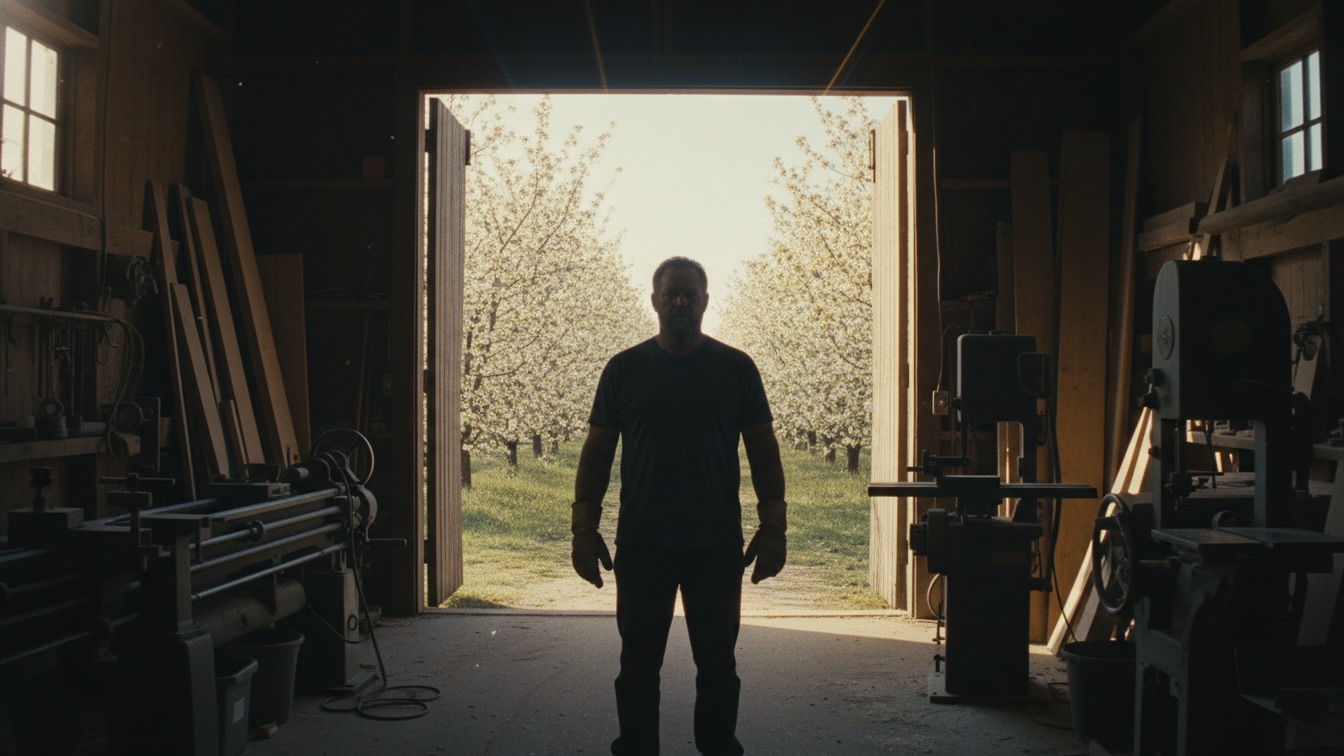
The climax arrives when a car pulls into the driveway, signaling the final confrontation with the outside world. Ed stands in the doorway, stripped of his illusions, as the "Shadow Mass" reaches its peak, forcing him to face the personification of his ruin.
The episode begins with a sense of heavy, stifling melancholy, transitioning through rising anxiety and sharp, jagged flashes of anger. It concludes with a hollow, resigned peace, as the protagonist accepts that the "frost" of the economy has finally killed the last of his professional dreams.
If expanded, the season would follow various characters in the same town as they navigate the ripple effects of the "Shadow Mass" and the economic collapse. Each episode would show how the same systemic failure touches different lives, eventually leading to a season finale where the town itself begins to buckle under the weight of the collective crisis.
The visual style is characterized by high-contrast, moody lighting, with the workshop serving as a claustrophobic, tactile environment filled with wood dust and deep, rich shadows. The "Shadow Mass" is rendered through practical lighting effects and subtle, unsettling camera movements that make the air feel thick and gelatinous.
The tone is somber, grounded, and slightly surreal, drawing inspiration from the works of Darren Aronofsky and the slow-burn tension of The Wrestler. It prioritizes the texture of wood, the sound of tools, and the cold, sterile look of digital notifications and red-inked notices.
The target audience is adults aged 30-60 who appreciate character-driven dramas, social commentary, and stories about the decline of traditional industries. It is designed for viewers of prestige television who enjoy atmospheric, slow-burn narratives that prioritize mood and thematic depth over fast-paced action.
The pacing is deliberate and rhythmic, mimicking the slow, methodical process of woodworking before accelerating into the frantic, disjointed energy of the financial crisis. The 10-12 minute runtime is structured into three distinct movements: the denial of the problem, the confrontation of the reality, and the final surrender.
The production will require a highly detailed, authentic workshop set that can be manipulated to show the "decay" of the environment, such as the wood cracking and the lighting shifting from warm to cold. The "Shadow Mass" should be achieved through practical on-set lighting rigs and atmospheric haze, avoiding heavy CGI to maintain the grounded, tactile feel of the film.
Special attention must be paid to the sound design, specifically the contrast between the rhythmic, comforting sounds of hand tools and the harsh, jarring sounds of automated texts and the landlord’s luxury vehicle. These audio cues are essential for anchoring the audience in Ed’s internal experience of the world shifting around him.


