Format: Short Film / Anthology Episode | Est. Length: 10-12 minutes
This story functions as a pilot episode for Glitch in the Hallway, an anthology series set in a suburban high school where the mundane stresses of adolescence—academic pressure, social anxiety, and burgeoning romance—manifest as literal, reality-bending physical anomalies. Each episode explores a different student’s psychological breaking point, suggesting that the school itself is a sentient, unstable environment that reacts to the volatile emotional frequencies of its teenage inhabitants.
Toby, a sleep-deprived student, sprints through a blindingly yellow school hallway while clutching a fragile, glitter-covered solar system project that feels like a ticking time bomb. As the sunlight turns the waxed floors into a disorienting mirror, the lockers begin to breathe in rhythm with his panic, signaling that his internal collapse is beginning to rewrite his physical surroundings.
A high-strung student suffering from a stress-induced psychotic break must navigate a hallway that is literally melting away to deliver his science project on time. With the help of a cynical classmate, he discovers that his anxiety is not just in his head—it is unraveling the fabric of the school itself.
The episode explores the crushing weight of academic perfectionism and the "hustle culture" imposed on modern teenagers, where a missed deadline feels like a life-altering catastrophe. It examines how severe anxiety distorts perception, turning the familiar, safe environment of a school into a hostile, alien landscape.
Furthermore, the narrative touches on the transformative power of human connection, specifically how a small act of empathy can ground someone experiencing a mental health crisis. The "glitch" serves as a metaphor for the loss of control, highlighting the struggle to maintain a facade of normalcy while one's internal world is falling apart.
Toby risks not only his academic standing and social reputation but his grip on reality itself as the "melting" phenomenon threatens to consume him. If he fails to reach the gym on time, his fear of failure will likely trigger a complete, irreversible collapse of his surroundings, potentially endangering himself and those nearby.
The primary antagonist is Toby’s own internal pressure, manifested as a sensory-overload disorder that warps his environment. Externally, the school’s rigid, unforgiving structure—represented by the looming deadline and the demanding Mr. Harris—acts as a catalyst that forces Toby’s fragile state into a full-blown reality-bending event.
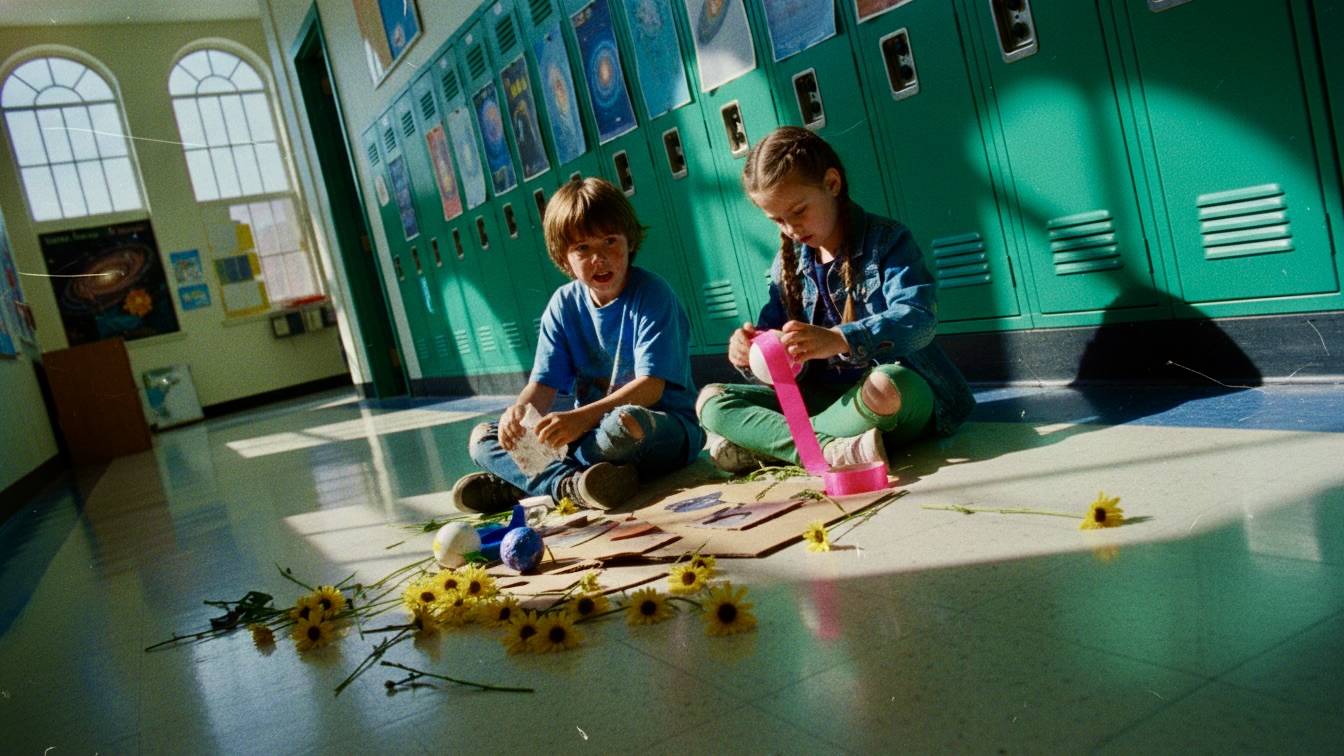
Toby, exhausted and desperate, races to the school gym with his Solar System 2.0 project, only to experience a sensory overload that makes the hallway appear to warp, breathe, and melt. After tripping and shattering his project, he is found by Tanya, who uses duct tape and cold, pragmatic logic to help him reconstruct his work while keeping him tethered to the physical world.
Despite his initial terror, the pair manages to repair the model, leading to a moment of quiet connection amidst the chaos. However, just as Toby successfully submits his project and believes he has conquered his anxiety, the gym itself begins to dissolve, revealing that his personal breakdown was merely a symptom of a larger, systemic instability within the school.
Toby is a high-achieving, anxious teenager defined by his need for external validation and his fear of failure, transitioning from a state of total sensory disintegration to a brief, fragile moment of stability. Tanya is a grounded, observant, and slightly cynical peer who acts as an anchor; she remains composed throughout the crisis, masking her own vulnerabilities behind a layer of modern, detached irony.
The opening sequence establishes Toby’s frantic mental state through high-contrast, over-saturated visuals and distorted audio as he navigates the hallway. The midpoint occurs when Toby collapses and destroys his project, forcing a confrontation between his internal panic and Tanya’s calm, reality-grounding intervention. The climax shifts from the hallway to the gym, where the successful submission of the project is immediately undercut by the terrifying revelation that the school is physically disintegrating.
The episode begins with an aggressive, jittery, and high-anxiety tone that keeps the audience in a state of sensory discomfort. As Tanya intervenes, the mood shifts toward a tender, intimate, and grounded atmosphere, only to plummet into a surreal, cosmic horror finale that leaves the audience questioning the nature of the school’s reality.
If expanded, the series would follow a group of students who begin to notice these "glitches" occurring across different departments, suggesting the school was built on a site of temporal instability. The season arc would involve these students teaming up to uncover the history of the school’s administration, realizing that the faculty may be intentionally inducing these breaks to harvest the emotional energy of the students.
As the season progresses, the "glitches" would escalate from minor environmental shifts to total reality collapses, forcing the characters to choose between conforming to the school’s demands or attempting to escape the institution entirely. The final episodes would focus on the students attempting to "reboot" the school, leading to a confrontation with the source of the instability.
The visual style utilizes extreme wide-angle lenses and high-contrast, saturated colors to represent Toby’s distorted perception, transitioning to handheld, shaky-cam footage during his panic attacks. The tone is a blend of coming-of-age drama and psychological surrealism, drawing stylistic inspiration from the disorienting, hyper-real aesthetics of Euphoria and the uncanny, reality-bending nature of The Twilight Zone.
The target audience is young adults (16-25) and fans of genre-bending psychological dramas. It is designed for streaming platforms where viewers appreciate character-driven narratives that utilize high-concept visual metaphors to explore mental health and social pressures.
The pacing is designed to be relentless and breathless in the first half to mirror Toby’s internal state, before slowing down significantly during the repair scene to allow for character development. The final three minutes shift tempo again, moving from a sense of relief to a jarring, rapid-fire sequence of environmental destruction to ensure a high-impact, cliffhanger ending.
The "melting" effects should be achieved through a combination of practical set pieces—such as motorized, flexible walls—and subtle CGI to ensure the distortion feels organic rather than purely digital. Sound design is critical; the "humming" of the heater and the "breathing" of the lockers should be layered with low-frequency sub-bass to create a visceral, physical reaction in the viewer.


