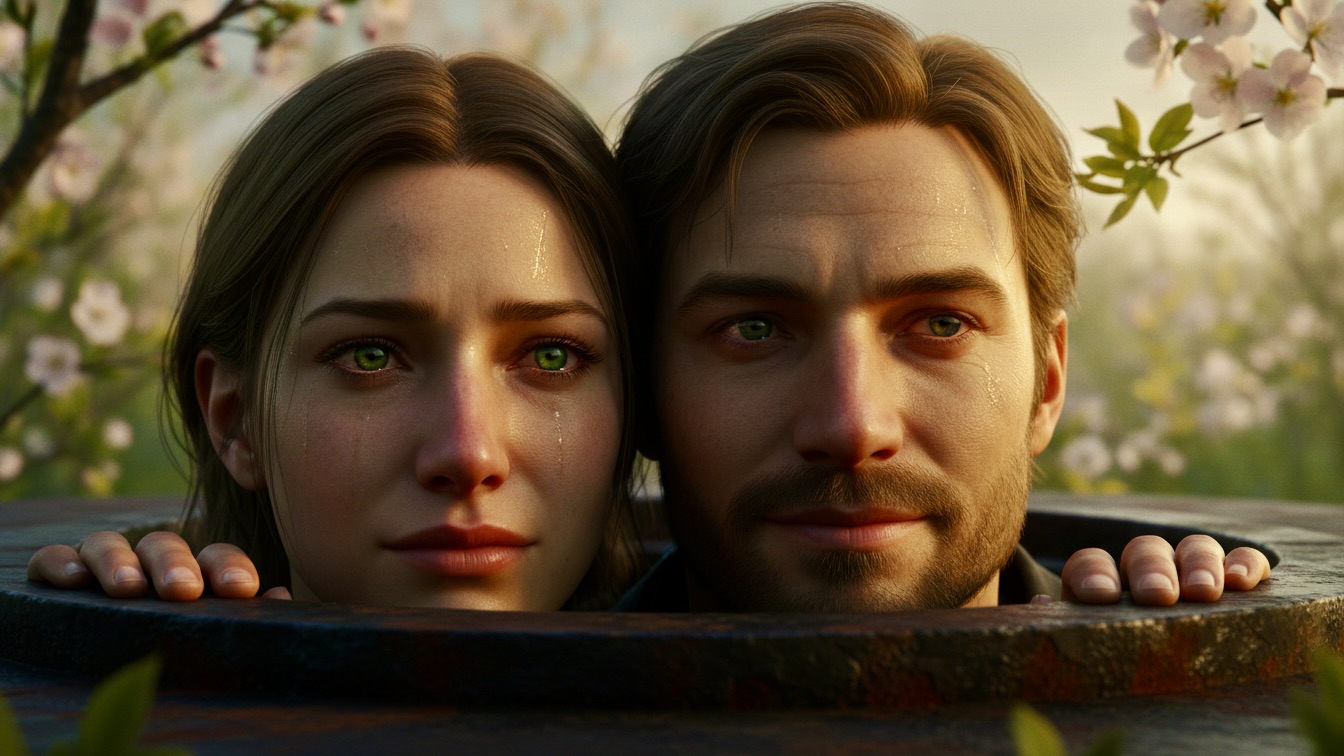
Edmund risks everything to lead Sandy through the dying vents of the bunker toward a spring they cannot keep.
The air in Sector 4 always tasted like old pennies and wet wool. It was a thick, recycled soup that sat in the back of your throat, reminding you that every breath you took had already been through a dozen pairs of lungs. I leaned against the vibrating housing of the main intake fan, feeling the hum in my teeth. My lungs felt small. They always felt small down here. I checked my watch. The display was cracked, a jagged line running through the numbers, but I could see enough. She was late. If she didn't show in three minutes, the security sweep would catch her in the crawlspace.
I’ve spent ten years fixing these machines. I know the rhythm of the city. I know when the pressure drops and when the heat spikes. I also know that Sandy shouldn't be here. We were a mistake from the first night in the hydroponics bay, two people trying to find heat in a world made of cold steel. She was a dreamer, the kind of person who thought the surface was waiting for us. I was the guy who knew exactly how much rust it took to make a bulkhead fail. We didn't fit. We were two gears with different pitches, grinding each other down to metal shavings.
I heard the scrape of a boot on the grating. I didn't move. I kept my eyes on the flickering overhead light. It strobed in a steady, annoying rhythm.
"Edmund," she whispered.
I turned. She looked terrible. Her hair was matted with grease from the vents, and there was a dark bruise bloom on her cheekbone. She was clutching a heavy canvas bag like it held her heart. It probably held something more dangerous.
"You're late," I said. My voice was flat. I wanted to sound angry, but I just felt tired.
"The patrol changed their route," she said, breathing hard. "They're sealing the lower levels early. Edmund, they're cutting the air to the crèche."
I felt a cold knot tighten in my stomach. "I heard the rumors. I didn't think they'd actually do it."
"They are. They’re calling it 'efficiency measures.' It’s murder, Edmund."
She stepped closer. She smelled like the deep vents—sulfur and stagnant water. I remembered how she used to smell when we first met, like the synthetic mint they used in the washrooms. That felt like a lifetime ago. Back when we thought we could just be two people.
"I have the key," she said, reaching into her pocket. She pulled out a heavy piece of brass. It was an old-world manual override. It shouldn't have existed.
"Where did you get that?" I asked, my heart hammering against my ribs.
"It doesn't matter. We have to go. Now. Before the pressure locks engage."
I looked at the brass key. It was solid, real. In a world of plastic and digital codes, it felt like an anchor. I looked at her. Her eyes were wide, bright with a desperate kind of hope that made me want to look away. We were doomed. I knew it. The math didn't add up. There was no version of this story where we both walked away clean.
"They'll kill us," I said.
"They're already killing us," she snapped. "Slowly. One breath at a time. I’d rather go fast."
I took a breath of the copper air. I made a choice. It wasn't a hero's choice. It was the choice of a man who was tired of suffocating. "Follow me. Stay off the main catwalks."
We moved through the guts of the station. It was a maze of sweating pipes and screaming steam valves. I led her through the maintenance shafts I’d spent a decade mapping. My boots made dull thuds on the rubberized flooring. Every shadow looked like a guard. Every hiss of a pipe sounded like a voice calling my name.
We hit the first seal. It was a heavy circular door, rusted shut around the edges. I pointed to the manual slot. Sandy stepped forward and jammed the brass key in. It didn't turn at first. She leaned into it, her knuckles turning white. I put my hand over hers, feeling the heat of her skin. Together, we shoved. The mechanism groaned, a sound of metal screaming against metal, and then it gave.
A puff of stale, pressurized air hit us. We scrambled through and I pulled the door shut behind us. We were in the transition zone now. The air here was colder. It felt thinner.
"How much further?" she asked. She was shivering.
"Three levels up. The emergency vent. But the sensors will trigger the moment we crack the exterior seal."
"Then we run."
"Sandy," I said, grabbing her arm. I needed her to look at me. "If we get out... there's nothing out there. You know that, right? It's just dirt and wind. No food. No masks."
She touched the bruise on her face. "It’s Spring, Edmund. I saw the readings from the probes. The toxicity is down. The plants are coming back. I’d rather starve under a tree than die in a box."
I didn't have her faith. I only had the brass key and the knowledge of the vents. We climbed. My muscles burned. My lungs felt like they were full of broken glass. We passed a viewport, a thick pane of leaded glass. Outside, it was black. Just endless, heavy dark. It was hard to believe anything else existed.
We reached the final ladder. It was a vertical shot, fifty feet of rusted rungs. I went first. My hands were slick with sweat. Halfway up, I heard a sound from below. A rhythmic thudding. Boots.
"They're behind us!" Sandy hissed.
"Don't look down. Just climb!"
I reached the top platform. The emergency hatch was massive, held shut by four locking bolts. There was no keyhole here. This was a manual break. I grabbed the iron bar and pulled. It didn't budge. I threw my whole weight into it. My shoulder screamed in protest.
Sandy reached the platform and grabbed the bar with me. "On three," I said.
"One. Two. Three!"
We pulled. The bolts snapped with a sound like a gunshot. The pressure difference took over. The hatch didn't just open; it exploded outward.
The world changed.
It wasn't a transition. It was a violent shift. The air hit me first. It wasn't the metallic, dead air of the bunker. It was cold. It was sharp. It tasted like wet stone and something green, something sharp and biting. It was oxygen. Real, unscrubbed oxygen.
I fell back against the wall, gasping. It felt like I was drowning in it. My head spun. The claustrophobia that had been my constant companion for thirty years simply vanished. It was like a physical weight had been lifted off my chest. I could see. Really see.
Sandy was already at the edge of the hatch. She was bathed in light. It wasn't the flickering yellow of the LEDs. It was pale, soft, and blue. The sun was coming up.
I crawled toward her. We looked out over the edge.
The world wasn't dead. It was waking up. Below us, the ruins of the old city were draped in a vibrant, aggressive green. Vines crawled over the husks of skyscrapers. The ground was a carpet of soft, damp moss. In the distance, a forest of skeletal trees was covered in a haze of new buds. The air was full of a low, constant hum—not the hum of machines, but the sound of life.
It was beautiful. It was also terrifying.
"We did it," she whispered. She reached out and touched a small flower growing in a crack in the concrete. It was yellow, bright and stubborn.
I looked back at the dark hole we had crawled out of. I could hear the alarms now, faint and tinny. They were coming. They would seal the hatch, or they would come out after us.
"They're coming," I said.
Sandy didn't look back. She looked at the horizon. The sun was hitting the tops of the trees now, turning the green into a shimmering gold. She looked at me, and for a second, the doom felt distant. The fact that we had no food, no shelter, and no plan didn't seem to matter.
"Let them," she said. "Look at the light, Edmund."
I looked. The sky was a pale, aching violet, shifting into a soft pink. It was Spring. The air was sweet, and for the first time in my life, I wasn't afraid to take a deep breath. But as the first patrol drone broke the silence of the morning, I realized the clarity of our situation. We were free, and we were completely, utterly alone.
I reached out and took her hand. Her fingers were cold. The brass key was still in her other hand, a useless piece of metal now. I took it from her and tossed it over the edge. It disappeared into the green below without a sound.
"Where do we go?" I asked.
She looked at the forest, then back at me. There was a sadness in her eyes that matched the beauty of the morning. We both knew this wasn't a beginning. It was just a longer, prettier ending.
"Away from the noise," she said.
We stood up. My legs felt shaky. The vastness of the sky made me feel small, like a speck of dust. I missed the low ceilings for a heartbeat, the safety of the walls. Then a gust of wind hit us, carrying the scent of damp earth and blooming things. It pushed us forward.
We started to walk toward the trees. Behind us, the bunker was a gray tomb buried in the hillside. Ahead, the world was wide and indifferent. I didn't know if we'd make it through the night. I didn't know if the air would turn sour again. But as the sun finally cleared the ridge, the light was so bright it washed everything else away.
“The first patrol drone broke the silence of the morning, its red eye fixing on us as we stepped into the light.”


