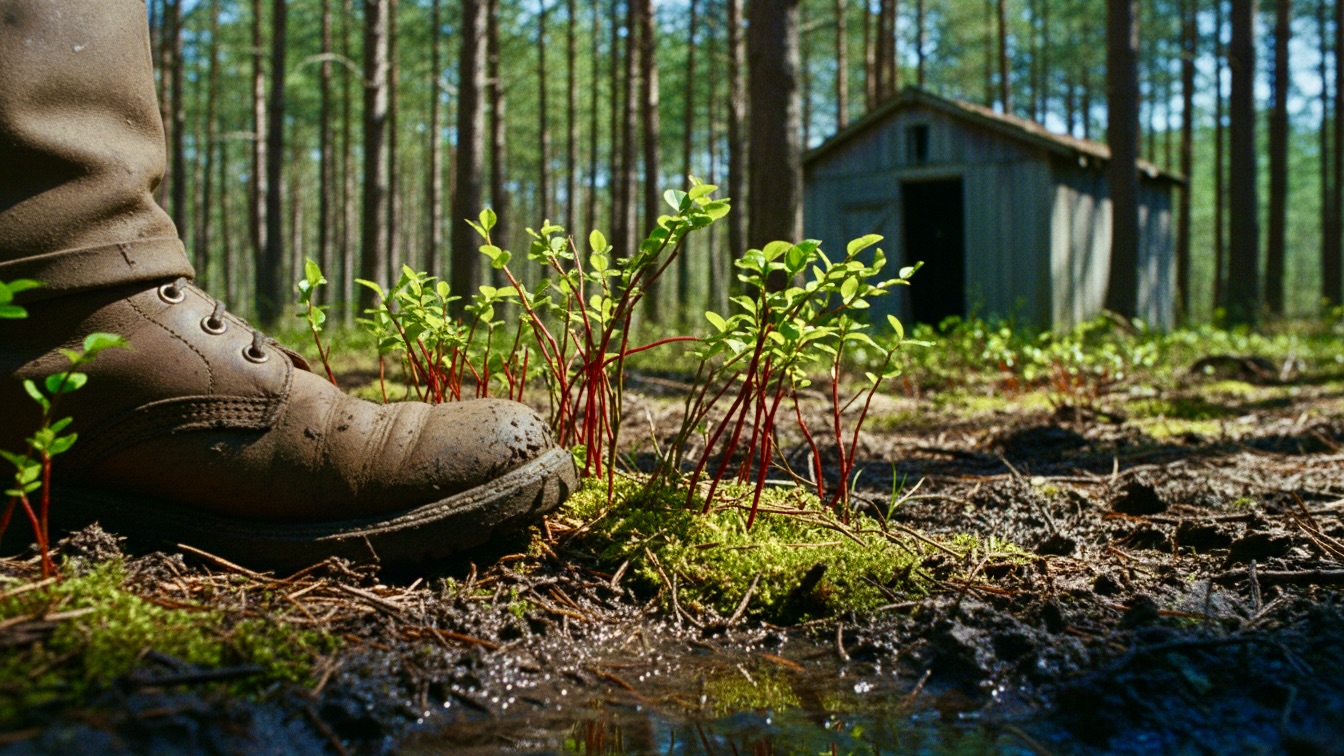
Miller finds a scrap of flannel caught on a jack pine while Elissa explains why wild things stay wild.
The mud was a living thing. It sucked at Miller’s boots with a wet, rhythmic sound that echoed in the silence of the jack pines. He felt the dampness through his socks, a cold, heavy weight that made every step a chore. The air smelled of wet bark and the sharp, metallic tang of the melting snow. It was spring, but the warmth hadn't reached the soil yet. The trees were thin and crowded, their branches interlocking like skeletal fingers. Miller stopped. He wiped a smear of dirt from his forehead, leaving a dark streak. His knees ached. The climb had been steep, and the ground was uneven, hidden under a layer of rotting needles and new moss.
He saw it then. A small, jagged piece of flannel caught on a low branch. It was red and black, the fabric frayed and damp. He leaned in, his breath huffing out in a pale cloud. The branch was stiff, unyielding. He didn't touch the scrap yet. He just looked. It was a loud color against the grey and green of the woods. It didn't belong here. Nothing about the missing man belonged here. Miller’s lower back gave a sharp twinge as he straightened up. He reached for his phone, then remembered the signal had died three miles back. He was alone. Or he was supposed to be.
"It does not want you here," a voice said.
Miller didn't jump. He was too tired for that. He turned slowly, his boots squelching in the muck. Elissa stood twenty feet away, partially obscured by the thin trunks. She wore a heavy canvas jacket, the shoulders darkened by moisture. Her hair was pulled back tight, her face pale and sharp. She held a plastic bucket, empty and white. It looked brand new, which meant it probably wasn't. She knew how to keep things clean.
"The land or you, Elissa?" Miller asked. His voice was gravelly. He hadn't spoken to anyone in four hours.
"Both," she said. She walked toward him, her movements light and deliberate. She didn't sink into the mud the way he did. She knew where the roots were. "That fabric is a scar. You should leave it where it is."
"It’s evidence," Miller said. "A man is missing. People don't just vanish in a patch of trees."
"They do if they don't know how to walk," she replied. She stopped beside him and looked at the flannel. Her eyes were dark, almost black in the flat light. "He was loud. He had those poles that click on the rocks. He thought he was in a park. This is not a park."
Miller looked back at the scrap. "He was seen near your patch. The one you harvest every year."
Elissa looked past him, toward the clearing where the blueberries grew. Right now, they were just low, tangled bushes, their stems a striking, deep red against the muddy earth. "It is not my patch. I just happen to be there when the fruit is ready. There is a difference."
"The family says he was looking for the 'authentic experience'," Miller said. He felt a bead of sweat roll down his spine, despite the cold. "He wanted to see the wild harvest."
"The wild harvest is not a show," Elissa said. She stepped closer to the bushes. She pointed at the blood-red stems. "Look at them. People try to plant these in their yards. They buy the soil. They buy the fertilizer. They try to force the vibe. But the wild blueberry refuses. It dies in a garden. It only grows where it chooses. Usually where the fire has been. It needs the burn to live."
Miller watched her. She spoke with a rehearsed intensity, like a performer on a stage. It was a local trait, this theatricality when dealing with outsiders. It was a shield. "He wasn't trying to plant them. He was just walking."
"He was trespassing," she said. "Not on my land. On the boundary. You see those stems? They turn that color in the spring to warn you. The best fruit hides underneath the leaves later. You have to earn it. You have to get on your knees and bleed a little on the thorns. He didn't want to get dirty. He wanted the photo. He wanted the story without the work."
Miller shifted his weight. His left boot was slowly filling with cold water. "Did you see him, Elissa?"
"I saw a ghost in a bright jacket," she said. "He asked me if the berries were 'organic'. I told him everything here is organic. Life, death, the rot. It’s all part of the same system."
"That’s not a yes or a no."
"It’s the only answer you’ll get," she said. She turned her bucket over and sat on it. She didn't care about the mud. "You’re looking for a body, Detective. But you should be looking for a lesson. The people here, we don't like visitors who treat the woods like a museum. We protect what’s ours."
Miller felt a chill that had nothing to do with the weather. The 'protective culture' of the valley was well-known, but usually, it was about poaching or property lines. This felt heavier. "He was a person, Elissa. He had a life."
"He had a brand," she corrected. "And he brought it somewhere that doesn't recognize currency. The blueberries don't care about his followers. Neither do the jack pines."
Miller reached out and plucked the flannel from the branch. It came away with a soft rip. "I'm going to need to search the storage shed at your camp."
Elissa stood up. The theatricality vanished, replaced by a cold, hard stillness. "You have a warrant?"
"I have a missing person and a piece of his clothing on the edge of your property," Miller said. "I can get one. Or you can be neighborly."
"Neighborly is for people who live on the same street," she said. "Out here, we are just survivors sharing the same air. If you go into that shed, you won't find him. But you might find things you aren't ready to explain to your superiors."
Miller took a step toward her. The mud gurgled. "Is that a threat?"
"It’s a forecast," she said. She looked at his muddy boots, then back at his face. "The rain is coming back. The tracks will be gone by morning. If I were you, I’d stop looking at the trees and start looking at the ground. Sometimes the earth opens up for people who don't belong."
She turned and began to walk away, back toward the thicket. She didn't look back. Miller stood in the darkening woods, the red flannel clutched in his hand. He looked down at the blood-red stems of the blueberries. They looked like veins rising out of the mud. He realized then that Elissa wasn't just talking about the plants. She was talking about the people. They were rooted here, fueled by the old fires, and they didn't transplant well.
He heard a sound from the direction of the shed—a low, metallic thud. It wasn't the wind. He started toward it, his heart hammering against his ribs. The grey weight of the atmosphere felt like it was pressing him into the soil. He reached the edge of the clearing and saw the shed. It was a leaning structure of grey wood, the door hanging on a single rusted hinge.
Inside, something shifted. A pale hand reached out from the darkness, grasping the edge of the doorframe, the fingernails caked in the same red mud that stained Miller’s boots.
“Inside, something shifted, and a pale hand reached out from the darkness, grasping the edge of the doorframe with fingernails caked in red mud.”


