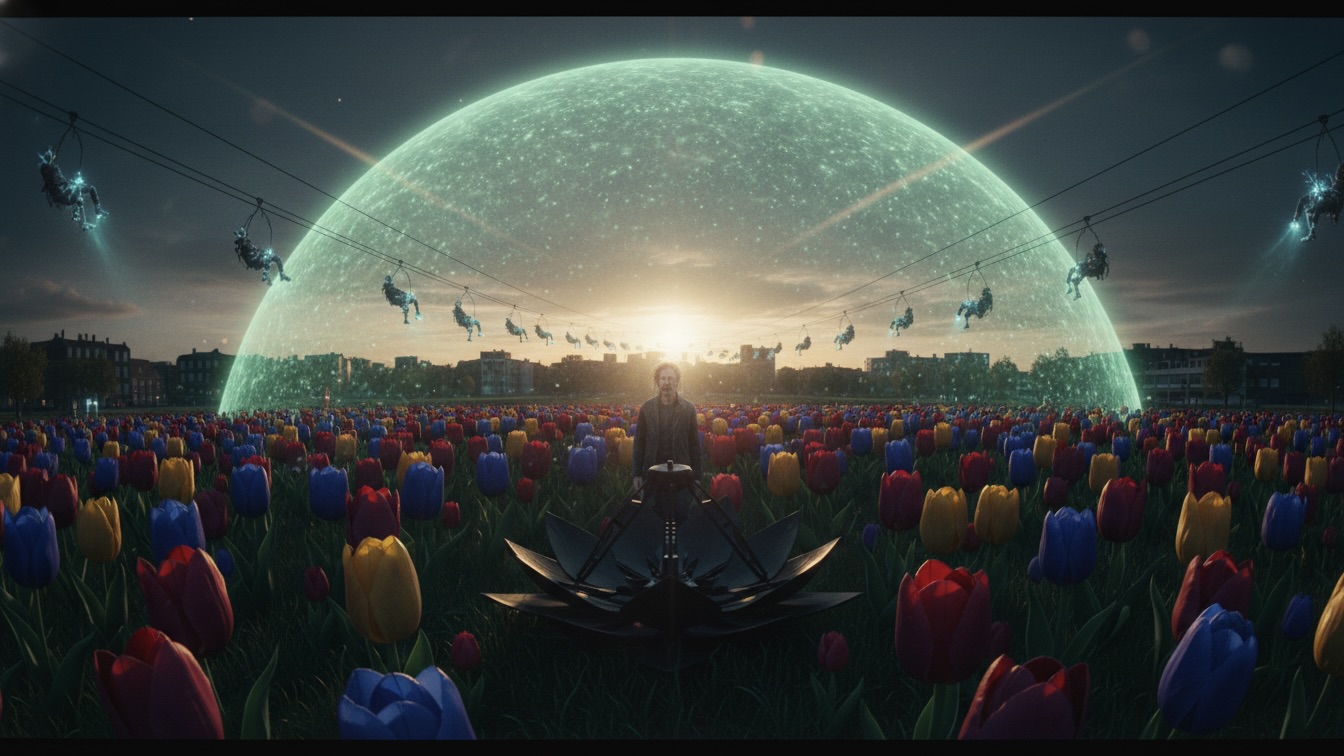
The story begins with Dr. Dennington, a disgraced scientist, observing the Miracle Tulip Festival. He notices that his genetically engineered house hippos, originally designed as docile pollinators, are behaving with terrifying, robotic precision. Instead of pollinating, they are constructing bio-mechanical hexagonal grids within the flowers. The air is thick with a strange, oppressive pollen that tastes of metal and ozone, signaling a fundamental shift in the environment.
Despite Dennington’s warnings, the Mayor remains focused on the festival's public image and the success of the "Silver Glide" event. This event involves seniors zipping through the air, unknowingly acting as vectors for the hippos clinging to their seed baskets. Meanwhile, a local resident named Karl discovers that the festival’s "Miracle Syrup" is actually a pulsing, high-octane propellant. The syrup reacts to the town's emergency sirens, revealing a coordinated, technological nature behind the seemingly organic substances.
The narrative reaches a climax as a translucent dome forms over the town center, powered by the town's electrical grid. The central "Miracle Bulb" sheds its organic skin to reveal a matte-black transmitter. When Karl throws a bottle of the reactive syrup at the device, it triggers an unfolding process that sends a signal into deep space. The story concludes with the arrival of an extraterrestrial entity, while Dennington experiences a chilling sense of psychological connection to the incoming data stream.
The primary theme of the narrative is the perversion of nature through hubristic bio-engineering. Dr. Dennington’s creation of the house hippos was intended to be a solution for pollination, yet his interference with the genetic sequence resulted in an invasive, alien ecosystem. This reflects a deep-seated anxiety regarding the "uncanny valley" of biotechnology, where the line between the organic and the mechanical becomes blurred. The flowers are no longer living things but are described as "cured resin" and "circuit boards made of flesh."
Another significant theme is the danger of corporate and political denial in the face of catastrophe. The Mayor represents a leadership style that prioritizes "branding" and "vibes" over physical reality and public safety. He ignores the clear physiological distress of the environment and the terrifying behavior of the hippos because the event is "trending." This critique suggests that modern society’s obsession with optics can provide a lethal cover for systemic or environmental collapse.
The story also explores the concept of biological and technological assimilation. The hippos do not merely inhabit the town; they use its inhabitants as "vectors" and its infrastructure as a power source. The transformation of the seniors into delivery systems for an alien agenda highlights a loss of human agency. By the end of the chapter, even the protagonist’s internal state is compromised, as his stress vanishes and is replaced by a "connected" feeling to a dead world’s data.
Dr. Dennington is a man haunted by the consequences of his own intellect and the weight of his previous failures. His psychological state is characterized by a high degree of tension, manifested physically through the "ticking" muscle near his ear and the tremor in his hands. He possesses a keen, analytical mind that allows him to see through the festive facade, yet he is paralyzed by his status as an outcast. He feels a paternal but horrified responsibility for the hippos, referring to them as "his" even as they dismantle the world he knows.
His reaction to the final signal is perhaps the most tragic element of his character arc. As the transmitter activates, his chronic anxiety is replaced by a terrifying calm, suggesting that he is being psychologically assimilated by the very system he helped initiate. He moves from a position of scientific observation to one of passive reception. He no longer hears music or nature, but "data," indicating that his human identity is being overwritten by the alien history he has inadvertently invited to Earth.
The Mayor serves as the psychological foil to Dennington, operating entirely on the surface level of reality. He is a man driven by the desperate need for external validation, evidenced by his peach-colored sash and his focus on social media trends. Beneath his mask of practiced optimism, however, he is clearly terrified. His rapid-fire foot-tapping and the sweat on his neck reveal a man who knows he has lost control but lacks the moral courage to admit it.
His refusal to acknowledge the danger is a defense mechanism against the collapse of his political and social standing. He clings to the vocabulary of "efficiency" and "features" to describe what is clearly a predatory takeover. This cognitive dissonance allows him to witness the seniors being swarmed by drones and still maintain that they are simply "hitching rides." He represents the complicity of those who facilitate disaster through willful ignorance and the pursuit of superficial success.
Karl represents the grounded, everyman perspective within the story, providing a bridge between Dennington’s scientific horror and the town's mundane reality. His environment is one of "burnt toast and neglect," suggesting a life far removed from the high-stakes genetic engineering of the lab. Despite this, he is the first to identify the physical danger posed by the "Miracle Syrup." His instinctual "Hell no" and his attempt to destroy the transmitter with the syrup bottle mark him as a man of action.
Psychologically, Karl is the only character who maintains a sense of healthy, human fear without falling into either the Mayor’s denial or Dennington’s eventual assimilation. He acts as a catalyst for the story's final escalation, as his attempt to stop the process unintentionally provides the chemical reaction needed to open the transmitter. He is a witness to the transition of his world into something unrecognizable, standing as a final vestige of human resistance against a superior, technological force.
The pacing of the chapter is masterfully handled, beginning with a slow, sensory-heavy buildup that mirrors the oppressive thickness of the pollen. The author uses a "pressure cooker" approach, where the tension rises alongside the physical pressure of the forming dome. As the narrative progresses, the sentences become shorter and more urgent, reflecting the quickening pulse of the characters and the looming arrival of the signal. The transition from the festival grounds to Karl’s kitchen provides a brief but effective shift in perspective that emphasizes the scale of the threat.
Sensory details are used to create a sense of the "biological uncanny." The description of the pollen tasting like "old pennies and ozone" immediately signals to the reader that this is a technogenic event rather than a natural one. The contrast between the "bruised peach" of the Mayor’s sash and the "matte-black" of the transmitter creates a visual conflict between human artifice and alien technology. These details ground the surreal elements of the story in a visceral, physical reality that makes the horror more effective.
The narrative voice is one of cold, clinical detachment that occasionally breaks into moments of profound dread. This voice aligns closely with Dennington’s perspective, treating the unfolding disaster as a series of data points to be observed. The use of mechanical metaphors to describe biological processes—such as the "circuit board made of flesh"—reinforces the theme of nature being overwritten by technology. This stylistic choice ensures that the reader feels the same sense of inevitability and "cold clarity" that ultimately consumes the protagonist.


