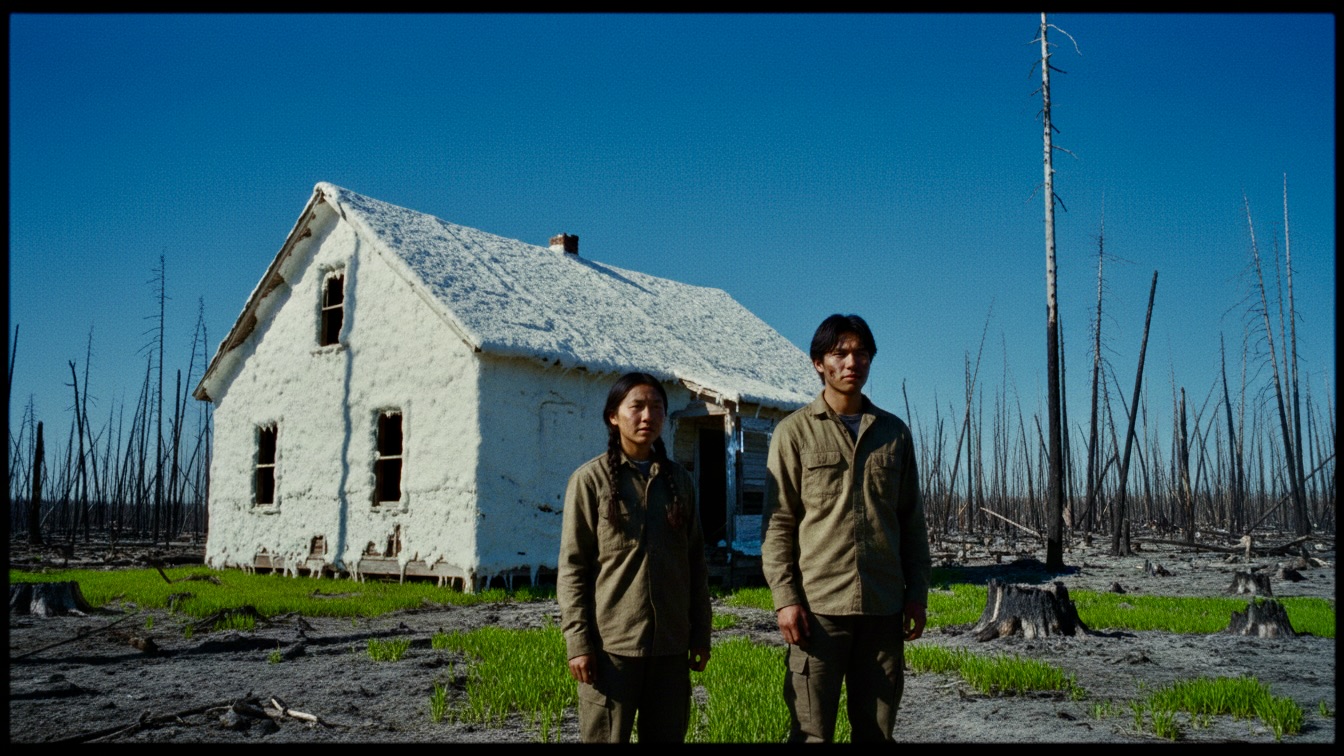
The narrative begins with Koda, an Indigenous scientist, receiving a formal notification that his bio-engineering project has been defunded by the Ministry. His research involves a specialized fungal strain designed to protect houses from extreme heat, a crucial necessity given the encroaching wildfires in Northwestern Ontario. As the provincial government abandons the region as a "total loss zone," Koda’s associate, Neeba, arrives with stolen industrial carbon-capture units. She insists that they use this equipment to jumpstart the fungal growth and save their community from the imminent fire.
As the duo works frantically to coat the local houses in the mycelium, they are interrupted by Sergeant Poiler and a private security team from Global Climate Solutions. Poiler demands the return of the proprietary technology, prioritizing corporate assets over the lives of the residents. The argument is cut short by the arrival of a devastating crown fire, forcing both the protectors and the corporate agents to take shelter inside one of the fungus-wrapped homes. The biological shield successfully maintains a cool, breathable environment while the world outside is incinerated.
In the aftermath, the group emerges to find the forest completely destroyed, yet the treated houses remain standing as organic beacons of survival. The success of the experiment transforms the power dynamic between the community and the corporation. Poiler, humbled by the experience, calls for medical aid and government intervention to witness the miracle. Koda realizes that his work is no longer a localized experiment but a blueprint for a new form of environmental resistance that cannot be easily commodified or controlled.
One of the primary themes explored in the text is the conflict between institutional neglect and communal self-reliance. The Ministry’s decision to pause Koda’s funding is portrayed not as a bureaucratic necessity but as a calculated abandonment of a marginalized community. By designating the area a "total loss zone," the state effectively chooses to let the community burn rather than invest in its preservation. This reflects a broader commentary on environmental racism, where the safety of Indigenous lands is treated as an optional expense rather than a fundamental right.
The story also delves deeply into the concept of biomimicry versus industrial exploitation. Koda’s fungal mats represent a harmonious integration of biology and technology, whereas Poiler’s carbon-capture units are viewed merely as "proprietary tech" and "tax credits." The narrative suggests that true environmental solutions must be living and adaptive rather than static and profit-driven. The fungus "breathing" and "transpiring" stands in stark contrast to the exploding SUVs and melting tactical gear, highlighting the superiority of organic resilience over mechanical rigidity.
Furthermore, the theme of sovereignty and the "unpatentable" nature of life emerges in the conclusion. When Koda tells Poiler that he cannot patent the air, he is asserting a form of intellectual and spiritual independence from corporate structures. The spores moving in the wind symbolize a decentralized revolution that bypasses the "consultation windows" and "federal oversight committees" that sought to stifle it. This suggests that survival in the face of climate collapse requires a radical reclamation of natural resources and scientific agency.
Koda is a man defined by a profound sense of intellectual isolation and moral responsibility. As a scientist, he possesses a visionary mind that sees life where others see only mold or decay, yet he is initially paralyzed by the weight of systemic failure. He experiences a psychological tension between his role as a researcher who follows protocol and the reality of a crisis that demands law-breaking action. His internal conflict is resolved only when the physical threat of the fire forces him to prioritize the immediate survival of his people over his professional standing.
From a psychological perspective, Koda exhibits high levels of resilience and adaptive intelligence. He does not view his work as a means to personal glory but as a necessary service to his elders and his land. His transition from despair at the start of the chapter to a state of "overwhelming energy" at the end marks a significant growth in his self-efficacy. He moves from being a victim of the Ministry’s whims to becoming a pioneer of a new world, one where he no longer seeks permission to exist or to innovate.
Neeba serves as the pragmatic and fierce catalyst for Koda’s scientific potential. She is a woman of action who rejects the "procedural pause" of the government in favor of direct, radical intervention. Her psychology is rooted in a survivalist instinct that is both desperate and calculated, as seen in her willingness to steal federal property to save her community. She provides the physical and emotional momentum that Koda lacks, acting as the grounded force that turns his theories into a tangible defense.
Her character represents the spirit of resistance that refuses to be cowed by corporate authority or legal threats. When she swings the wrench at Poiler, she is not merely defending a piece of equipment; she is defending the right of her community to survive. Neeba’s lack of hesitation suggests a clear moral compass that prioritizes human life above the sanctity of private property. She is the essential bridge between Koda’s laboratory and the harsh reality of the burning forest.
Sergeant Poiler embodies the cold, detached nature of corporate interests, though he undergoes a significant psychological shift throughout the narrative. Initially, he is a man who hides behind contracts and proprietary rights, viewing the world through the lens of asset reclamation. He lacks empathy for the residents of the reserve, seeing them only as obstacles to his corporate mission. His respirator and tactical gear serve as physical and psychological barriers that distance him from the environment he is supposed to be "managing."
However, the overwhelming power of the wildfire shatters his facade of control and forces him into a state of vulnerability. Inside the fungal house, he is reduced to a "trembling" observer, his world-view upended by a biological miracle he cannot explain. This experience humbles him, shifting his motivation from protecting corporate profits to recognizing the value of Koda’s work. By the end of the chapter, his call to the Ministry is no longer about reclamation but about witnessing a paradigm shift, indicating a newfound respect for the people he once dismissed.
The pacing of the chapter is masterfully handled, beginning with a slow, stifling atmosphere of bureaucratic dread and accelerating into a high-stakes survival thriller. The early descriptions of the "cramped, humid air" and "brittle brown needles" create a sensory foundation of stagnation and impending doom. As the fire approaches, the sentences become more urgent and action-oriented, reflecting the "fever" of Koda and Neeba’s work. This rhythmic shift mirrors the physiological response of the characters as they move from the lab into the heat of the clearing.
Sensory details are used to create a vivid, almost tactile experience for the reader. The author contrasts the "milky-white," "cool to the touch" fungus with the "screaming, tearing noise" and "thermal shock" of the wildfire. The smell of "mushrooms and ozone" inside the house provides a sharp, olfactory relief from the "swallowing sand" sensation of the smoky air outside. These details serve to ground the science-fiction elements of the story in a visceral reality, making the "fungal womb" feel like a plausible sanctuary.
The narrative voice is one of grim determination that eventually blossoms into a quiet, profound hope. The tone remains grounded in the harsh realities of the Northwestern Ontario landscape, avoiding overly sentimental tropes in favor of a "mask of grim determination." By focusing on the physical sensations of the fire and the biological reactions of the mycelium, the author creates a sense of "hard" speculative fiction. The final image of "green shoots" poking through the ash serves as a powerful visual metaphor for the resilience of both nature and the human spirit.


