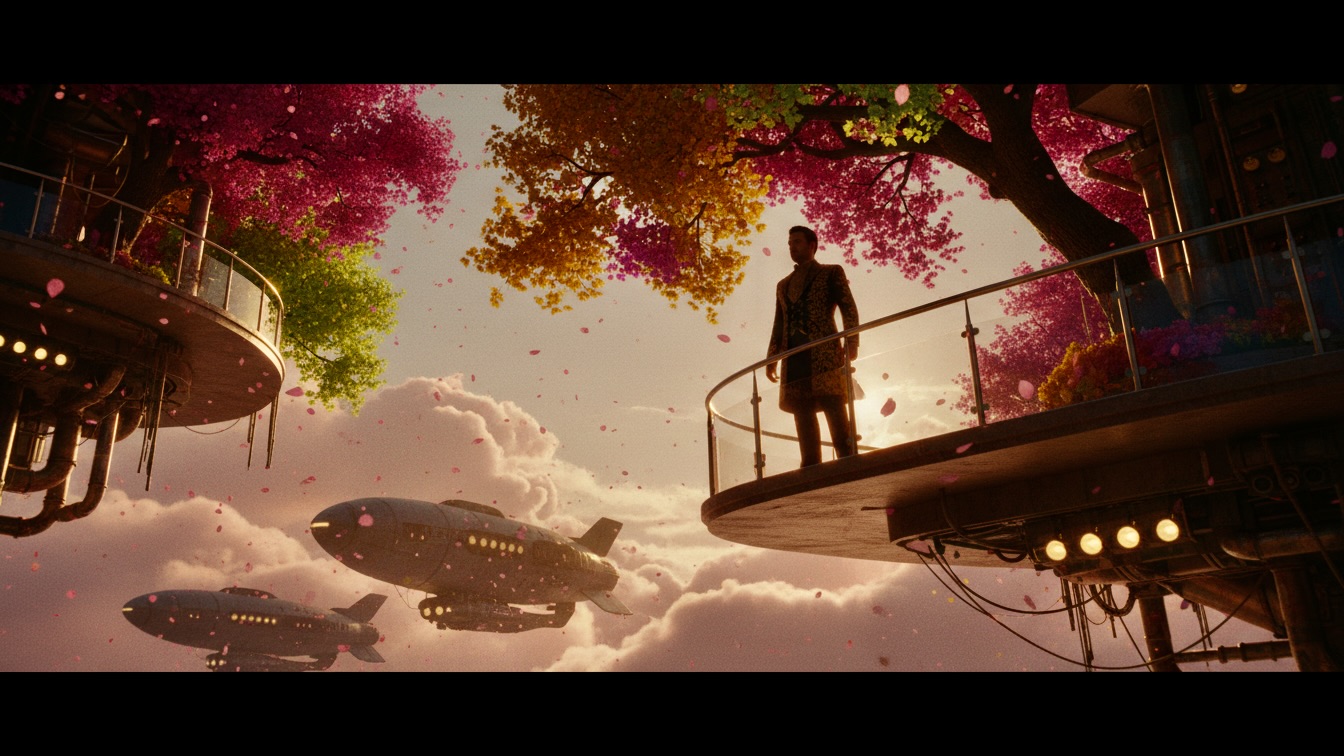
The narrative unfolds in the hyper-stratified floating city of Cloud-09, where the elite maintain eternal youth through the literal extraction of bone marrow from the lower classes. John, a high-ranking proponent of this "optimization" philosophy, prepares for a keynote speech that celebrates the consumption of the "unmotivated" as a moral imperative. During his presentation, a young girl is harvested behind a silk curtain to provide the "Juice" that fuels the audience's vitality. This act serves as a visceral demonstration of John’s core belief: that the world is divided into those who harvest and those who are harvested.
Following his performance, John demonstrates his ruthless adherence to this ideology by discarding his anxious intern, Benny, and sending him to the extraction labs for a minor mistake. To satisfy a high-tier client named Vic, who is spiraling into a panic over microscopic signs of aging, John descends to the lower tiers to find a fresh donor. He lures a young scavenger named Z with promises of a better life in the upper tiers. The story concludes with John cold-bloodedly overseeing Z's extraction, reaffirming his role as the "god of the grind" while the city’s massive harvest ships descend to feed on the remaining population.
The central theme of the story is the horrific evolution of bio-capitalism, where the human body is no longer a vessel for life but a commodity to be mined. In the world of Cloud-09, "optimization" is the ultimate virtue, and any sign of natural aging or emotional vulnerability is rebranded as a "poverty mindset" or a "moral failure." The narrative suggests that when productivity becomes the sole measure of human worth, the logical conclusion is the literal consumption of the weak by the strong. This predatory system is masked by the language of self-improvement and meritocracy, allowing the elite to view their cruelty as a form of administrative efficiency.
Another prominent theme is the rejection of nature and the embrace of a synthetic, stagnant reality. The city of Cloud-09 exists in a state of permanent, artificial Spring, mirroring the inhabitants' refusal to accept the natural cycles of decay and death. This environmental stagnation serves as a metaphor for the moral rot hidden beneath a polished, chrome exterior. The characters are trapped in a "closed system" where they must constantly consume others to prevent their own inevitable collapse. This creates a paradox where the pursuit of eternal life results in a hollow, parasitic existence that lacks genuine human connection or growth.
The story also explores the psychological power of the "beautiful lie" over the "ugly truth." This is most evident in the character of Z, who recognizes the danger John represents but chooses the possibility of the upper tiers over the certain misery of the Dregs. The elite are equally complicit, as they ignore the "wet slurping sounds" of extraction in favor of the "smooth, low-frequency hum" of John’s rhetoric. The narrative posits that people will endure or participate in unimaginable horrors if those horrors are packaged in the aesthetics of luxury and the promise of status.
John functions as the personification of the "Dark Triad" personality traits: narcissism, Machiavellianism, and psychopathy. From a psychological perspective, he has completely internalized a corporate identity, viewing his own body and the bodies of others as biological machines that must be "optimized." He lacks empathy, viewing emotions like pity as "low-vibration" toxins that threaten his internal stability. His obsession with his reflection and his "perfect" skin suggests a profound underlying insecurity; he is a man who exists only as a brand, terrified that any crack in his facade will lead to a total loss of power.
His role as the "god of the grind" allows him to justify his predatory behavior as a service to the city's infrastructure. He views himself as a host providing a dream, rather than a parasite feeding on the vulnerable. By recontextualizing murder as "optimization" and "donor acquisition," he maintains a sense of moral superiority. He is the ultimate architect of a system that rewards his lack of conscience, turning his sociopathy into a competitive advantage in a world that has abandoned traditional ethics.
Benny serves as a tragic representation of the "failed" worker within the hyper-competitive environment of Cloud-09. His character is defined by his anxiety and his "poverty mindset," which in John’s eyes are not symptoms of overwork but inherent glitches in his biological programming. Benny’s desperation to please John and his subsequent terror when he fails highlight the precarious nature of life for those who serve the elite. He is a cautionary tale of what happens when an individual tries to integrate into a system that views them as nothing more than a temporary resource.
Z is a pragmatic survivor whose brief appearance highlights the crushing weight of the story’s social hierarchy. Unlike the elite, she is not blinded by the ideology of optimization; she is skeptical and sharp, yet she is still susceptible to the lure of Tier-1. Her decision to sit in the extraction chair despite her realization of the danger reflects a devastating lack of options. She chooses a quick, beautiful death in the clouds over a slow, gritty death in the Dregs, illustrating how the system co-opts even the most resilient individuals.
Sully represents the "memento mori," a living reminder of the natural world that John and his peers have tried to erase. His gray hair and deep-set wrinkles are treated as offensive anomalies in a world of synthetic perfection. Psychologically, Sully acts as John’s shadow, speaking the truths that John’s modulated voice seeks to drown out. He is the only character who possesses true autonomy, as he has accepted his mortality, making him the only person John cannot truly control or "optimize" through rhetoric.
The pacing of the narrative is relentless and clinical, reflecting the "grind" that John constantly preaches. The story moves quickly from the high-glamour setting of the keynote stage to the gritty realities of the lower tiers, creating a jarring contrast between the two worlds. This rapid movement prevents the reader from lingering too long on the horror of the extractions, much like the characters themselves who move from one "fix" to the next. The tone is one of detached coldness, punctuated by moments of intense, sensory-driven imagery that emphasizes the artificiality of the setting.
Sensory details play a crucial role in establishing the story's atmosphere. The author frequently contrasts pleasant, synthetic smells like "ozone and expensive laundry detergent" with the "soft, wet slurping sound" of the marrow extraction. This juxtaposition forces the reader to experience the sensory cognitive dissonance that the elite of Cloud-09 have mastered. The "permanent, synthetic pink" sky and the "bio-engineered confetti" of the cherry blossoms create a sense of claustrophobic beauty, suggesting a world that is beautiful to look at but impossible to breathe in.
The narrative voice is a third-person limited perspective that stays close to John, allowing his distorted logic to frame the entire story. This choice is particularly effective because it forces the reader to see the world through the eyes of a predator. The language used is a blend of corporate jargon and biological terminology, which serves to dehumanize the victims of the "Juice" trade. By using terms like "yield," "optimization," and "high-density bone structure," the narrative voice strips the characters of their humanity, leaving only their utility as data points in John’s "larger equation."


