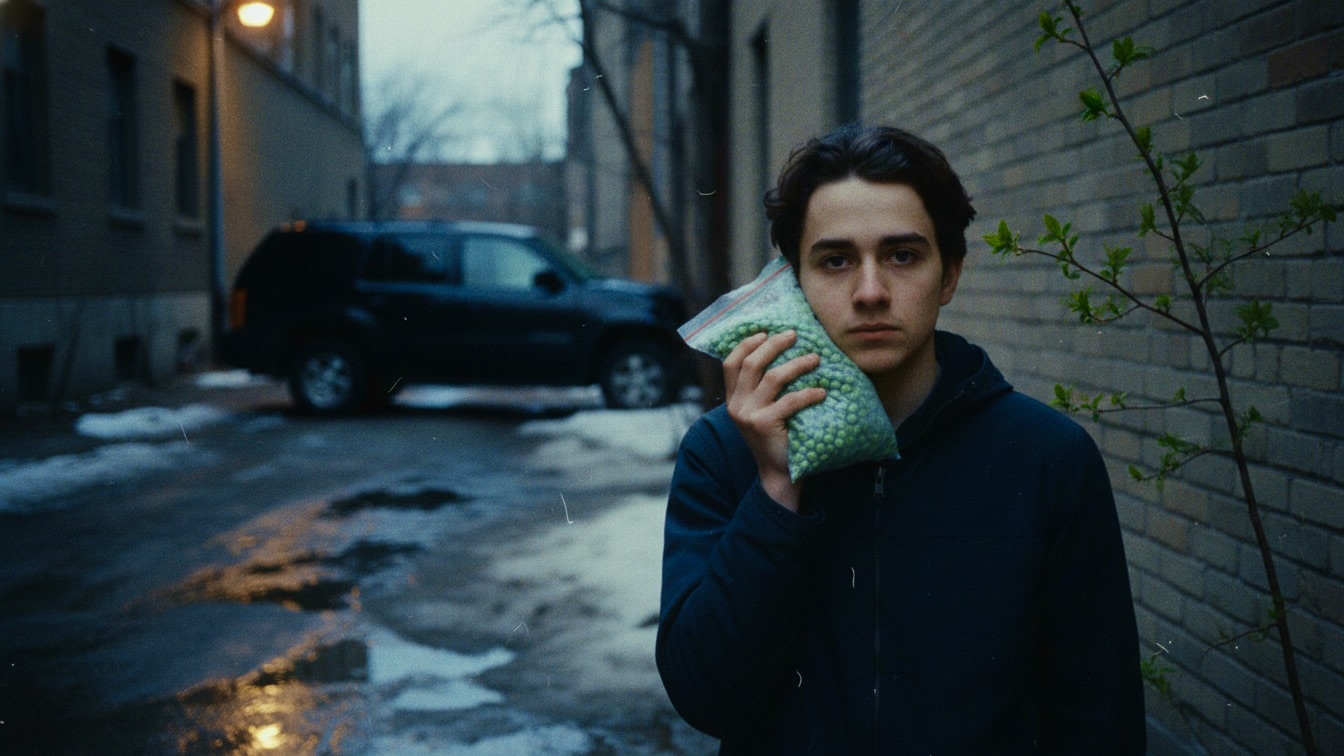
The story follows Oliver and his friend Jay as they stock a community fridge in the North End at one o'clock in the morning. While Jay focuses on capturing the "aesthetic" of their mutual aid for social media, Oliver discovers a brick of high-potency fentanyl hidden inside a bag of frozen peas. This discovery is interrupted by the arrival of Big Mike, a local criminal figure who uses the fridge as a dead drop for drug distribution. Oliver narrowly manages to hide the drugs and deflect Big Mike’s suspicions, though the encounter leaves both boys shaken and aware of the danger they are in.
Refusing to leave the poison for a community member to find, Oliver leads Jay on a frantic retreat through the neighborhood to his home. There, Oliver constructs a decoy brick out of flour and plastic wrap, intending to swap it for the real drugs to buy them safety and time. They return to the fridge during a neighborhood blackout to perform the switch. Oliver confronts Big Mike directly, using the threat of Jay’s recorded footage as leverage to force a tense standoff.
The chapter concludes with Big Mike discovering the flour swap but choosing to retreat for the moment due to the potential digital evidence against him. Oliver is left with the real fentanyl in his backpack and a promise of future retribution hanging over him. Despite the looming threat, he experiences a hollow victory, having cleared the fridge of the immediate danger. He places a single granola bar on the shelf, a small gesture of genuine aid in a landscape dominated by systemic rot and violence.
The central theme of the narrative explores the corruption of communal safe spaces by systemic criminal exploitation. The community fridge, intended as a symbol of mutual aid and "North End" resilience, is literally and figuratively hollowed out to serve as a vessel for the very substances destroying the neighborhood. This juxtaposition highlights the fragility of grassroots activism when it intersects with the brutal realities of the drug trade. The fridge transitions from a source of life-sustaining yogurt to a "bomb" capable of ruining lives, illustrating how poverty-stricken areas are often forced to host their own destruction.
Another prominent theme is the tension between digital performance and physical reality. Jay views their activism through the lens of "grit" and "clout," attempting to curate a specific image of martyrdom for a 2026 audience. Oliver, conversely, is grounded in the visceral, sensory details of the North End, such as the smell of chemicals and the jagged wood of a back fence. The story suggests that while digital leverage can provide a modern form of protection, it is a thin shield against the physical presence of men like Big Mike.
The narrative also delves into the concept of moral responsibility within a "no-win" scenario. Oliver is faced with a choice between self-preservation and the protection of his community. If he leaves the drugs, an innocent person might die; if he takes them, he invites the wrath of a powerful criminal. His decision to engage in a dangerous "shell game" with Big Mike represents a desperate attempt to reclaim agency in a system that offers none. He chooses a path of active resistance, even though it ensures his life will never be the same.
Oliver serves as the pragmatic and observant heart of the story, possessing a deep, cartographic knowledge of his neighborhood’s "scars." As a psychologist might observe, he exhibits a high degree of hyper-vigilance, likely a byproduct of growing up in an environment where safety is a luxury. His primary motivation is protective, extending from his mother’s well-being to the literal survival of the anonymous neighbors who use the fridge. He is a character defined by his hands—cracked, cold, and capable of both feeding and deconstructing the machinery of the local drug trade.
His internal conflict stems from the weight of his own intelligence and his awareness of the stakes. He understands that he is not a "hero" in the cinematic sense Jay desires, but a person making life-and-death calculations in real-time. When he confronts Big Mike, Oliver displays a remarkable "poker face," suppressing his physiological terror to project a sense of strategic dominance. This shift from a "guy moving yogurt" to a calculated negotiator shows his rapid psychological adaptation to crisis. He ends the chapter in a state of somber realization, knowing that his act of defiance has marked him.
Jay functions as a foil to Oliver, representing a generation that mediates its trauma and experiences through a digital interface. He uses irony and cinematic tropes as a psychological defense mechanism to distance himself from the immediate danger of their surroundings. By framing their life-threatening situation as a "final act" or a "heist movie," he attempts to exert control over a reality that is fundamentally uncontrollable. His obsession with lighting and "pathos" suggests a character who is more comfortable with the representation of struggle than the struggle itself.
Despite his superficiality and shaking hands, Jay remains loyal to Oliver, following him into the dark despite his vocal protests. His role as the "cameraman" is crucial, as it provides the only weapon the boys have against Big Mike’s physical power. Psychologically, Jay is dependent on Oliver’s groundedness to navigate the North End, acting as the frantic energy to Oliver’s steady resolve. His realization at the end that they might have "won" shows a lingering naivety about the nature of the world they inhabit.
Big Mike is the embodiment of the predatory forces that capitalize on the vulnerabilities of the North End. He is described not as a monster, but as a man who looks like a legitimate business owner, which makes his flat, reflecting eyes even more chilling. He exerts power through psychological intimidation and his intimate knowledge of the community’s residents. By mentioning Oliver’s mother and her use of the food bank, he demonstrates that his control is not just about violence, but about the total surveillance of the poor.
His reaction to the flour swap reveals a man who values calculation over impulsive rage. He weighs the "hassle" of a police report against the immediate satisfaction of violence and chooses the path that protects his business interests. This cold rationality makes him a formidable antagonist, as he is not driven by emotion but by the maintenance of his territory. His final promise that Oliver must "sleep sometime" is a psychological tether, ensuring that Oliver’s victory remains overshadowed by a permanent state of fear.
The pacing of the narrative is expertly managed, beginning with a slow, atmospheric build that mirrors the "low-frequency hum" of the fridge. The author uses sensory details to ground the reader in the setting, such as the "icy marbles" of the peas and the "vinegar-like" scent of the fentanyl. These details create a visceral sense of place, making the North End feel like a living, breathing entity. The transition from the mundane task of stocking yogurt to the high-stakes chase is marked by a shift in sentence length and urgency.
The tone of the story is "North End Noir," blending the gritty realism of urban poverty with the tension of a thriller. The narrative voice is cynical yet deeply empathetic, capturing the specific weariness of living in a neighborhood where the power grid is a "joke" and the dirt "comes out of hibernation." This voice is consistent throughout, even during the more action-oriented sequences. The use of the blackout as a plot device serves both a functional and a symbolic purpose, plunging the characters into a literal and moral darkness.
Finally, the narrative employs a sharp contrast between the "stylish" deaths of movies and the un-soundtracked reality of the North End. This stylistic choice reinforces the theme of performance versus reality, stripping away any romanticism from Oliver’s actions. The ending is intentionally ambiguous, refusing to grant the characters a clean resolution. This lack of closure mirrors the reality of community activism in high-crime areas, where one night’s success does not guarantee a safer tomorrow.


