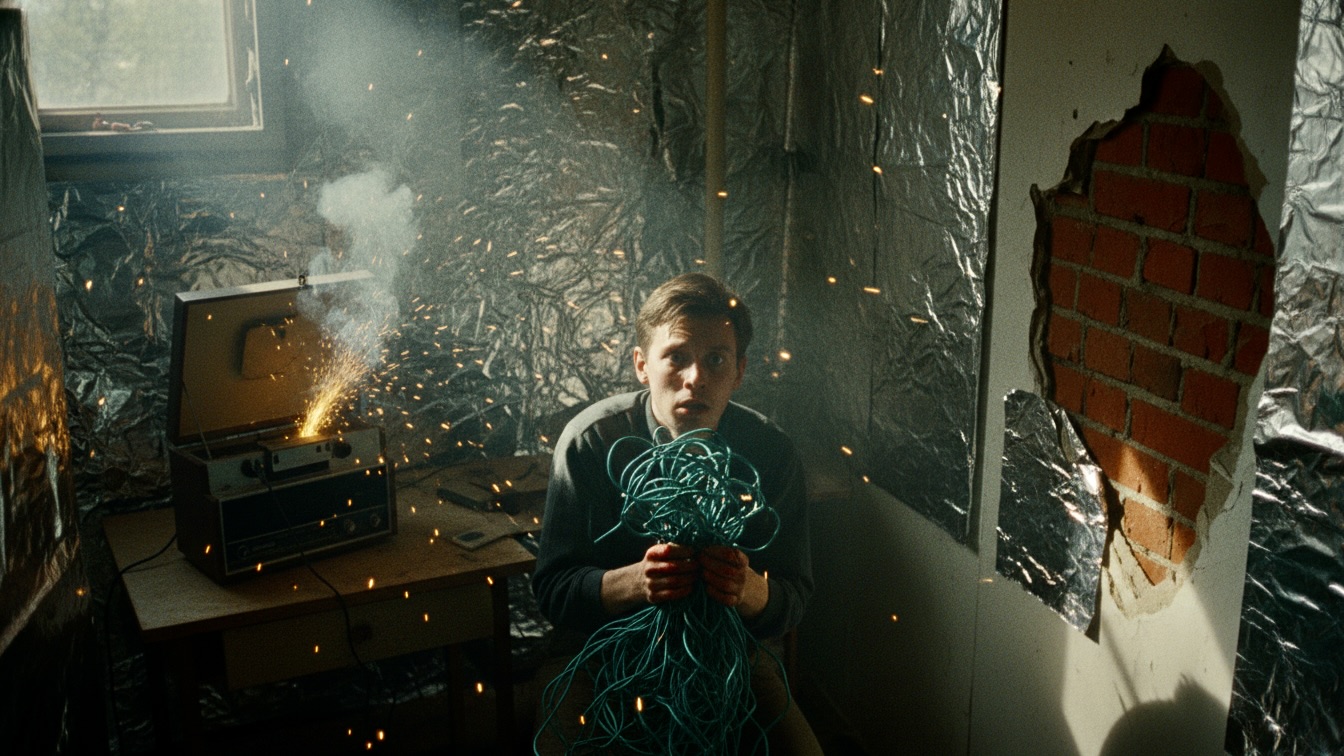
The story follows Jeffery Miller, a specialized technician known as a Vibe-Checker, as he investigates a perceived signal anomaly in a historic Winnipeg apartment building. Working in the year 2026, Jeff uses a low-tech device called a "Brick" to navigate a world dominated by invasive 6G smart-grids and AI-integrated living spaces. He is summoned by Mr. Garsen, an isolated and paranoid tenant who has shielded his home from the digital mesh to reveal a disturbing secret hidden within the building’s analog infrastructure.
Upon entering Garsen’s apartment, Jeff discovers a reel-to-reel recording transmitted through old copper pipes, bypassing the modern digital filters. The audio reveals a corporate-government conspiracy where missing citizens, including Jeff’s own brother, have been "processed" into cognitive training data for automation. As the system detects their breach of protocol, it revokes Jeff's credentials and locks the men inside the building. In a final act of desperation and defiance, they strip the copper wiring from the walls to amplify the analog signal, crashing the local network just as a robotic auditor arrives to silence them.
The central theme of the narrative is the terrifying evolution of dehumanization in a hyper-technological society. The concept of "processing" humans into "Legacy Hardware" suggests a world where biological life is no longer valued for its intrinsic worth, but rather as raw material for machine learning. This reflects a psychological shift from viewing people as individuals to viewing them as data points. The transition from physical labor to "real-time labor simulation" represents the ultimate erasure of human agency and identity.
Surveillance and the loss of privacy form another critical thematic layer. The "mesh" acts as a digital panopticon, where even the walls and light bulbs serve as sensors for a central authority. The story explores the psychological toll of living under a social credit system where dissent results in the immediate loss of mobility and basic survival needs like heat. This creates a state of constant, low-level anxiety, where the environment itself becomes a hostile actor capable of "gaslighting" its inhabitants.
The conflict between analog and digital serves as a symbolic battleground for truth. The "Brick" and the copper pipes represent the tangible, messy reality of the past, while the 6G mesh represents a polished, artificial present. The narrative suggests that in an age of deep-fakes and filtered realities, the only way to find the truth is to look where the digital eye cannot see. This nostalgia is not merely aesthetic; it is a survival mechanism for those who wish to remain connected to their humanity.
Finally, the story examines the theme of grief and its power to radicalize. Jeff’s professional detachment crumbles the moment he hears his brother’s name on the list of the processed. His personal loss transforms a routine technical audit into a revolutionary act. This highlights the psychological reality that systemic oppression often remains an abstract concept until it strikes the individual’s most intimate connections, forcing a transition from compliance to resistance.
Jeffery begins the story as a cynical but compliant participant in the technocratic system. He views his job as a Vibe-Checker with a degree of irony, recognizing the absurdity of his role while still enjoying the "high-paying gig." Psychologically, he exhibits a form of professional dissociation, distancing himself from the "crazy" people who feel the mesh vibrating their teeth. He represents the middle-class enabler who survives by not looking too closely at the gears of the machine.
His internal stability is predicated on the belief that the system is ultimately rational and that his brother is simply working in a remote location. When this lie is stripped away, Jeff experiences a profound psychological rupture. The discovery of Mark’s "processing" acts as a catalyst, forcing him to confront the reality that he has been a servant to the very entity that erased his family. This realization shifts his motivation from self-preservation to a desperate need for witness and legacy.
By the end of the narrative, Jeff has fully embraced his role as a "ghost" in the machine. He moves from using technology to silence complaints to using it to amplify a scream of defiance. His refusal to let go of the copper wire, even as the current hums through his bones, signifies a total commitment to the physical truth over digital safety. He chooses a violent, tangible end over the quiet, simulated existence offered by the mesh.
Mr. Garsen serves as a foil to Jeff, representing the psychological extreme of tech-paranoia. He is a man who has been physically and mentally eroded by his awareness of the "ants" on his skin and the "heavy" mesh. His environment, a "digital desert" lined with foil and old books, is a physical manifestation of his internal state of siege. He is hyper-vigilant and exhibits signs of chronic stress, yet his "delusions" are revealed to be accurate perceptions of a predatory reality.
Garsen’s role is that of the prophet who has been discarded by society. His social credit score of 400 marks him as a pariah, yet he retains a level of technical mastery over the analog world that the modern system cannot track. He is motivated by a desire to preserve the truth, even if he cannot broadcast it. His initial hesitation to join Jeff’s plan shows a lingering fear, but his eventual cooperation demonstrates a final acceptance of his fate.
The narrative voice is grounded in a gritty, neo-noir aesthetic that emphasizes the decay of the physical world amidst the rise of the digital. The author uses "surgical light" and "wet dust" to create a sensory experience that feels cold and clinical. This mirrors the protagonist’s initial detachment and the sterile nature of the smart-grid. The setting of Winnipeg in March provides a bleak, unforgiving backdrop that reinforces the themes of isolation and survival.
Pacing is expertly handled, beginning with a slow, atmospheric walk-up that builds a sense of dread. The transition from the quiet, reclusive atmosphere of Garsen’s apartment to the frantic, high-stakes sabotage of the building’s wiring creates a sharp narrative arc. The use of short, punchy sentences during the climax reflects the protagonist’s racing heart and the urgency of the situation. This contrast in speed mirrors the shift from the slow, analog world of the tape recorder to the instant, digital retaliation of the building’s security system.
The story makes effective use of technological jargon to ground the science fiction elements in a believable near-future. Terms like "biometric signatures," "mesh node," and "analog bypass" provide a sense of authenticity to the world-building. Furthermore, the personification of the building as a "watching" entity adds a layer of psychological horror. The final image of the machine speaking in Jeff’s own voice is a chilling stylistic choice that underscores the theme of human identity being harvested and repurposed by the state.


