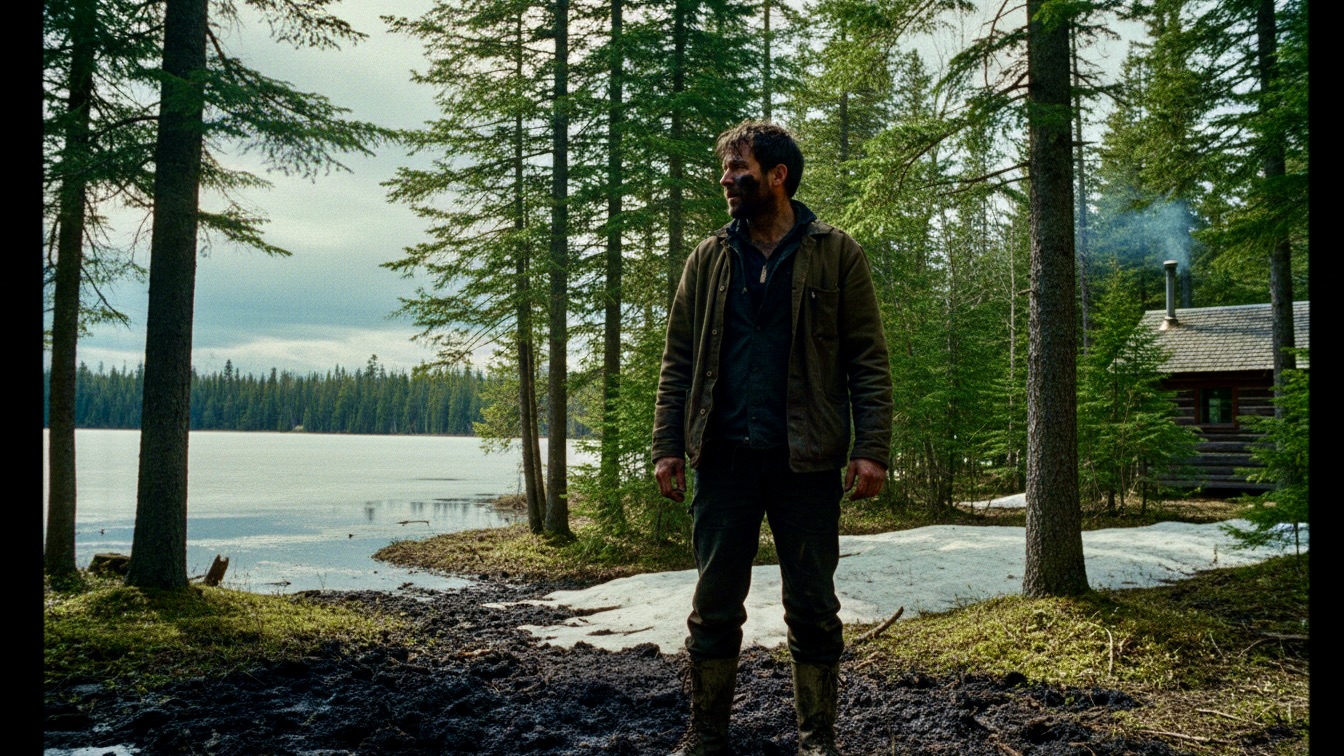
The story follows Andy, a former city dweller who has retreated to his family cabin in the wilderness following a mental health crisis. Upon his arrival, he struggles to extract his SUV from the deep, freezing mud of his driveway, a task that forces him to confront his lack of practical survival skills. He is assisted by Cathy, a local who represents the grounded, resilient life he abandoned years ago. Through the grueling physical labor of freeing the vehicle and the subsequent repair of the property, Andy begins to shed his corporate identity. The chapter concludes with Andy embracing the slow, deliberate rhythm of the natural world, finding a sense of purpose in the tangible work of maintaining his home.
The central theme of this narrative is the reconciliation between the artificial, frictionless life of the modern professional and the raw, demanding reality of the natural world. Andy’s journey from a Toronto high-rise to the mud of Kenora serves as a metaphor for the human need for groundedness. The mud itself acts as a threshold, representing the suffocating weight of his past failures and the resistance he must overcome to re-enter a state of authentic living.
Another prominent theme involves the generational transition of responsibility. When Andy enters the shed and smells the familiar scents of his father’s past, he realizes that he has inherited not just a property, but a legacy of maintenance. He moves from being a passive consumer of services to an active steward of his own environment. This transformation signifies a rejection of the ephemeral nature of digital work in favor of the permanence of physical labor.
Finally, the story explores the concept of healing through struggle. Cathy’s warnings about the violence of the ice break emphasize that growth is often a chaotic, loud, and difficult process. Andy finds solace in this violence, preferring the honest ache of physical exhaustion over the hollow, numbing peace of his city existence. The small green shoot he discovers at the end of the chapter reinforces the idea that life, much like his own recovery, is a persistent force that thrives despite harsh conditions.
Andy is a man in the midst of a profound existential pivot, characterized by a deep-seated fatigue with his previous life. His initial incompetence with the winch reveals a man who has become detached from his own physical capability, relying entirely on the systems of urban convenience. He carries the trauma of his breakdown in his silence, masking his professional collapse under the guise of a sabbatical. As the story progresses, his internal state shifts from one of brittle anxiety to a quiet, determined clarity.
His motivation is not merely to escape his job, but to find a version of himself that feels real again. Andy is deeply introspective, constantly comparing his current physical sensations to the sterile, automated nature of his former life. By the end of the chapter, his decision to stop checking his digital devices and start repairing his roof signals a full commitment to his new reality. He is no longer looking for an exit strategy, but rather a foundation upon which he can finally stand.
Cathy functions as a foil to Andy, representing the wisdom of someone who has remained in harmony with the land. She is characterized by her skepticism, which serves as a necessary anchor for Andy’s romanticized, and perhaps naive, expectations of his return to nature. Her bluntness is not an act of cruelty, but a form of tough love that prevents Andy from succumbing to his own incompetence. She understands the land’s rhythm and acts as the gatekeeper who ensures that Andy respects the environment rather than trying to dominate it.
The narrative voice is intimate and sensory, deeply rooted in the physical experience of the protagonist. The author utilizes a stark, visceral vocabulary—words like "grit," "slush," "groaned," and "sharp"—to ground the reader in the cold, unforgiving atmosphere of the Canadian bush. This sensory focus emphasizes the contrast between the city, which is described as secondhand and airy, and the woods, which are described as heavy, urgent, and raw.
The pacing of the chapter mirrors the transition from the frantic energy of a corporate burnout to the slow, intentional work of the wilderness. Early scenes are characterized by the jagged, frustrated movements of a man struggling against his own limitations. As the narrative progresses, the tempo settles into a rhythmic, steady cadence that reflects the manual labor Andy performs with Ben. The prose becomes more fluid as Andy finds his footing, mirroring his internal alignment.
The tone is one of tempered optimism, avoiding the pitfalls of overly sentimental nature writing. By highlighting the "violent" nature of the ice breaking and the danger of the work involved, the author maintains a grounded, realistic perspective. The dialogue is sparse and utilitarian, reflecting the characters' preference for action over empty communication. This stylistic choice effectively conveys the shift from a world of performative, digital chatter to a world where words are used only when necessary.


