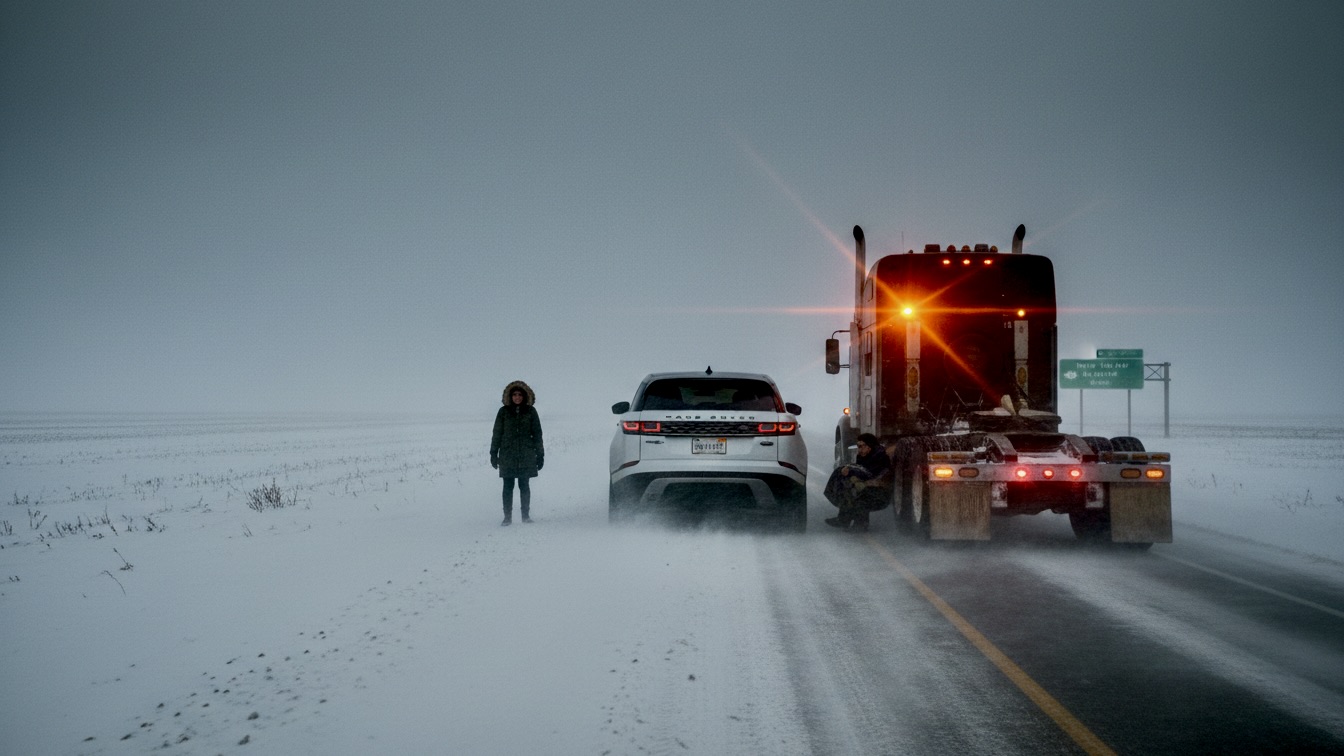
The story follows Penny and her cousin Tommy as they become stranded in a brutal Manitoba blizzard. Tommy, an aspiring influencer obsessed with "high-vibration" aesthetics, refuses to stop at several gas stations because they do not align with his spiritual brand, eventually causing their SUV to run out of fuel. As the temperature drops and the reality of their life-threatening situation sets in, Tommy attempts to maintain his performative persona through breathing exercises and digital manifestation.
The tension reaches a breaking point when a semi-truck stops, and Tommy tries to barter Penny’s laptop—her sole means of livelihood—for a ride to the next town. Penny intervenes, displaying a cold and calculated pragmatism that stands in stark contrast to Tommy’s desperation. She manages to purchase a small amount of fuel from the trucker using her own money, rejecting Tommy's attempt to turn the moment into social media content.
After successfully refueling and starting the vehicle, Penny drives to the nearest town of Elie. There, she finally breaks the cycle of enablement that has defined her relationship with her family. She forces Tommy out of the car at a coffee shop, reclaiming her property and her autonomy. The chapter concludes with Penny driving away alone, finally free from the parasitic weight of Tommy’s delusions.
The central theme of the narrative is the violent collision between performative digital identity and the unforgiving reality of the physical world. Tommy represents a modern archetype who views the world through a curated lens, prioritizing "vibes" and "energy" over the tangible necessities of survival. The blizzard acts as a Great Equalizer, a force of nature that does not respond to hashtags or manifestation. This conflict highlights the fragility of an identity built entirely on the validation of a digital audience.
Another significant theme is the exhaustion of the "reliable" family member and the eventual collapse of enablement. Penny has spent her life functioning as the structural support for the "dreamers and drifters" in her family. Her internal journey is not one of fear, but of anticipation for the moment when the illusions of those around her finally shatter. The story explores the psychological threshold where a caretaker decides to stop absorbing the consequences of another person’s incompetence.
The narrative also critiques the commodification of spirituality. Tommy uses the language of mindfulness and "pranic friction" not for personal growth, but as a tool for manipulation and a shield against accountability. When he attempts to trade Penny's laptop, he reveals that his "high-vibration" philosophy is merely a thin veil for a profound lack of empathy. The story suggests that true competence is a form of integrity that performative spirituality cannot replicate.
Finally, the story touches on the theme of autonomy through ownership and boundaries. The SUV, the laptop, and the fifty-dollar bill are all instruments of Penny's agency. By asserting her legal and financial right to these objects, she strips Tommy of his power. Her refusal to be a "prop" in his digital narrative is the ultimate act of self-preservation, signifying her transition from a passenger in her own life to the driver.
Penny is defined by a weary, hyper-competent pragmatism that masks a deep-seated resentment toward her family. As a freelance worker who has sacrificed her independence to help her grandmother, she represents the "burden of the sane." Her psychological state is characterized by a "strange, cold clarity" rather than panic. She does not fear the blizzard as much as she welcomes the opportunity to see Tommy’s facade crumble under the weight of his own choices.
Her motivation is rooted in a desire for truth, even if that truth is dangerous. She has reached a psychological breaking point where the "internal clock" in her chest demands a resolution to the years of enabling Tommy’s behavior. When she refuses to let him trade her laptop, she is not just protecting a piece of hardware; she is protecting her dignity and her future. This moment marks her transition from a silent observer to a decisive actor who reclaimed her life.
By the end of the chapter, Penny experiences a profound sense of catharsis. Her decision to leave Tommy in Elie is not an act of cruelty, but a necessary surgical separation. She recognizes that his survival is no longer her responsibility, and her "high-vibration" act is to finally prioritize her own well-being. The "clean air" she feels at the end of the story symbolizes the removal of the toxic influence that Tommy exerted over her environment.
Tommy is a psychological study in narcissism and arrested development. He is twenty-four years old but remains emotionally infantile, relying on a script of influencer jargon to navigate a world he does not understand. His tripod is described as a "parasite," a metaphor that extends to his relationship with Penny. He views other people only in terms of how they can serve his narrative or provide him with "content."
His primary defense mechanism is denial, which he cloaks in the language of New Age spirituality. When faced with the literal threat of freezing to death, he retreats into breathing exercises and "manifestation" rather than taking practical action. This behavior reveals a profound disconnection from reality, where he believes his internal state can dictate external physical laws. His "influencer mask" is his only protection against the terrifying realization of his own inadequacy.
The true nature of his character is exposed when he attempts to steal Penny's laptop to save himself. In this moment, his "Midweek Mindfulness" persona vanishes, revealing a "small, scared thief." He is incapable of genuine gratitude or remorse, as evidenced by his attempt to "forgive" Penny for her supposed trauma even as she is saving his life. He exits the story as a "ghost" in the rearview mirror, a man who has lost his audience and, consequently, his sense of self.
The pacing of the story mirrors the escalating tension of the blizzard and the mechanical failure of the car. The narrative begins with a slow, atmospheric build-up, emphasizing the sensory details of the "cedar-scented vape juice" and the "flat, white scream" of the prairie. As the SUV dies, the prose becomes more rhythmic and percussive, reflecting the "hacking cough" of the engine and the "relentless" hammering of the wind. This shift creates a sense of claustrophobia that heightens the psychological stakes.
The author employs vivid, often harsh imagery to emphasize the cold and the isolation of the setting. The description of the world as a "bowl of milk" and the characters as "flies at the bottom of it" effectively conveys their insignificance in the face of nature. The use of metallic and clinical metaphors—such as the "metallic tang of a dying heater" and the "No Service" icon being a "death sentence in a font he didn't recognize"—adds a layer of modern dread to the traditional survival narrative.
The narrative voice is anchored in Penny’s perspective, providing a cynical and grounded lens through which to view Tommy’s antics. This choice of focalization allows the reader to feel the weight of Penny’s frustration and the sharpness of her observations. The contrast between Tommy’s "oily" dialogue and Penny’s quiet, "white-hot spike of clarity" creates a linguistic divide that mirrors their psychological separation. This stylistic choice ensures that the reader remains aligned with Penny’s eventual decision to abandon him.
Finally, the sensory details of the ending provide a sharp contrast to the beginning of the story. The "clean air" and the "salted pavement" represent a return to the "hard and perfectly real" world that Penny craves. The transition from the "blurred, crystalline prison" of the frosted windows to the "clear" view provided by the wipers serves as a metaphor for Penny’s newfound perspective. The story ends on a note of stark realism, eschewing a sentimental resolution in favor of a cold, necessary truth.


