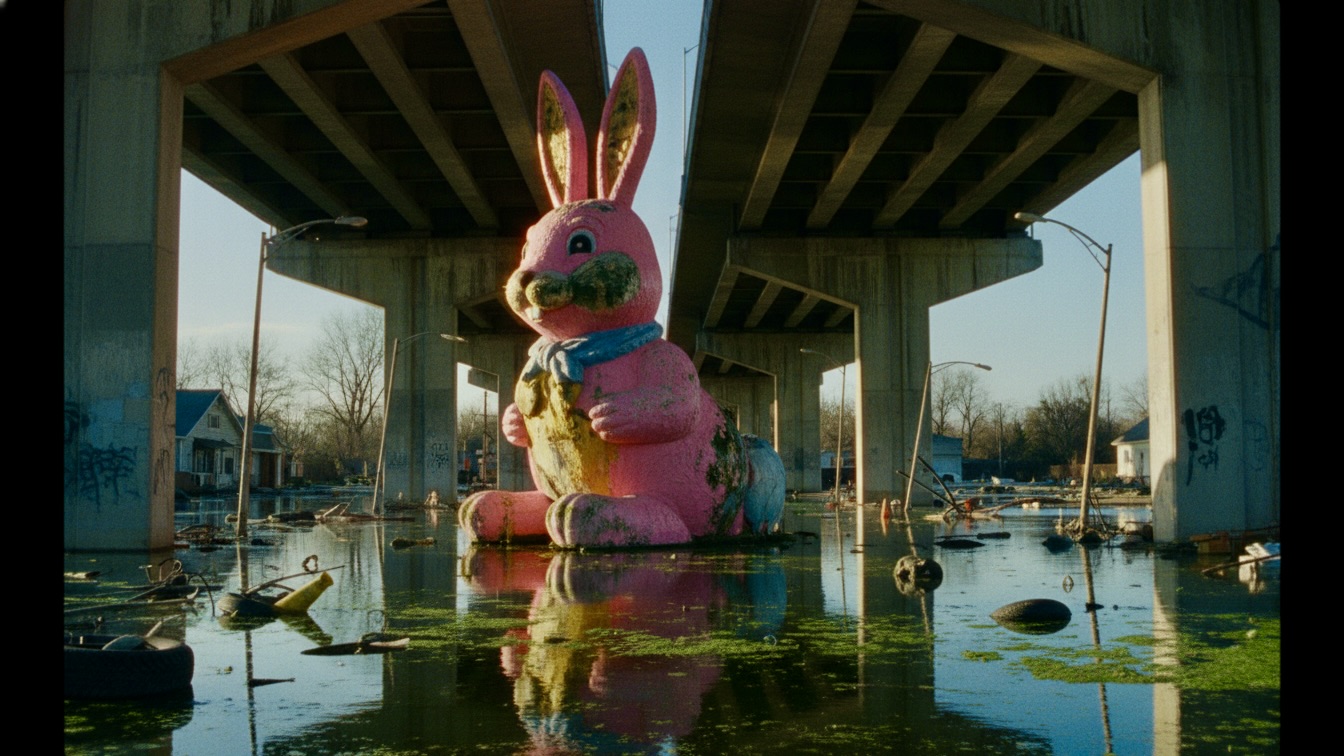
The story opens in a bleak, transitional spring landscape where the protagonist, Dave, and his friends Mimi and Toby are languishing in the suffocating boredom of their suburban town. Dave, desperate to escape the "vicious, stupid cycle" of their existence and reclaim what he calls "main character energy," convinces his reluctant companions to seek out a rumored rave at a distant water treatment plant. Because Toby’s car is incapacitated, Dave leads them to a municipal storage lot where they discover a decaying, twelve-foot-tall fiberglass Easter Bunny parade float.
Despite Toby’s intense anxiety and practical objections, he successfully hotwires the grotesque vehicle, and the trio embarks on a slow, surreal journey through the flooded streets. Along the way, they pick up a strange hitchhiker named Gary and narrowly avoid detection by a police cruiser by hiding in a narrow alley. The tension of the heist briefly transforms their mundane reality into a high-stakes adventure, fulfilling Dave's desire for a narrative shift in his life.
Upon arriving at the viaduct, the group discovers that the rave was a fabrication or a failure, leaving them in a silent, flooded wasteland. Gary wanders off into the dark, and the initial excitement of the mission collapses into a somber realization of their circumstances. However, the friends decide to climb to the top of the giant rabbit's head to watch the sunrise. In this final moment of quietude, the absurdity of their act provides a sense of communal victory and meaning, which is abruptly interrupted by the sound of an approaching vehicle.
The central theme of the narrative is the struggle against existential ennui and the desperate quest for agency in a stagnant environment. The protagonist’s obsession with "main character energy" reflects a modern psychological yearning to feel significant in a world that feels increasingly automated and dull. By stealing the parade float, the characters are not just seeking a party; they are attempting to hijack the narrative of their own lives. The "vicious, stupid cycle" of the weather serves as a metaphor for their social and economic stagnation, which they briefly break through an act of absurd rebellion.
Another prominent theme is the subversion of traditional symbols of renewal and innocence. Spring is described not as a time of birth, but as a "season of wet socks and gray skies," and the Easter Bunny is reimagined as a moldy, terrifying monolith with a missing ear. This imagery suggests that the promised "renewal" of adulthood or the changing seasons is a hollow promise for the characters. The fiberglass rabbit, once a symbol of community celebration, becomes a vessel for a "mild felony," illustrating how the characters must repurpose the wreckage of their environment to find any sense of movement.
The story also explores the concept of the "Found Absurd" as a form of spiritual or emotional refuge. The rave itself is a MacGuffin—a hollow goal that serves only to set the plot in motion. The true value of the night is found in the shared experience of the ridiculous, such as driving a two-ton rabbit through a flooded suburb at fifteen miles per hour. This suggests that in a "dead town," meaning is not something one finds at a destination, but something one creates through the sheer will to do something illogical and memorable.
Dave serves as the primary catalyst for the story’s events, driven by a deep-seated psychological need to escape the feeling of invisibility. He is acutely aware of his age and the perceived lack of progress in his life, which manifests as a frantic, almost aggressive optimism regarding the rave. His decision to steal the float is not born of criminal intent, but of a desperate desire to feel "sharp and defined" against the gray backdrop of his town. He is the visionary of the group, though his visions are often grounded in the unreliable information of social outcasts like Scab.
Psychologically, Dave is grappling with the fear of being a "non-player character" in his own existence. He equates movement with meaning, which is why the slow pace of the rabbit float is such a poignant irony. He is willing to ignore the physical discomfort of the rain and the very real threat of legal consequences because the alternative—sitting on wet concrete outside a closed gas station—is emotionally unbearable. By the end of the story, his smile indicates that he has achieved a temporary internal resolution, finding a sense of victory in the absurdity he orchestrated.
Mimi functions as the group’s cynical realist, yet she is surprisingly the first to support Dave’s reckless plan. Her "harsh, barking laugh" and constant smoking suggest a defensive layer of detachment used to cope with her environment. While she mocks Dave’s complaints, she admits to being "bored enough to risk a mild felony," indicating that her cynicism is merely a different reaction to the same crushing ennui that plagues Dave. She provides the necessary social validation for Dave’s madness, turning his solitary whim into a group mission.
Her character shows a high degree of adaptability and a lack of fear regarding social or legal boundaries. She is the one who suggests climbing the rabbit at the end, demonstrating that she, too, finds value in the elevated perspective the float provides. Mimi does not need the "main character" label as much as Dave does, but she craves the sensory disruption of the heist. Her quiet acceptance of the failed rave shows a resilience that suggests she is accustomed to disappointment and has learned to find beauty in the ruins.
Toby represents the voice of reason and the physical labor required to sustain Dave’s fantasies. He is the most grounded of the trio, evidenced by his focus on immediate needs like food and warmth, and his genuine fear of "federal prison." His reluctance to hotwire the float stems from a practical understanding of consequences that his friends seem to lack. However, his eventual compliance reveals a deep loyalty to his peers and a hidden desire to be part of something larger than his mundane daily routine.
Throughout the journey, Toby experiences the highest level of stress, yet he is also the one who eventually validates the experience as the "best Tuesday ever." His transformation from a shivering, hot-dog-eating bystander to the pilot of a stolen fiberglass rabbit marks a significant arc. He provides the technical skill that turns Dave's abstract "plan" into a physical reality. His shaking hands on the steering wheel highlight the high emotional cost of his participation, making his final moment of peace on top of the rabbit’s head all the more earned.
Gary is a brief but vital addition to the narrative, serving as a mirror for the absurdity of the trio's situation. As a hitchhiker who believes a giant rabbit is a "rave shuttle," he embodies the total breakdown of logic that occurs in the industrial park. His flat delivery and strange comments about "rats learning to swim" suggest a character who has already been fully subsumed by the weirdness of the town. He represents a potential future for the protagonists—someone who has moved past the need for "main character energy" and simply exists within the surreal.
His departure into the knee-deep black water without a word of thanks or a clear destination emphasizes the transience of the night. Gary doesn't care about the lack of a rave; he is "peaking" and simply needs to keep moving. For Dave and the others, Gary is a signifier that they have successfully entered a different world, one where the normal rules of social interaction and logic no longer apply. His presence validates the "weirdness" they were seeking, even if he himself is a harbinger of the town's decay.
The narrative voice is characterized by a gritty, sensory-heavy realism that heightens the impact of the surreal elements. The author uses visceral descriptions—"wet socks," "oily rainbow water," and "wet dog and stale tobacco"—to ground the reader in the physical misery of the setting. This makes the appearance of the "twelve-foot-tall fiberglass Easter Bunny" feel jarring and hallucinatory. The contrast between the mundane filth of the gas station and the bruised, peeling pink of the float creates a visual style that mirrors the "ugly-beautiful" aesthetic of the story's conclusion.
Pacing is expertly handled, beginning with a slow, heavy stagnation that mirrors the characters' boredom. The tempo increases during the hotwiring scene and the drive through the suburbs, using short, punchy sentences to convey Toby’s panic and Dave’s adrenaline. The tension peaks during the encounter with the police cruiser, where the silence and "jagged shadows" create a cinematic atmosphere. This high-speed energy then dissipates into a lingering, atmospheric stillness once they reach the viaduct, allowing the emotional weight of the sunrise to land effectively.
The use of color and light is a recurring stylistic motif that tracks the emotional journey of the characters. The story begins in a world of "gray skies" and "brown, soggy" mud, lit only by "fluorescent lights" and "flickering streetlights." As the night progresses, the light becomes more theatrical, with "orange flares" from cigarettes and "red and blue" police flashes. The final transition to the "reflective gold" of the sunrise signifies a shift in perception. The world has not changed, but the light in which the characters see it has been transformed by their actions.


