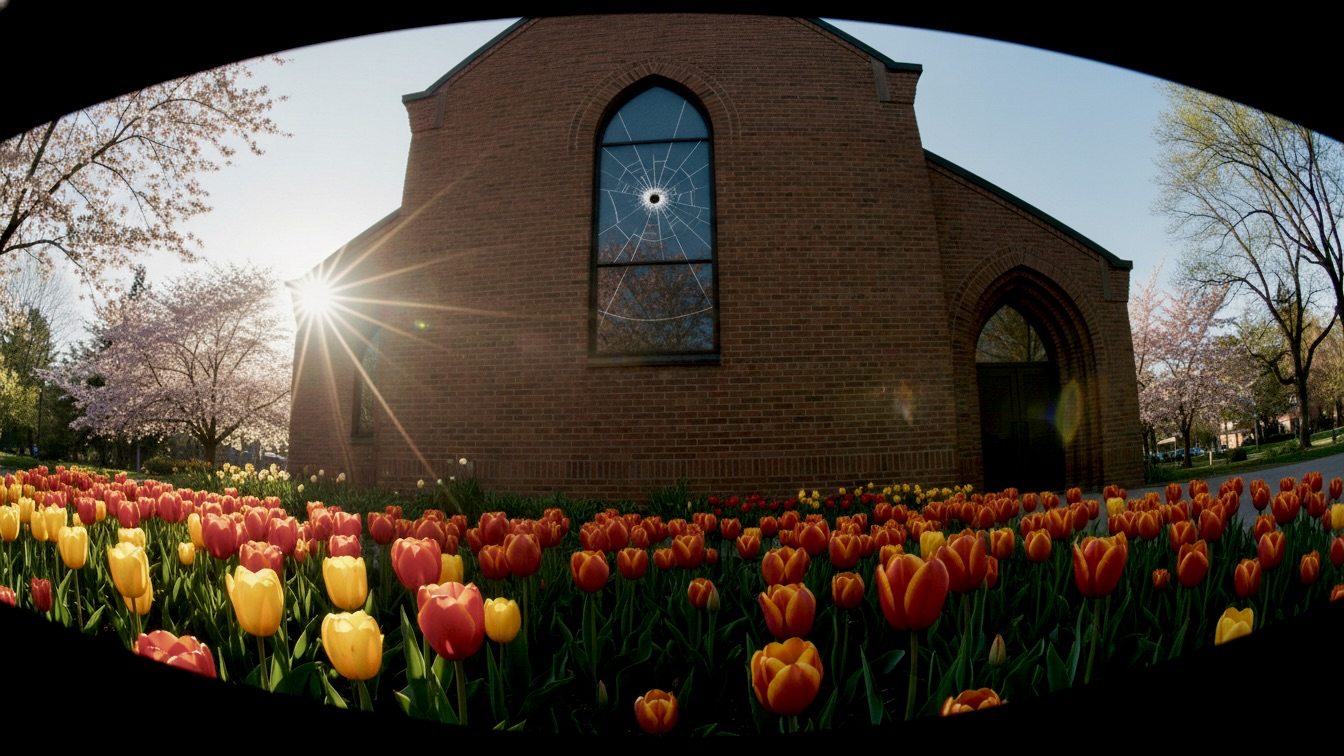
The story follows Mark, an observant and anxious security coordinator, as he discovers a bullet hole in the glass of a synagogue in Toronto. Despite his warnings, the event organizer, Annette, insists on proceeding with an intercultural reconciliation ceremony, viewing it as a necessary act of defiance against those who threaten their community. As the event progresses, Mark becomes increasingly aware of being watched by a hostile, organized group. He eventually leaves the safety of the synagogue to pursue a suspicious figure into the nearby park, only to be lured into a trap. The chapter concludes with Mark being incapacitated, leaving the congregation inside blissfully unaware of the imminent danger lurking just outside their doors.
The narrative explores the fragility of modern civil society when confronted by the cold, calculated nihilism of extremist violence. The synagogue acts as a microcosm of a peace-seeking community attempting to maintain a facade of normalcy while the structural integrity of their security is systematically compromised. The contrast between the aesthetic beauty of the spring season and the violent reality of the threat highlights a central theme of cognitive dissonance. The characters struggle to reconcile their belief in a moral, ordered world with the chaotic and predatory nature of the "Northern Vanguard," who view the community as a target to be harvested.
The tension between romantic idealism and cynical realism drives the plot toward its inevitable conclusion. Annette represents the human need to uphold institutional dignity and hope, using theatricality as a protective mechanism against despair. In contrast, Mark embodies the burden of hyper-vigilance, recognizing that the "moral arc" is often a fiction that fails to protect the vulnerable from physical harm. This disconnect between those who maintain the hope of dialogue and those who witness the encroaching darkness creates a profound sense of foreboding that permeates the entire scene.
Mark is a man defined by his role as a sentinel, forced to bear the weight of a reality that others choose to ignore. His internal state is characterized by a persistent, vibrating anxiety that stems from his deep understanding of the digital and physical threats facing his community. He is motivated by a protective instinct toward the people inside the synagogue, yet he feels increasingly isolated by his awareness of the impending danger. His trauma is not merely a memory of the past, but a functional, ongoing assessment of a world that he views as fundamentally hostile.
His conflict arises from the necessity of being the "adult in the room" while others, like Annette, cling to the comfort of ritual and tradition. Mark feels the exhaustion of a man who knows the locks are insufficient but lacks the power to change the fundamental trajectory of the events. His final decision to leave the synagogue is a desperate, flawed attempt to confront the shadow that haunts him. By chasing the assailant, he moves from a state of passive observation to an active, albeit doomed, engagement with his enemy, ultimately sacrificing his safety in a futile attempt to make the abstract threat tangible.
Annette functions as the emotional anchor of the synagogue, driven by an unwavering commitment to the narrative of reconciliation. Her primary motivation is the preservation of order and the performance of peace, which she believes is the only way to resist those who seek to silence them. She perceives the threat not as a physical reality to be feared, but as a logistical obstacle to be managed or a symbolic challenge to be overcome. Her shaking hands suggest a hidden depth of fear, yet she chooses to prioritize the image of defiance over the practical reality of danger.
Kareem serves as a pragmatist who bridges the gap between Mark’s grim realism and Annette’s hopeful idealism. He recognizes the inherent danger of their situation, yet he chooses to participate in the defense of the community through collective presence. His motivation is rooted in a shared recognition of damage and a desire to stand in solidarity against a common adversary. By bringing his own men to the event, he acknowledges that the "bridge" they are building is not merely metaphorical, but one that requires physical strength and vigilance to maintain.
The pacing of the narrative is deliberate and suffocating, mirroring the slow, rhythmic encroachment of the threat on the sanctuary. The author utilizes short, punchy sentences to convey Mark’s heightened state of alertness and the clinical precision of the violence he investigates. This staccato rhythm slows down during moments of reflection, allowing the reader to inhabit Mark’s internal exhaustion and his fixation on the small, unsettling details of his environment.
The sensory details are particularly effective in establishing the tone of dread. The contrast between the "aggressively bright" spring morning and the "stagnant" air inside the synagogue creates a jarring dissonance. By focusing on the physical, such as the smell of floor wax, the rhythmic clicking of paper, and the visual of a bullet as a "spent bug," the author anchors the abstract threat in the tangible world. The recurring motif of silence—the birds stopping, the lack of wind—serves as an auditory shorthand for the presence of the predator, effectively isolating the characters from the vibrant, oblivious world of the joggers just outside the walls.


