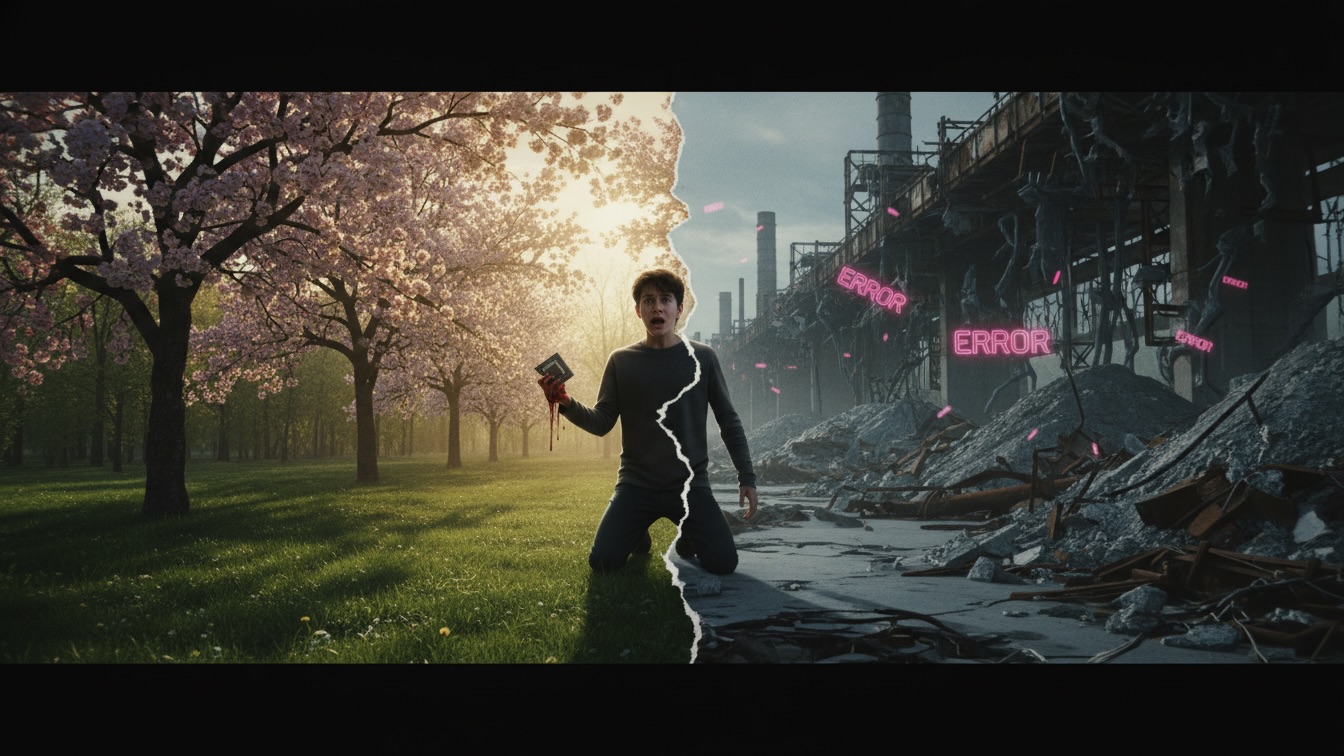
The story follows a teenager named Benji who makes the radical decision to disconnect from a pervasive augmented reality system known as the neural-link. Despite the frantic protests of his friend Toby, who warns him of the psychological and social consequences of going "offline," Benji forcibly removes the neural-patch from the base of his skull. The immediate transition is a violent sensory shock, as the beautiful, curated digital overlay of his life vanishes to reveal a grim, decaying reality. He finds himself in a cramped, filthy room rather than a luxury loft, and his friend Toby is revealed to be a sickly, pale boy instead of a glowing avatar.
Driven by a desperate need to see the "base layer" of the world, Benji ventures outside into a suburban landscape that has been entirely reclaimed by industrial rot and toxic waste. The "premium" woods he once enjoyed are exposed as a dumping ground for chemical runoff, where the local government can no longer even afford to maintain the digital illusion. As the physical environment begins to glitch and the very ground seems to un-render into a digital void, Benji faces a crushing existential crisis. The chapter ends with him standing on the edge of a literal and metaphorical abyss, holding his bloody neural-patch and contemplating a return to the comfort of the digital lie.
The primary theme of the narrative is the tension between manufactured comfort and the horrifying truth of environmental collapse. The "premium grass" mentioned in the title serves as a metaphor for a society that has chosen to commodify perception rather than preserve the physical world. By placing a paywall behind the appearance of nature, the ruling entities have effectively replaced the ecosystem with a subscription service. This suggests a future where the elite or those who can afford "local taxes" are granted the privilege of a beautiful hallucination while the physical earth is treated as a disposable waste site.
Another significant theme is the psychological fragility of a population raised on digital dopamine. Toby’s reaction to Benji’s disconnection is not one of curiosity, but of genuine, visceral terror. He views the real world as a "hallucination" or a "crash," indicating that the digital overlay has become the primary reality for this generation. This inversion of truth highlights how technology can be used as a tool for social control, where the fear of "withdrawal" or being "flagged for proximity" keeps the citizenry tethered to a false, sanitized existence.
Finally, the story explores the theme of the "Death of the Real," as popularized by postmodern theorists. The characters are living in a simulacrum where the copy of the world—the "Spring Showers event" or the "retro-suburban utopia"—has completely replaced the original. When the servers begin to fail and the "texture-map" peels away, the characters are left with nothing. The void that opens up at the end of the story represents the ultimate consequence of neglecting the physical in favor of the digital: a total collapse of meaning and existence.
Benji is a protagonist defined by his burgeoning cognitive dissonance and a desperate, almost self-destructive pursuit of authenticity. He is no longer satisfied with the "auto-EQ filtering" of his life and exhibits the classic symptoms of an individual waking up from a collective trance. His decision to rip the patch off, causing physical injury to himself, suggests that his internal psychological pressure had reached a breaking point. He represents the human instinct to seek the truth, even when that truth is objectively worse than the lie he has been fed since birth.
Psychologically, Benji is undergoing a massive trauma as his brain struggles to process the "base layer" without the assistance of motion-assist software and temperature regulation. His journey to the woods is a pilgrimage to the heart of his world's deception, and the resulting panic attack is a natural reaction to the total loss of his reality-testing mechanisms. By the end of the chapter, his resolve is wavering, showing the intense power of digital addiction. He is a tragic figure caught between a reality that is killing him and a digital dream that is already dead.
Toby functions as a personification of the system's success in domesticating the human psyche. He is terrified of the "base layer" and uses the language of the software—terms like "soft-lock" and "proximity"—to describe his social and physical reality. His identity is entirely wrapped up in his "Spring Equinox skin," and without it, he is revealed to be a frail, uncoordinated youth. This contrast highlights his deep-seated insecurity and his total reliance on the mesh to provide him with a sense of self-worth and beauty.
His refusal to look out the window, even when Benji points out that the "Spring Showers" are a lie, demonstrates a powerful psychological defense mechanism known as denial. Toby would rather believe a weather app than his own eyes because the app provides a sense of order and comfort that the gray, chemical sky cannot. He represents the majority of the population who will defend the system that enslaves them because they are too terrified to face the "tinny" and "hollow" reality of their actual lives. His departure from the room is a flight from the truth, leaving Benji to face the void alone.
The narrative voice is heavy with sensory details that emphasize the jarring contrast between the digital and the physical. The author uses vibrant, rhythmic language to describe the AR world, such as "glowing streetwear" and "lofi hip-hop," which creates a sense of artificial harmony. This is immediately subverted after the patch is removed, as the prose shifts to harsh, visceral descriptions of "cold, rough concrete" and "stagnant, glowing chemical runoff." This shift in tone effectively mirrors Benji's own disorientation and physical sickness, pulling the reader into his sensory nightmare.
Pacing is handled through the steady escalation of the "withdrawal" symptoms and the literal deconstruction of the environment. The story begins in a claustrophobic bedroom and expands into a wide-scale industrial wasteland, mirroring the way Benji's perspective is being forcibly widened. The use of technical errors, such as "RENDER ERROR 404" and "texture-map failure," adds a layer of existential horror to the setting. It suggests that the world is not just ugly, but is actually being deleted as the infrastructure supporting the illusion fails.
The narrative voice remains grounded in Benji's subjective experience, which heightens the emotional impact of the "glitching" world. By focusing on small, mundane horrors—like the "rusted, four-legged robotic drone" that used to be a golden retriever—the author makes the systemic collapse feel personal and intimate. The final image of the "wireframe void" serves as a powerful stylistic climax. It leaves the reader with a sense of profound vertigo, reflecting the protagonist's own feeling that there is no longer any solid ground left to stand on.


