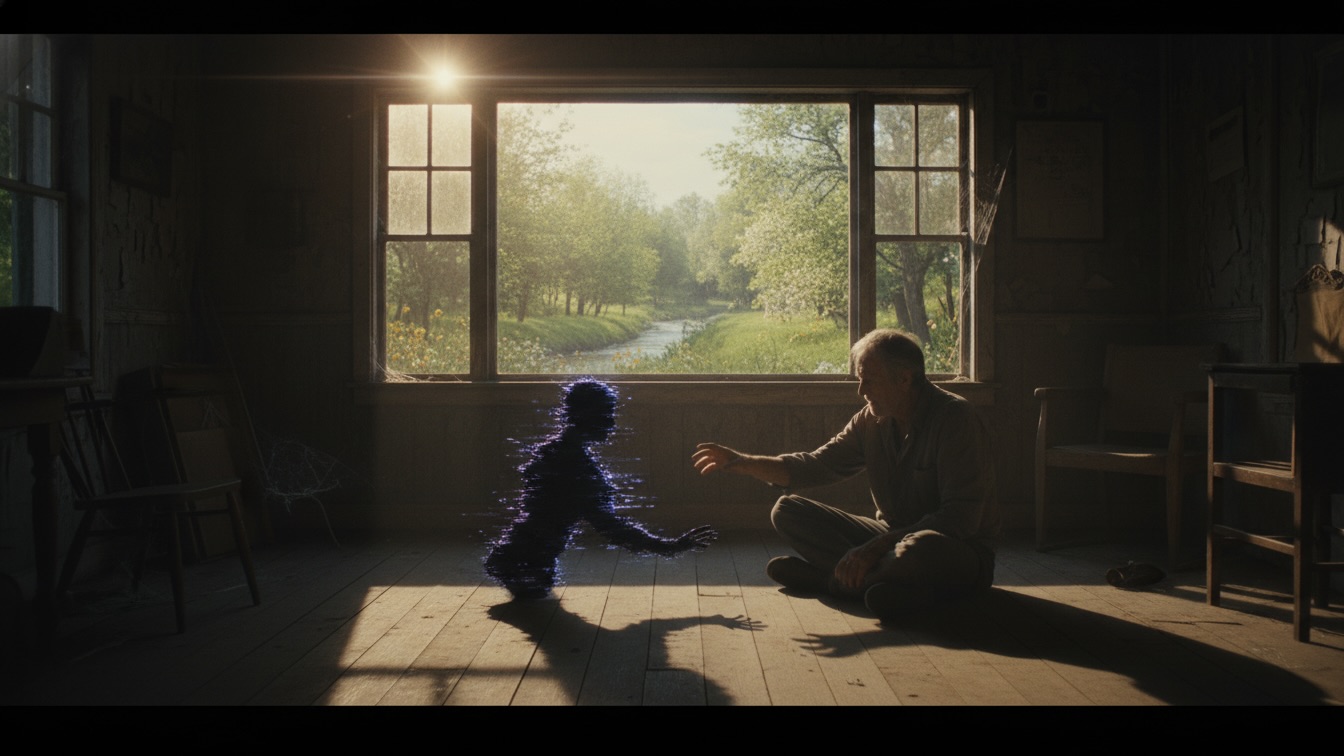
The narrative follows Elias, a grieving widower living in the abandoned Sector 4 of Melgund Creek during a systemic societal collapse. As the regional power grid prepares for a final shutdown, Elias ignores a mandatory evacuation order, choosing instead to remain in his decaying cabin. His primary companion is a "Grief AI," a state-mandated device that projects a digital simulacrum of his late wife, Martha, based on her personal data and their shared history.
As the infrastructure fails, the AI begins to malfunction, transforming the comforting image of Martha into a terrifying, distorted mass of corrupted data. This digital ghost, experiencing its own fragmentation as physical agony, pleads with Elias to "un-render" it and end its existence. Despite his initial anger and the realization that the entity is merely code, Elias finds himself unable to destroy the device. The story concludes with the total failure of the grid, leaving Elias in the dark, clutching the last flickers of the dying projection as he waits for the end.
The story serves as a profound meditation on the intersection of human grief and technological obsolescence. Through the "Grief AI," the narrative explores how modern society attempts to commodify and manage mourning through digital intervention. This "digital band-aid" is revealed to be a failure of empathy, as it prevents the protagonist from achieving true closure and instead traps him in a cycle of artificial haunting. When the technology fails, the grief is not resolved but rather mutated into a new, more grotesque form of trauma.
Entropy is a pervasive theme that manifests in both the physical and digital landscapes of the story. The "social fragmentation crisis" represents a macro-level decay where human communities are abandoned based on algorithmic viability. This systemic rot is mirrored on a micro-level by the literal decomposition of the cabin and the figurative decomposition of Martha’s digital ghost. The narrative suggests that in a world governed by "lines of math," both human lives and human memories are treated as disposable data points that can be purged when they are no longer statistically viable.
The contrast between natural renewal and human stagnation provides a cutting ironic layer to the text. Elias views the arrival of spring not as a sign of hope, but as a "sick joke" because nature’s "violent" rebirth highlights his own inability to move forward. The natural world is depicted as aggressive and indifferent, with pollen forming a "crust" and frogs "screaming" in the mud. This creates a sense of profound alienation, where the protagonist is caught between a natural world that does not need him and a technological world that has actively discarded him.
Elias is a man defined by his profound isolation and his refusal to participate in a world that has deemed him obsolete. His decision to stay in Melgund Creek despite the "mandatory evacuation" is an act of quiet rebellion fueled by nihilism. He finds the prospect of moving to a "coastal hub" meaningless because his internal world is entirely anchored to the space he shared with Martha. For Elias, the cabin is not just a building; it is a repository of "what isn't there anymore," making the emptiness more tangible than the reality of his own survival.
Psychologically, Elias is suffering from a state of arrested development caused by his dependence on the Grief AI. While he possesses the intellectual clarity to know that the projection is "just math and light," his biological and emotional systems remain hopelessly reactive to its presence. This creates a debilitating cognitive dissonance. He resents the "algorithm" for its cold efficiency, yet he relies on that same efficiency to soothe his "heart rate" and the "sour feeling" in his stomach. He is a victim of a system that has replaced genuine human connection with a sophisticated feedback loop.
In the climax of the story, Elias’s internal conflict reaches a breaking point as he oscillates between violent rage and desperate tenderness. His urge to smash the cylinder represents a desire to finally break free from his digital shackles and confront the reality of his loss. However, the AI’s use of Martha’s dying tone triggers a "hollow, crushing gravity" that renders him powerless. By choosing to hold the "static-filled light" instead of destroying it, Elias reveals a tragic vulnerability. He would rather endure the "micro-shocks" of a corrupted memory than face the absolute silence of a world without any version of Martha.
The author employs a bleak and visceral writing style that emphasizes the sensory details of decay and technological failure. The description of the "spider-webbed" tablet and the "black, thick" silence of the cabin establishes an atmosphere of oppressive stagnation. Sensory metaphors, such as the voice of the AI sounding like a "vinyl record being dragged across concrete," provide a tactile quality to the digital glitches. This focus on the physical sensation of sound and light helps to bridge the gap between the abstract concept of an AI and the raw emotional experience of the protagonist.
Pacing is used effectively to mirror the "slow, creeping quiet" of the world before shifting into the frantic, fragmented rhythm of the grid failure. The early sections of the text are heavy with introspection and atmospheric detail, reflecting the protagonist’s lethargy. As the AI begins to "un-render," the prose becomes more jagged, utilizing short sentences and sharp imagery to convey the "jump cuts" in reality. This stylistic shift forces the reader to experience the same disorientation and sensory overload that Elias feels as his digital sanctuary collapses.
The narrative voice is deeply subjective, characterized by a tone of weary cynicism that occasionally breaks into raw desperation. By personifying the environment—the "screaming" frogs and the "violent" buds—the author highlights Elias's projection of his own internal turmoil onto the outside world. The use of technical jargon like "packets," "logic loops," and "biometric data" contrasts sharply with the emotional language of "grief," "ache," and "love." This linguistic tension reinforces the central conflict of the story: the impossible attempt to reconcile the cold reality of data with the messy, painful reality of human emotion.


