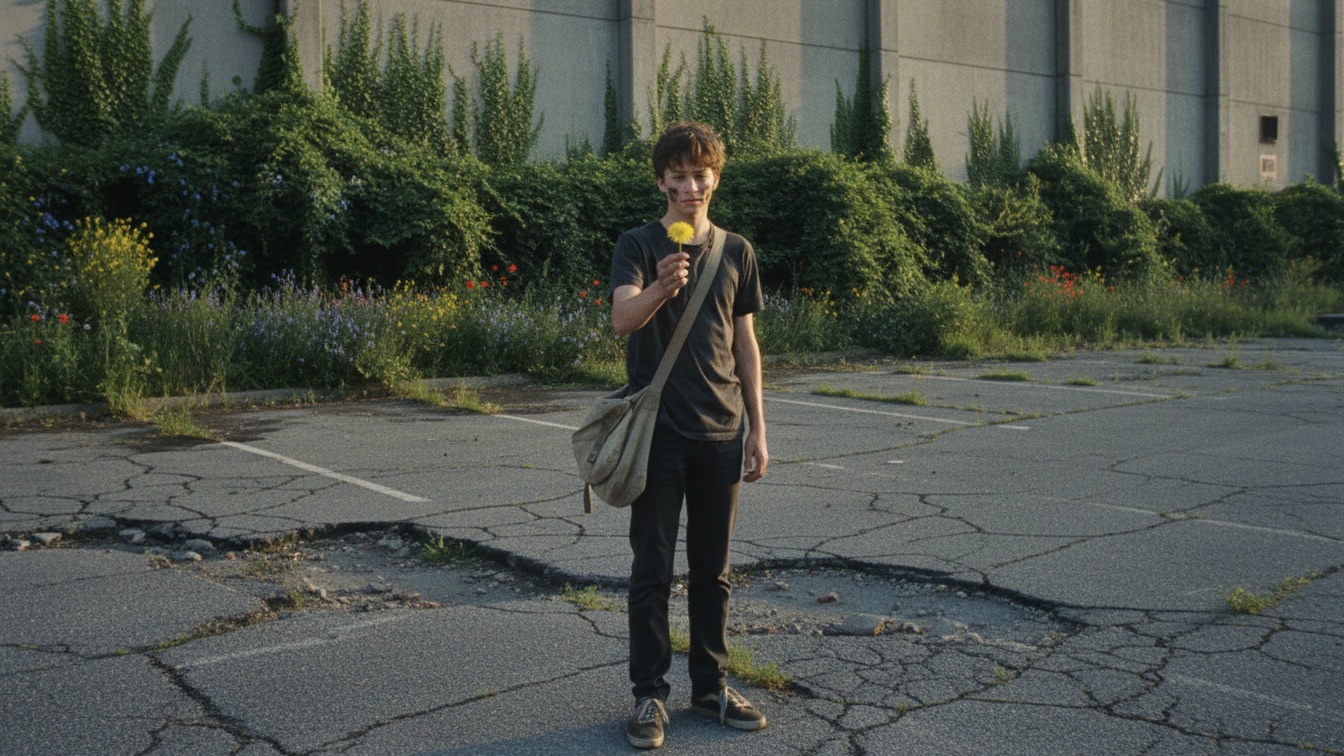
The narrative follows Sam, a seventeen-year-old courier trapped in the grinding gears of a hyper-efficient gig economy. He operates as a literal data point for an uncaring algorithm, navigating a desolate urban landscape where every movement is tracked and monetized. His life is defined by the mechanical rhythm of deliveries until he discovers a single, vibrant flower growing through a crack in a concrete logistics hub. This small moment of biological defiance sparks a psychological shift in him, leading him to share the discovery on a niche online forum.
This act of digital sharing connects him with Carmen, an eighteen-year-old activist who recognizes the flower not just as a plant, but as a systemic failure. She identifies "null-spaces" within the corporate mapping software—areas the algorithm ignores because they lack commercial value. Together, they launch a movement called Petal Punk, recruiting other disillusioned couriers to plant "seed bombs" in these overlooked cracks. The movement quickly evolves from a quiet act of sabotage into a massive public demonstration of ecological reclamation.
The story reaches its climax during a mass "Spring Breakout" where citizens march to the headquarters of Omni-Logistics to plant a forest in its sterile plaza. While the event is a symbolic victory that restores a sense of agency to the participants, the ending takes an ominous turn. As Sam and Carmen celebrate their success, they witness corporate drones rising from the rooftops. The algorithm is not defeated; it is simply recalibrating to address the new biological threat, suggesting that the battle for the city’s soul has only just begun.
The central theme of the story is the conflict between organic life and algorithmic control. The author portrays the modern city as a digital panopticon where every human action is measured for efficiency and profit. Sam’s initial state of being "legacy hardware" suggests that in a world optimized for machines, humanity itself becomes an outdated burden. The introduction of the flower serves as the ultimate "glitch," a symbol of spontaneous, unmanaged growth that the system cannot comprehend or categorize.
Another prominent theme is the reclamation of agency through subversion. Carmen and Sam do not attempt to destroy the system from the outside; instead, they use its own tools and "blind spots" to plant the seeds of its transformation. This reflects a modern psychological struggle against the feeling of powerlessness in the face of massive, invisible corporate structures. By turning the delivery routes into gardening paths, the characters transform their labor from a source of exhaustion into a source of purpose.
The narrative also explores the aesthetic of resistance, contrasting the "Grey" of corporate sterility with the "Green" of biological chaos. The corporate entities view the flowers as "unauthorized biological growth" and a "tripping hazard," revealing a mindset that prioritizes order and safety over vitality and beauty. The movement’s success lies in its ability to make people see the world differently, shifting their focus from the glowing screens of their phones to the cracks in the pavement beneath their feet.
Finally, the story touches on the limitations of symbolic victory. While the planting of the weeping willow at the Omni-Logistics headquarters is a powerful act of defiance, the closing image of the drones reminds the reader that systems of power are highly adaptable. The theme of environmentalism is thus tied to a cycle of constant vigilance. The "Spring Breakout" is presented not as a final resolution, but as the opening move in a long-term conflict between those who wish to control the earth and those who wish to let it grow.
Sam begins the story as a cynical and physically exhausted young man who views himself through the lens of the machine he serves. He describes his own body in technological terms, feeling like "legacy hardware" with clicking knees and a back like a "tight wire." His psychological state is one of profound alienation, where he is more attuned to the data points of the asphalt than to his own humanity. The discovery of the flower acts as a catalyst for his reawakening, forcing him to engage with something that exists outside the logic of the delivery app.
As the story progresses, Sam transitions from a passive observer to a leader of a movement. His internal conflict shifts from a struggle for survival to a struggle for meaning. He finds a new sense of clarity when he realizes that he is no longer just a "delivery boy" but a "gardener in a war zone." This shift in identity is most evident when he confronts Officer Wilson, where he replaces his usual fear of authority with a "cold, hard resolve." He discovers that his true power lies in his ability to witness and protect the life that the system ignores.
By the end of the narrative, Sam has achieved a state of psychological liberation, yet he remains grounded in reality. He is the one who recognizes the beauty of the newly planted forest, but he is also the one who keeps a seed bomb in his pocket for the next fight. His growth is not just about environmentalism; it is about the recovery of his own soul from the "long, grey sleep" of the gig economy. He ends the chapter as a seasoned veteran of a new kind of warfare, prepared for the corporate counter-attack.
Carmen serves as the intellectual and ideological engine of the Petal Punk movement. She is portrayed as a young woman with a deep understanding of urban decay and systemic failure, using her knowledge to turn Sam’s aesthetic appreciation into a political weapon. Unlike Sam, who reacts emotionally to the beauty of the flower, she views the crack in the concrete as a "breach" and a "null-space." She possesses a visionary quality, speaking with a voice that is "deep and practiced," suggesting she has long been preparing for this moment of disruption.
Her motivation is rooted in the desire to "glitch the grey until it turns green," a goal that is as much about digital subversion as it is about botany. She is the one who synthesizes the "glitch-matter" and identifies the flaws in the courier API, demonstrating a high level of technical and strategic competence. She does not see the flowers as mere decorations but as functional tools for reclaiming the city’s architecture. Her intensity can be seen in her "wide and unblinking" eyes, which reflect a singular focus on her mission.
Despite her radicalism, Carmen shows a degree of pragmatism and foresight that Sam initially lacks. At the end of the story, she is the one who warns Sam that the corporate entities are "already recalculating." While Sam is caught up in the beauty of the moment, she is already looking at the "blue glow of monitors" in the tower above. She represents the necessity of merging passion with strategy, reminding the protagonist and the reader that true change requires more than just a single act of defiance.
The narrative voice is characterized by a gritty, first-person perspective that blends the vocabulary of technology with the sensory details of urban decay. The author uses mechanical metaphors—such as the bike frame vibrating against thighs and the phone "screaming"—to establish a tone of constant, low-level anxiety. This creates a sharp contrast with the descriptions of the flowers, which are depicted with vivid, "loud" colors like "solar flares." This stylistic choice highlights the intrusion of life into a dead, industrial world.
The pacing of the story mirrors the escalation of the Petal Punk movement. It begins with a slow, rhythmic focus on the drudgery of Sam’s daily routine, reflecting the repetitive nature of his work. Once the movement begins, the sentences become shorter and more punchy, mirroring the "explosion" of the forum post and the rapid spread of the "glitch." The final scenes at the Omni-Logistics plaza are sweeping and cinematic, capturing the collective energy of the march before narrowing back down to the intimate conversation between Sam and Carmen.
Sensory details play a crucial role in grounding the story’s themes. The author emphasizes the "burnt rubber and old grease" of the industrial district to make the "sudden and sharp" oxygen of the new forest feel more earned. The soundscape also shifts throughout the chapter, moving from the "rattle" of the phone clip and the "roar of traffic" to the "sound of shovels hitting dirt" and the "sound of people laughing." These auditory shifts signal the transformation of the environment from a place of labor to a place of community.
The ending of the chapter utilizes a classic cliffhanger structure that shifts the tone from triumph to suspense. By introducing the "black drones" with their "red lights blinking like eyes," the author undercuts the pastoral beauty of the new forest with a reminder of the cyberpunk reality the characters inhabit. This creates a lingering sense of unease, suggesting that while the "Spring Breakout" was a success, the war between the algorithm and the garden is an ongoing struggle. The prose remains lean and evocative, leaving the reader with a powerful image of resistance in the face of overwhelming technological force.


