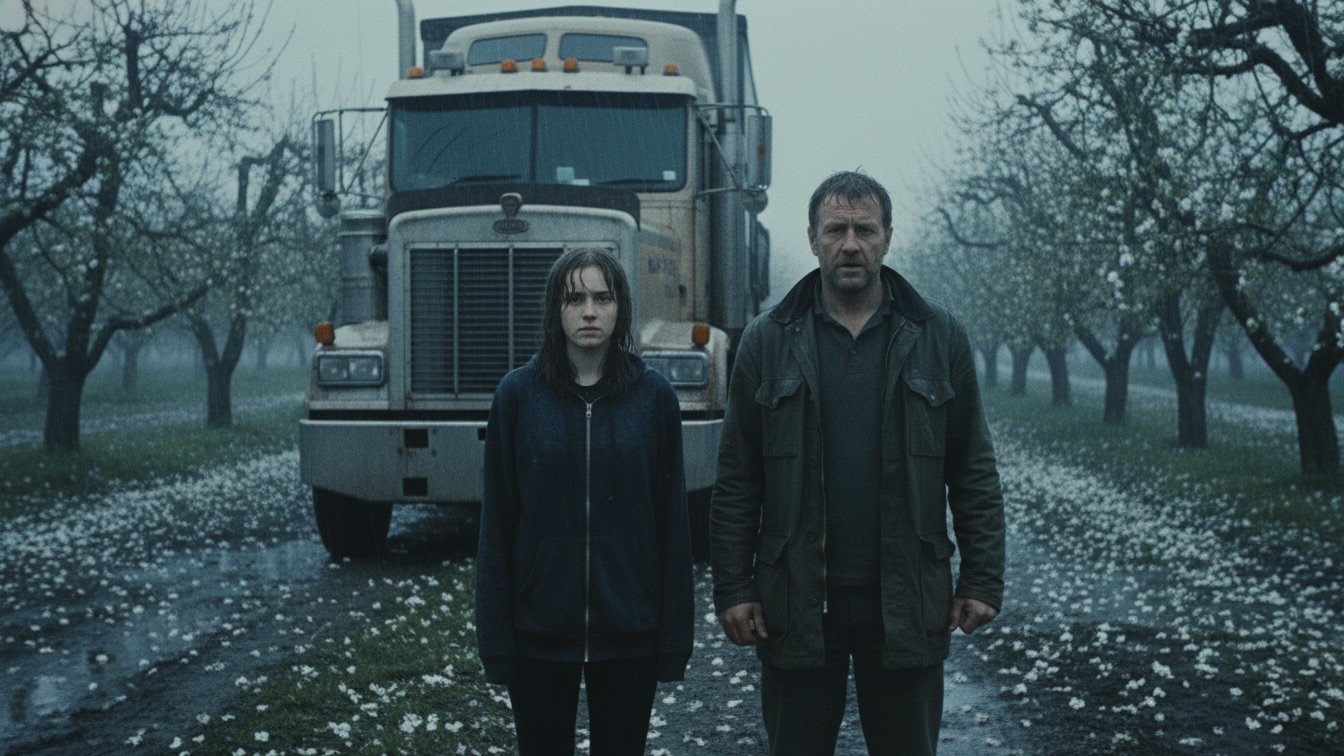
Lena is a social media influencer attempting to salvage her waning career by rebranding herself with a "trad-wife" and spiritual aesthetic. During a staged photoshoot in an apple orchard, she is confronted by Gabe, a union leader who reveals that the orchard workers are on strike. He exposes the fact that the "sacred" apple Lena is holding is actually a chemically treated fruit from cold storage. In a desperate attempt to pivot her content, Lena livestreams the encounter, only for Gabe to reveal her sponsorship by the very chemical company poisoning the workers.
The fallout is immediate, resulting in the termination of her contracts and the destruction of her digital persona. That night, a violent storm ravages the orchard, destroying the blossoms and the hopes of a future harvest. Driven by a newfound sense of clarity, Lena returns to the orchard in her ordinary clothes, stripping away her curated image. She finds Gabe standing against the transport trucks and decides to join him in a literal blockade. This act of defiance marks her transition from a performative existence to a confrontation with reality.
The narrative explores the profound tension between digital performance and physical reality. Lena’s "connection to the land" is initially presented as a commodity, a carefully constructed "vibe" designed to manipulate an algorithm. This commodification of nature is contrasted with the grim, material conditions of the people who actually work the soil. The story suggests that the "golden hour" of the influencer is built upon the "dark hour" of the laborer, highlighting a parasitic relationship between the aesthetic and the actual.
Environmental toxicity serves as both a literal and metaphorical theme throughout the chapter. The apple, described as a "holy relic" by Lena and a "biohazard" by Gabe, symbolizes the rot hidden beneath a polished exterior. This toxicity extends to Lena’s career and her relationships, as her lifestyle is funded by the same corporations that exploit the land and its workers. The "bruised apple" becomes a gospel of truth, suggesting that authenticity can only be found by acknowledging the damage rather than hiding it.
The theme of identity and redemption is woven into Lena’s internal journey from fraudulence to agency. Her initial identity is a series of "masks" and "rebrands" aimed at maintaining a middle-class lifestyle through corporate sponsorships. It is only when she loses everything—her money, her reputation, and her aesthetic—that she is able to make a choice that is not dictated by a marketing strategy. Her final decision to stand in the rain represents a baptismal shift, where she trades the safety of the "green screen" for the danger of the front line.
Lena is a woman defined by the fragmentation of her own identity in the face of digital demands. She views her life through a lens of "filters" and "transitions," even when she is standing in the middle of a literal field. Psychologically, she is suffering from a deep-seated alienation, recognizing her linen dress is "scratchy" and her voice is "flat," yet she continues the performance for survival. Her motivation is rooted in economic anxiety, as she fears becoming a "ghost" in the eyes of the algorithm.
Her transformation is triggered by the public collapse of her carefully managed persona. When Gabe exposes her hypocrisy on a live stream, the psychological weight of her fraudulence becomes a physical sensation in her lungs. The storm acts as an external manifestation of her internal chaos, clearing away the "wet confetti" of her pretensions. By the end of the chapter, she moves from being a passive recipient of corporate checks to an active participant in a social struggle.
The shift in her attire from a three-hundred-dollar dress to old jeans and sneakers signifies her rejection of the "spiritual" brand in favor of a grounded reality. She no longer seeks to "offer" the apple to a god she doesn't believe in; instead, she offers its bruised reality to a man she respects. Her relief at the end of the story is the relief of someone who has finally stopped running from the truth. She finds her first authentic moment not in a prayer transition, but in the cold, unapologetic rain of a protest.
Gabe serves as the narrative’s moral compass and the embodiment of the "unseen" labor force. He is a man who operates in a world of facts and neurotoxins rather than vibes and aesthetics. His exhaustion is palpable, reflecting the weight of his responsibility as a union leader during a strike. He views Lena not as a person, but as a symptom of a larger systemic rot that prioritizes "clicks" over human health.
His character represents the antithesis of the influencer lifestyle, as he is grounded in the physical consequences of his environment. He does not care about the "golden hour" because he is too busy worrying about health insurance and respirators. His skepticism toward Lena is justified by her corporate ties, yet he remains open enough to witness her eventual change of heart. He provides the catalyst for her growth by refusing to play a part in her staged reality.
In the final scene, Gabe is shown as a figure of quiet, stubborn persistence. He stands in the road not for the sake of a photo, but because he has no other choice if he wants to protect his people. His acceptance of Lena at the blockade is not a warm embrace, but a grim acknowledgment of a new ally. He represents the reality that Lena was trying to fake, and his presence forces her to decide which side of the "private shoot" she truly belongs on.
The narrative voice is sharp and cynical, utilizing a first-person perspective that allows the reader to see the gap between Lena’s internal thoughts and her public actions. The pacing is deliberate, beginning with the slow, artificial movements of a photoshoot and accelerating into the chaotic fallout of the livestream. This shift mirrors Lena’s loss of control as her curated world begins to unravel. The author uses a "bruised" color palette—honey-colored glows, purple twilights, and gray dawns—to signal the transition from artifice to reality.
Sensory details are used effectively to highlight the contrast between the fake and the real. The "block of ice" feel of the cold-storage apple and the "metallic" scent of the air provide a visceral grounding for the reader. These sharp, cold sensations cut through the "soft-focus" language that Lena uses for her brand. The sound of the "tractor" and the "revving engine" of the tanker truck serve as a constant reminder of the industrial reality underlying the pastoral setting.
The tone of the story shifts from satirical to somber, reflecting the protagonist's emotional journey. The early descriptions of Tiffany as a "misplaced astronaut" provide a biting critique of the influencer industry. However, by the end of the chapter, the humor is replaced by a gritty, cinematic realism. The final image of the "twin suns" of the truck's headlights cutting through the dawn creates a sense of impending confrontation that is both terrifying and liberating.


