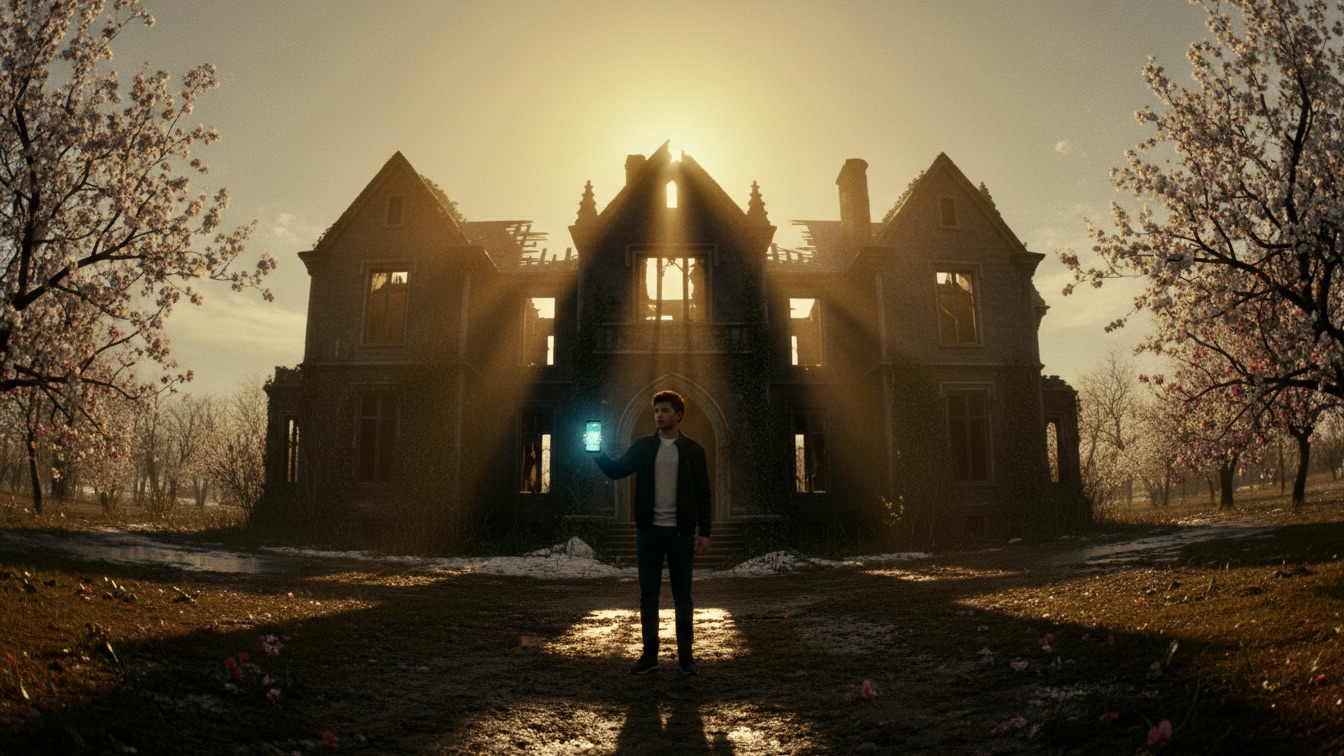
The story follows Hassan and Priya, two international students struggling to survive in a decaying Winnipeg house during a bleak March. Their landlord, Mr. Chase, is a literal vampire who has converted the basement into a high-density "crypt" for gig workers, complete with stone coffins and high-speed Wi-Fi. The students face the crushing weight of tuition fees, housing scarcity, and the threat of deportation, which Mr. Chase exploits to maintain his predatory "blood-rent" arrangement.
A turning point occurs when Hassan encounters the ghost of Mike, a labor leader from the 1919 Winnipeg General Strike, who urges him to organize rather than submit. A subsequent visit from a city inspector proves useless, as the bureaucrat is only concerned with minor building code violations rather than the landlord’s supernatural predation. Inspired by Mike’s rhetoric and the absurdity of their situation, Hassan and Priya use a TikTok livestream and garlic-infused poutine to publicly shame and repel Mr. Chase. They successfully negotiate a legal lease and better living conditions, realizing that their struggle is part of a larger, systemic battle involving other exploited tenants across the city.
The central theme of the narrative is the literalization of predatory capitalism through the figure of the vampire landlord. Mr. Chase represents the "rentier" class that survives by draining the life force and resources of the vulnerable. By demanding "blood-rent" and offering coffins as housing, the story suggests that the modern housing market is inherently ghoulish. It transforms the basic human need for shelter into a survivalist "Hunger Games" scenario where students are forced to trade their health and dignity for a place to sleep.
The story also explores the continuity of labor struggles across a century of history. By introducing Mike, a ghost from the 1919 General Strike, the author connects the plight of modern international students to the historical working class. This thematic bridge suggests that while the tools of exploitation have changed—from coal shovels to 5G routers—the fundamental power imbalance remains the same. The "glowing brick" of the smartphone becomes the modern equivalent of the picket line, providing a new method for collective bargaining.
The absurdity of bureaucratic indifference serves as a biting critique of institutional failure. Inspector Miller’s focus on Wi-Fi mounting heights and pipe diameters while ignoring the presence of an undead predator highlights how regulatory systems often prioritize trivialities over human rights. This theme suggests that the law is not designed to protect the individual from exploitation, but merely to ensure that the exploitation is "up to code." This realization forces the protagonists to seek justice outside of traditional channels through social media and direct action.
Finally, the narrative touches upon the specific anxieties of the immigrant experience. Hassan and Priya are trapped by their visa requirements and the lack of a local credit score, which makes them the perfect prey for someone like Mr. Chase. Their fear of the border is a weapon used against them, illustrating how the immigration system can be co-opted by private interests to enforce silence and compliance. The resolution of the story, however, suggests that transparency and community solidarity can dismantle these fears.
Hassan serves as the narrative's moral compass and the primary observer of its escalating absurdities. Psychologically, he is defined by a weary resilience common to those living under constant economic pressure. He initially exhibits a defensive cynicism, using dark humor to cope with the "slurping sludge" of his environment. His internal conflict stems from the tension between his desire for a stable life and the indignity of his current living conditions.
His transformation begins when he stops viewing himself as a victim of bad luck and starts seeing himself as a participant in a historical struggle. When he encounters the ghost of Mike, Hassan is forced to confront his own passivity. He moves from a state of learned helplessness to one of strategic defiance. By filming the landlord, he reclaims his agency, using his digital literacy to flip the power dynamic in his favor.
Priya represents the practical, high-stakes anxiety of the international student community. Her primary motivation is academic and legal survival, as she is acutely aware that her presence in the country is contingent on her ability to pay tuition. This financial desperation makes her more willing than Hassan to tolerate the "crypt" in the basement. Her psychological state is one of constant calculation, weighing the loss of a "pint of blood" against the loss of her future.
Despite her fear, Priya proves to be a vital partner in the resistance. She is the one who translates Hassan’s digital activism into physical defense by preparing the garlic poutine. Her quick thinking during the livestream, where she tags government boards and news stations, shows a keen understanding of how to weaponize the system's own visibility against it. She transitions from a person paralyzed by her bank balance to a confident strategist.
Mr. Chase is the embodiment of ancient greed adapted for the modern era. He is not a romanticized vampire but a "land-lord" in the most feudal sense of the word. His psychology is rooted in total detachment from human empathy, viewing his tenants merely as "units" or "juice boxes." He represents a form of power that is "out of fashion" but still deeply entrenched in the physical and economic foundations of the city.
His weakness is revealed to be his inability to cope with the transparency of the digital age. He thrives in the shadows and through "blood-loyalty" waivers, but he cannot withstand the "light" of a viral video. His eventual defeat shows that he is a creature of the old rules. Once Hassan and Priya change the game, he becomes small and fearful, proving that his power was largely dependent on his tenants' silence.
Mike functions as the psychological catalyst for the protagonists' radicalization. As a ghost of the 1919 General Strike, he represents the collective memory of resistance that the modern city has forgotten. He is blunt and uncompromising, serving as a foil to the bureaucratic indifference of the inspector. His presence suggests that the spirit of the labor movement is "full" in the house, waiting for someone to tap into it.
He provides Hassan with the historical context necessary to see Mr. Chase as a "boss" rather than a supernatural inevitability. Mike’s role is to remind the students that they are not alone and that their fear of the border is a tool of the oppressor. Although he is a figure from the past, his advice is remarkably contemporary. He understands that power only respects those who organize and use the tools at their disposal.
The narrative voice of the story is characterized by a blend of "Winnipeg Gothic" and sharp, modern satire. The author uses vivid, often repulsive imagery to establish the setting, such as wallpaper that looks like "scabbed skin" and mud that tastes like "broken dreams." This creates a visceral sense of decay that mirrors the protagonists' dwindling options. The tone is consistently dry and self-aware, allowing the supernatural elements to feel grounded in the mundane horrors of the housing crisis.
Pacing is managed through a series of escalating encounters that move the story from domestic realism to supernatural confrontation. The introduction of the stone coffins serves as a shocking visual anchor for the story’s themes. The transition from the bureaucratic farce of the city inspector to the high-energy TikTok confrontation creates a dynamic rhythm. This shifts the reader's experience from one of dread to one of cathartic triumph, mirroring the characters' own emotional journey.
Sensory details are used effectively to heighten the conflict, particularly the contrast between the "harsh blue light" of technology and the "wet dirt" smell of the basement. The final confrontation is defined by the pungent aroma of garlic poutine, a clever subversion of traditional vampire lore that incorporates local Canadian culture. This choice grounds the climax in a relatable, almost absurd reality that underscores the story's satirical edge. The "blinking digital heartbeats" of the routers provide a persistent, rhythmic reminder of the intersection between the ancient and the modern.
The narrative also makes effective use of dialogue to establish power dynamics. Mr. Chase’s "dry, rattling tone" and Mike’s "gravelly" voice provide a stark contrast to the quick, anxious banter between Hassan and Priya. The inspector’s dismissive, clinical language further emphasizes the theme of institutional indifference. These stylistic choices ensure that every interaction reinforces the central conflict between the exploited and the exploiters, making the eventual victory feel earned through a clever use of the "glowing bricks" of modern life.


