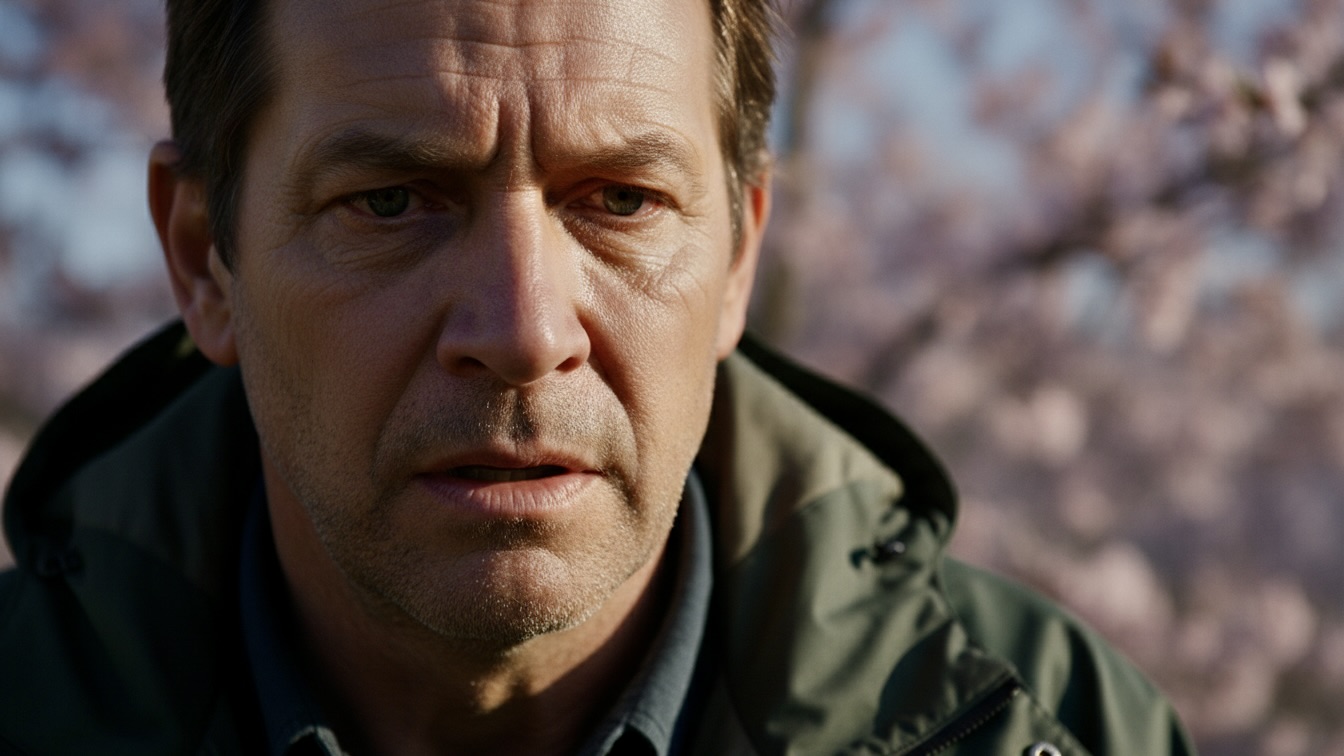
The story begins at a bleak industrial site known as the Depot, where an aging man named Wally discovers that the local salmon have mutated into rigid, plastic-like runes in the mud. While the town celebrates a corporate "green initiative" nearby, Wally remains deeply unsettled by the unnatural state of the environment. He confronts the Mayor and the festive crowd with a Geiger counter, which reveals that the decorative wildflower fence is actually a radioactive, predatory organism.
As the tension peaks, the wildflower fence violently attacks, dragging a child’s balloons into its depths and revealing its true, hungry nature. Wally provides a horrifying demonstration of the ecological collapse by pulling a "recycled" fish from the water, showing it has been physically transformed into consumer waste. The chapter ends on a claustrophobic note as the Depot's gates lock automatically and a distorted anthem begins to play. Wally realizes the townspeople are no longer guests at a party but are the intended harvest for a biological machine that has outgrown its cage.
The central theme of the narrative is the perversion of environmentalism and the concept of a "closed-loop" ecology. In this story, the corporate "green initiative" is revealed to be a literal and terrifying interpretation of recycling, where nature does not recover from pollution but is instead overwritten by it. The salmon are not merely dying; they are being physically replaced by the very microplastics and polymers that poisoned their habitat. This suggests a cynical view of corporate sustainability, portraying it as a force that consumes life to sustain the existence of waste.
Another prominent theme is the danger of willful ignorance and the suppression of truth for the sake of social cohesion. The Mayor represents the political and corporate interests that prioritize optics over public safety, using mockery to silence Wally’s legitimate concerns. The townspeople, distracted by "fermented punch" and "ribbon cutting," choose to ignore the sensory evidence of decay around them. Their refusal to acknowledge the "wrongness" of the water and the fish makes them complicit in their own entrapment, highlighting how easily a community can be led into a trap by the promise of progress.
The story also explores the theme of the "Uncanny Valley" within nature. The wildflowers are described as a "violent shade of violet" with "hairy" stems, and the fish "clack" like plastic rather than squishing like organic matter. This subversion of natural expectations creates a sense of deep-seated horror. The transition from the "spring thaw," which usually symbolizes rebirth, to a "harvest" of human life suggests that when humanity attempts to manufacture or control nature through toxic means, the resulting creation will eventually view humanity as just another resource to be processed.
Wally serves as the archetypal "Cassandra" figure, a man who sees the impending doom but is dismissed by those around him. His physical ailments, such as his aching hip and popping joints, ground him in a gritty reality that contrasts with the drunken delusions of the partygoers. He possesses a scientific or perhaps investigative background, evidenced by his use of a camera and a Geiger counter to document the anomaly. Psychologically, he is a man burdened by the weight of truth, remaining stoic even when the Mayor attempts to humiliate him in front of the town.
He demonstrates a high degree of moral courage and quick thinking when the crisis begins. Rather than fleeing in terror when the fence attacks Little Timmy, he lunges forward to save the boy, showing that his concern for the community outweighs his resentment for their mockery. Wally is the only character who looks beneath the surface, both literally in the drainage ditch and metaphorically regarding the corporate "green" facade. His motivation is not ego, but a desperate need to prevent a catastrophe he clearly saw coming long before the first vine lashed out.
The Mayor is the narrative’s human antagonist, embodying the arrogance and negligence of local leadership. He uses his "calculated swagger" and a "smile that felt like a threat" to dominate the social space of the Depot. Psychologically, he is driven by the need to maintain his image of authority and the success of the corporate partnership. He views Wally’s warnings as a personal affront to his leadership and a threat to the economic narrative he has constructed for the town.
His reaction to the Geiger counter—turning "mottled purple"—reveals a man who is more afraid of a scandal than he is of a genuine threat. He attempts to gaslight Wally and the crowd by attributing the radiation to "old medical waste," showing a reflexive habit of lying to maintain order. Even as the ground begins to heave and the truth becomes undeniable, his first instinct is to silence the messenger. His eventual fall into the mud symbolizes the collapse of his manufactured reality as he is literally brought down to the level of the "slurry" he tried to ignore.
Brenda represents the collective consciousness of the townspeople, characterized by a desire for escapism and a lack of critical awareness. She is introduced through her sensory indulgence, holding a cup of "fermented punch" and laughing in the face of environmental decay. Her initial interactions with Wally are dismissive and playful, suggesting that she views his seriousness as a buzzkill rather than a warning. She is a victim of the "bread and circuses" strategy, where the promise of cake and a party blinds her to the "violent" and "hungry" nature of her surroundings.
As the horror unfolds, Brenda’s transition from drunken mirth to "wide-eyed terror" mirrors the audience's realization of the stakes. She is the first to notice the physical manifestation of the threat when she drops her cup, a symbolic end to the festivities. Her reliance on Wally for direction in the final moments shows how quickly the social hierarchy shifts when survival is at stake. She moves from a position of mocking superiority to one of total vulnerability, highlighting the fragility of those who trust blindly in corporate or political promises.
The author employs a dark, industrial-gothic tone that emphasizes the decay of the setting. The description of the mud as a "gelatinous slurry" that smells of "motor oil and old snow" immediately establishes a sensory world that is both cold and polluted. This grim atmosphere is maintained throughout the chapter, creating a sharp contrast between the "violent" colors of the mutated flowers and the grey, bleak reality of the Depot. The use of words like "calcified," "polymer," and "staccato" adds a mechanical, cold edge to the prose that reflects the story's theme of life being replaced by industry.
Pacing in the chapter is masterfully handled, beginning with a slow, contemplative observation of the fish and escalating into a frantic survival scenario. The first half of the text is heavy with foreboding imagery and tense dialogue, building a sense of "wrongness" that the characters try to laugh off. The introduction of the Geiger counter acts as the catalyst for the shift in pace, turning the psychological tension into physical action. The sudden locking of the gates and the "metallic thud" provide a definitive transition into the climax, trapping the reader along with the characters in a high-stakes environment.
The use of sound is particularly effective in heightening the horror of the final scenes. The "rhythmic vibration" of the party music is replaced by the "frantic, staccato clicking" of the Geiger counter, and finally by the "distorted and slowed down" hockey anthem. This auditory shift signals the end of human civilization's control over the site. By using a familiar, local melody like a hockey anthem and turning it into a "funeral dirge," the author taps into the uncanny, making the familiar seem alien and predatory. This stylistic choice reinforces the idea that the community’s own culture and waste have been weaponized against them.


