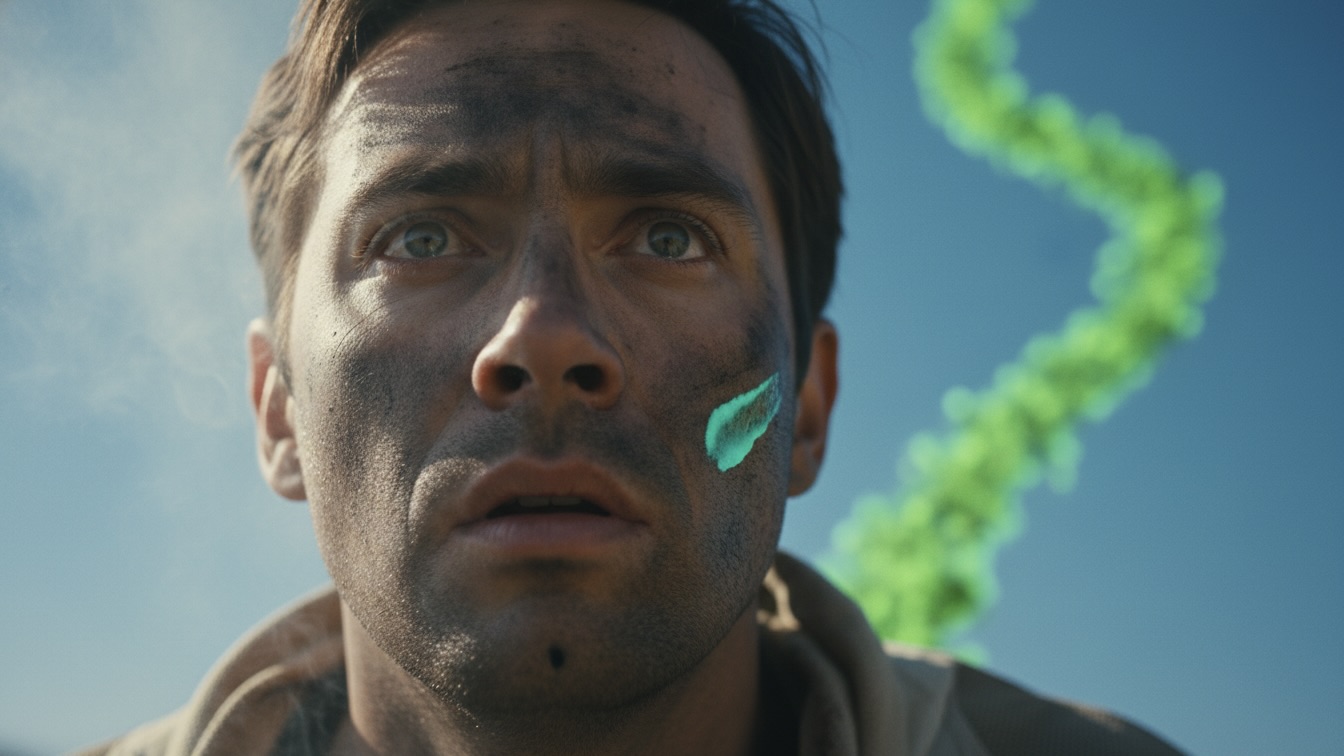
The narrative unfolds on a rooftop garden in the year 2026, where Tomas and Janet observe a disturbing transformation in their honeybee colonies. Instead of traditional pollen, the bees are returning with neon green synthetic enzymes, producing a volatile, teal-colored royal jelly that functions as a biological data storage system. This ecological mutation is revealed to be a state-sponsored project when a tactical team led by a figure known as The Handler arrives to seize the hives.
The tension escalates into a physical confrontation as Tomas uses the glowing jelly to mark the soldiers, triggering a defensive swarm that overwhelms the intruders. In the midst of this chaos, a massive explosion devastates the city center, signaling a larger conflict or structural collapse. Tomas realizes that the bees’ strange flight patterns and mutations were actually a sophisticated predictive map of the disaster. The story ends with Tomas and Janet fleeing the rooftop, following the glowing trail of the swarm toward safety as the city burns.
The central theme of the story explores the total commodification of nature within a hyper-technological society. In this world, the distinction between organic life and digital data has dissolved, as evidenced by the bees being utilized as "printers" for synthetic compounds. The state no longer views the environment as a resource to be protected, but as a medium for data production and storage. This reflects a cynical vision of the future where the beauty of the natural world is replaced by the utility of the "grid."
Another prominent theme is the dehumanization inherent in a surveillance state. The Handler represents the ultimate extension of this, as he lacks a name and views sentient creatures as mere "units." This mechanical worldview contrasts sharply with Tomas’s emotional connection to his hives. The story suggests that when humanity begins to treat living systems as hardware, it loses its ability to perceive the very warnings those systems provide.
Finally, the narrative examines the concept of environmental intuition versus technological calculation. While the state uses the bees to manufacture weapons or store data, the bees themselves are processing the environment on a level that transcends human technology. Their "mutation" is actually an adaptation to a coming catastrophe that the humans are too distracted by their own data to see. The bees represent a collective intelligence that prioritizes survival over the "mapping" of a doomed civilization.
Tomas serves as the story’s primary lens, exhibiting a deep psychological bond with the natural world that borders on the obsessive. He is a man caught between two eras, possessing the traditional skills of a beekeeper while existing in a world defined by "industrial bleach" and "synthetic enzymes." His hyper-vigilance regarding the bees' flight paths suggests a man who feels a profound responsibility for the creatures under his care. This protective instinct is his driving force, pushing him to risk his life against armed soldiers.
From a psychological perspective, Tomas displays signs of profound alienation from his urban environment. He finds more meaning in the "geometric circles" of his bees than in the "white noise" of the city. His decision to shatter the hives is a pivotal moment of character growth, showing his transition from a passive observer to a radical protector. He chooses to liberate the bees and use their collective power as a weapon, proving that his loyalty lies with the organic rather than the state.
Janet acts as a grounded, cynical foil to Tomas’s intense focus. She initially uses irony and detachment as a defense mechanism against the encroaching dystopia, leaning on her tablet and making dry remarks about the sky. Her skepticism reflects a common psychological response to a world that feels increasingly surreal and uncontrollable. By treating the apocalypse with a sense of "pretty" resignation, she attempts to maintain a semblance of agency in a world that treats her as irrelevant.
However, as the threat becomes physical, Janet’s veneer of irony cracks, revealing a deep-seated fear and a reliance on Tomas’s expertise. Her transition from a detached observer to an active participant in their flight shows her adaptability. While she lacks Tomas’s intuitive connection to the bees, her presence provides the necessary human anchor for his more abstract observations. She represents the average citizen who must eventually wake up to the reality that the "grid" will not protect her.
The Handler is the personification of the state’s cold, utilitarian logic. He is stripped of individual identity, hidden behind a "smooth and faceless" helmet and speaking in a "flat electronic bark." His primary motivation is the retrieval of "property," showing a complete lack of empathy for either the bees or the humans who tended them. He views the world through the lens of "projections" and "collateral," terms that distance him from the violent reality of his actions.
Psychologically, The Handler represents the "banality of evil" in a high-tech setting. He does not seem to harbor personal malice toward Tomas; he simply views him as a failed component in a larger system. This detachment makes his eventual downfall at the hands of the bees particularly symbolic. He is undone by the very biological "data" he sought to control, proving that nature cannot be fully subjugated by tactical gear and modulated voices.
The narrative voice of the story is characterized by a blend of lyrical beauty and industrial harshness. The author uses vivid sensory details, such as the smell of "cherry blossoms and industrial bleach," to create a sense of cognitive dissonance. This juxtaposition mirrors the story’s themes, placing the delicate life of the bees against the "aggressive" and "metallic" reality of the city. The use of color is particularly striking, with the "neon green" and "teal" providing a sickly, unnatural contrast to the "blue spring sky."
The pacing of the chapter is masterfully handled, beginning with a slow, observational tension that gradually accelerates into a frantic climax. The initial dialogue between Tomas and Janet is heavy with subtext, building a sense of unease before the physical arrival of the tactical team. Once the confrontation begins, the sentences become shorter and more kinetic, reflecting the "chaos of sound and motion" on the rooftop. The sudden shift from the bee attack to the city-wide explosion provides a jarring transition that expands the scope of the story.
The author also employs effective metaphorical language to bridge the gap between biology and technology. Describing the jets as "stitching a wound in the blue" or the bees as a "living hard drive" reinforces the idea that the world has been fundamentally altered. The sub-bass growl of the engines and the "screaming" of the hive create a soundscape that feels both futuristic and primal. This stylistic choice ensures that the reader feels the physical weight of the environment, making the eventual destruction of the city feel like an inevitable consequence of its own distorted logic.


