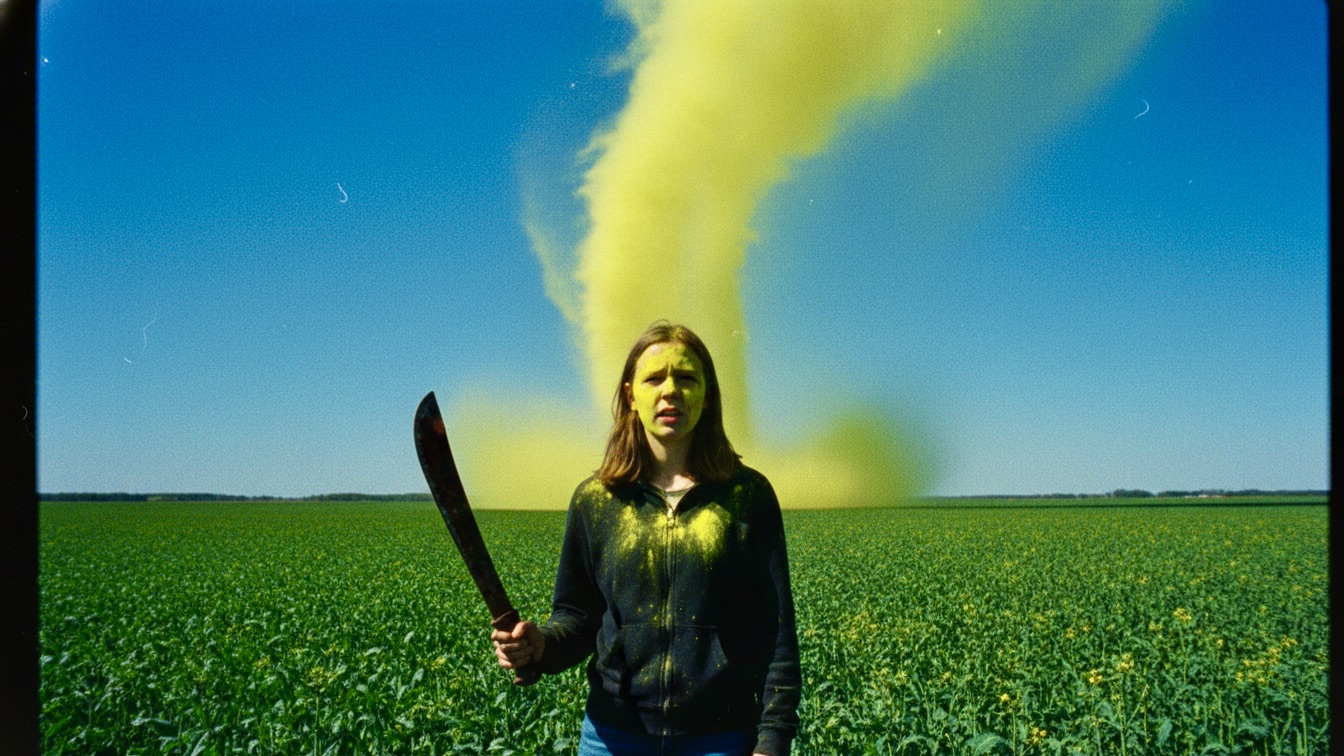
The story follows Kenzie, a young scavenger, as she navigates a mutated and hyper-evolved Manitoba landscape alongside her companions, Rat-Boy and Coach Chang. In the wake of a technological and environmental collapse known as "The Great Glitch," the trio searches for valuable "Scav-Credits" to ensure their survival. Their journey is interrupted by a "pollen tornado" from genetically modified lilies, which induces hallucinogenic visions and marks their location with a crystalline GPS flare in the sky.
This signal attracts a rival group called the Gophers, led by a boy named Jasper. The two groups clash at a flooded bridge over a vital marine battery, engaging in a high-stakes trivia contest mediated by bio-engineered "Echo-Blooms." The situation quickly deteriorates when Jasper triggers a biological chain reaction that attracts a pack of feral heritage dogs. Despite the rivalry, Kenzie chooses to save Jasper from a predatory poplar hedge and the approaching dogs, ultimately securing the battery and returning to her settlement while grappling with the lingering effects of the pollen visions.
One of the most prominent themes in the narrative is the aggressive reclamation of the planet by a mutated form of nature. The author presents a world where the "Great Glitch" has not only destroyed human infrastructure but has also accelerated biological processes to a terrifying degree. Plants like the Hope Row poplars and the Expresso Lilies are no longer passive background elements; they are active, predatory participants in the ecosystem. This shift suggests a subversion of the traditional pastoral ideal, replacing it with a "biopunk" nightmare where humanity is an invasive species being crowded out.
The intersection of technology and biology serves as another core theme. The "Whimsy" pollen acts as a bridge between these two worlds, allowing Kenzie to see digital data, such as GPS coordinates and future possibilities, through a biological medium. This suggests that while the "grid" is dead, the information it once carried has been absorbed into the environment itself. The characters are forced to navigate this new reality where a geography teacher’s knowledge of mushrooms is more valuable than a high-tech sensor, highlighting a total shift in the value of human expertise.
Finally, the story explores the persistence of human morality in a landscape defined by scarcity. Kenzie’s internal conflict regarding whether to leave Jasper to his fate or save him represents the struggle between cold, Darwinian survival and the empathetic bonds of the old world. By choosing to save her rival, she rejects the idea that humans must become as cold and predatory as the environment around them. This decision suggests that while the "Great Glitch" broke the planet’s thermostat, it did not entirely break the human spirit or the capacity for altruism.
Kenzie is a pragmatic and resilient protagonist who serves as the grounded center of her scavenging unit. She possesses a sharp, cynical wit that acts as a shield against the absurdity and danger of her environment. Her leadership is not born of a desire for power, but rather a necessity for survival, as she manages the anxieties of Rat-Boy and the eccentricities of Coach Chang. She is deeply affected by the "Whimsy," showing a psychological susceptibility to the environment that gives her a unique, albeit terrifying, perspective on reality.
Her internal conflict reaches a boiling point during the encounter with the feral dogs and the Hope Row. She is torn between the "quota" demanded by her society and her innate sense of justice. Despite the practical benefits of leaving Jasper behind, she chooses to risk her life for him, proving that she values human life over "Scav-Credits." This act of heroism is framed not as a grand gesture, but as a "stupid" necessity, reflecting her complicated relationship with her own morality in a world that often punishes kindness.
Rat-Boy serves as the intellectual and emotional foil to Kenzie’s stoic pragmatism. He is characterized by his high levels of anxiety and his reliance on technical knowledge that is rapidly becoming obsolete. His shivering and mutterings about social constructs reveal a character who is struggling to cope with the loss of the stable, predictable world of the past. Despite his fear, he remains intensely loyal to Kenzie, showing a hidden well of courage when he uses the Snap-Dragon grenade to save her from the Malamute.
Coach Chang represents the remnants of the pre-Glitch social order, clinging to his identity as a teacher even in a lawless wasteland. He views the survival of his students through the lens of a school project, grading their performance and maintaining a facade of authority. This psychological coping mechanism allows him to function as a "warlord" of geography, using his past knowledge to navigate a present that has no room for traditional education. He is less of a leader and more of a nostalgic guide, providing a sense of continuity for Kenzie and Rat-Boy.
Jasper is the embodiment of the arrogance and competitive drive that persists even after the collapse of civilization. His "pristine Nike headband" is a symbol of his attachment to status and the artifacts of a dead consumer culture. He attempts to use the environment as a weapon but ultimately falls victim to it, highlighting the folly of trying to control a world that has become wild. His vulnerability when trapped by the Hope Row strips away his smug persona, revealing a terrified child and serving as the catalyst for Kenzie’s moral choice.
The narrative voice is characterized by a blend of gritty realism and surrealist imagery, creating a tone that is both immersive and unsettling. The author uses vivid sensory details to bring the mutated Manitoba to life, such as the "chemical plant" smell of spring and the "vibrating needles" of the pollen cloud. This sensory-heavy approach forces the reader to experience the "Whimsy" alongside Kenzie, making the hallucinations feel as tangible as the rusted rebar of the bridge. The pacing is frantic, mirroring the rapid growth of the environment and the constant threat of predation.
The use of "biopunk" terminology—such as Echo-Blooms, Snap-Dragons, and Glitter-Vines—adds a layer of world-building that feels organic to the setting. These terms suggest a history of failed corporate and governmental interventions that have left the world in its current state. The dialogue is snappy and laden with dark humor, which serves to alleviate the tension while reinforcing the characters' exhaustion. The contrast between the beauty of the "pastel smoke" and the lethality of the "feral heritage dogs" creates a cognitive dissonance that defines the story’s atmosphere.
Technically, the story utilizes a first-person perspective that limits the reader’s understanding to Kenzie’s immediate experiences and visions. This creates a sense of claustrophobia and uncertainty, especially during the "Whimsy" sequences where the line between reality and hallucination blurs. The ending of the chapter, with the discovery of the leaking AA battery and the lingering effects of the vision, provides a haunting conclusion. It suggests that while the immediate physical threat has passed, the psychological and environmental changes wrought by the Glitch are permanent and ongoing.


