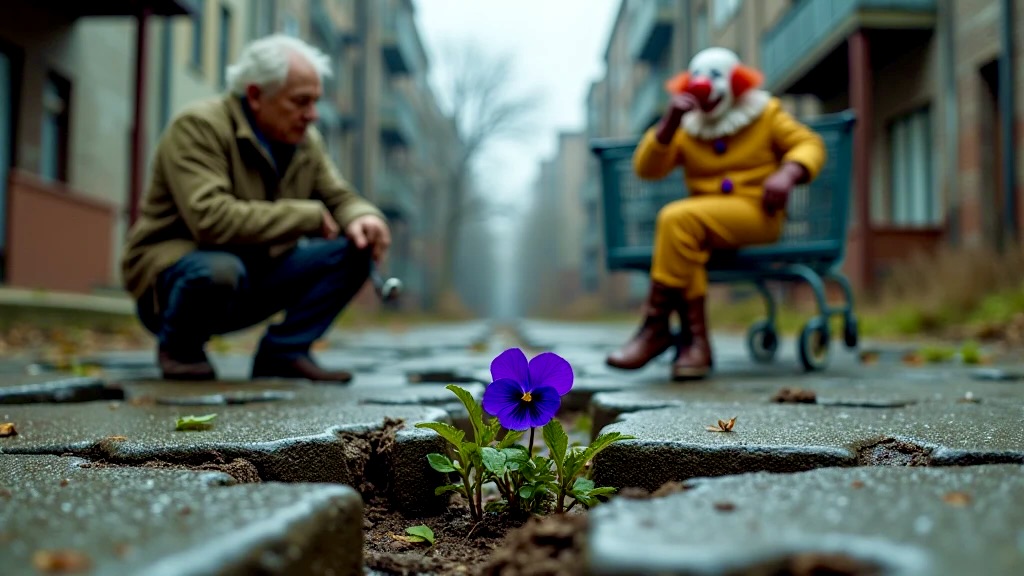
The story follows Evan, a fifty-four-year-old man who ventures beyond the safety perimeter of a decaying, sterile city to find a real flower for his granddaughter. In a ditch filled with rubble, he encounters a disheveled, intoxicated man dressed as a clown who claims to be the Event Manager. This mysterious figure guards a single, stubborn violet, which he describes as a defiance against the sterile, controlled world of the city. As the sky darkens and a massive, otherworldly structure descends, the environment undergoes a violent transformation. The clown reveals that the world is being reclaimed by a force that turns the city's concrete into a glowing, mechanical garden, forcing Evan to flee back to the safety zone while carrying a mysterious, pulsing violet.
The narrative explores the tension between organic authenticity and artificial control. The city, defined by hydroponic labs and serial-numbered plants, represents a suffocating, sanitized existence that has lost its connection to the natural world. By seeking a real violet, Evan searches for a remnant of humanity that does not belong to the state or the corporate developers. This quest highlights the human need for genuine experience in an era of manufactured reality.
The theme of the absurd is personified through the clown, who acts as a herald for a chaotic, inevitable collapse. He views the appearance of a flower in a wasteland as a form of comedy, suggesting that nature's persistence is an insult to the orderly, lifeless structures imposed by society. The final transformation of the city suggests that this rebellion is not merely metaphorical but a literal, cosmic reclamation. It posits that the "tidy" world is fragile and destined to be overwhelmed by the very chaos it seeks to suppress.
Evan is a man defined by a profound sense of obsolescence and a yearning for a lost past. He feels the weight of his fifty-four years and the physical decay of his body, which mirrors the crumbling state of his environment. His motivation for venturing into the dangerous outskirts is rooted in a grandfatherly desire to provide his granddaughter with a tangible piece of reality, reflecting his struggle to find meaning in a world that has replaced beauty with utility.
Throughout the encounter with the Event Manager, Evan oscillates between fear and a begrudging recognition of a kindred spirit. He is initially defensive, gripping his trowel as a weapon, yet he eventually shows vulnerability by engaging with the clown’s cryptic warnings. His decision to follow the clown's advice and leave the flower initially demonstrates a newfound respect for the autonomy of nature. By the end of the chapter, his transformation is complete as he becomes a witness to the end of his world, clutching the pulsing flower as a symbol of his transition from a passive observer to a survivor of the coming change.
The Event Manager is a multifaceted figure who embodies the archetype of the trickster and the prophet. He uses his clown persona as a mask to deflect from the severity of his role as a guardian of the final, authentic spark in a dying world. His erratic behavior and substance abuse serve as a facade that masks a deep, cynical intelligence regarding the true state of the world and its impending demise.
He acts as a catalyst for Evan’s awakening, guiding him away from the desire to possess the flower and toward an understanding of its significance. By stripping away his costume and revealing a presence that transcends his drunken appearance, he exerts a powerful, almost supernatural authority over the landscape. His function is to signal the end of the "show," acting as the grim usher for a reality that is ready to shed its artificial skin.
The narrative voice is grounded, gritty, and deeply introspective, utilizing sensory details to establish a atmosphere of decay. The author employs sharp, evocative imagery, such as the air tasting like "wet dirt and old pennies," to immerse the reader in the protagonist's bleak, sensory-deprived reality. This establishes a tone of melancholic realism that is effectively disrupted by the surreal, neon-blue elements of the climax.
Pacing is handled with deliberate control, starting with a slow, meditative exploration of the outskirts before accelerating into the frantic, chaotic sequence of the city's collapse. The transition from the slow, popping sound of a knee to the mechanical, clicking sound of the flowering lens creates a jarring sense of unease. This stylistic shift mirrors the theme of nature being subsumed by an alien, technological force, effectively pulling the reader into the protagonist's growing disorientation.


