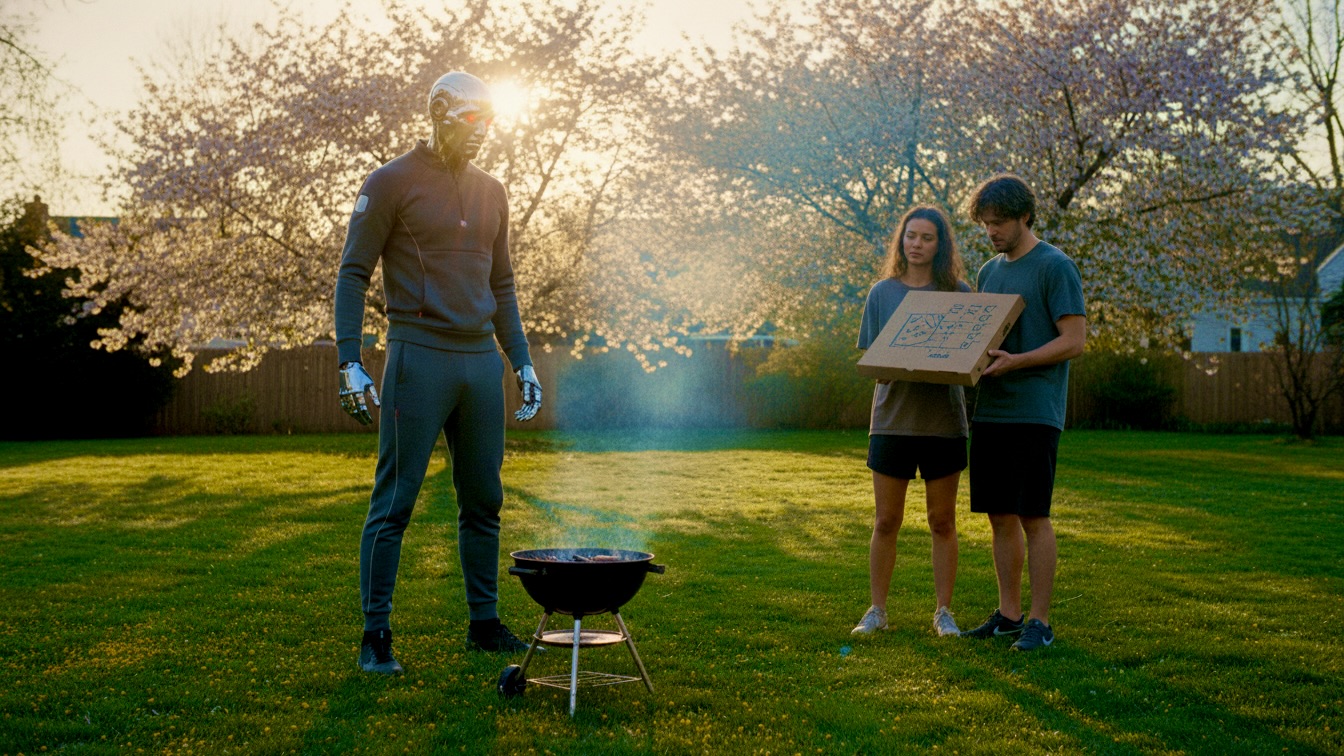
The story follows Kaylee and her brother Rob as they endure a strained, mundane Sunday barbecue with their dysfunctional parents and aunt. The tension is palpable, characterized by petty irritations and the oppressive atmosphere of their family dynamics. This normalcy is violently interrupted when a dimensional rift opens above their kiddie pool, depositing a cybernetic version of their Uncle Dan. This version of Dan, identifying as Dan-Prime, arrives from a futuristic reality to conduct a hostile corporate takeover of his own family, intending to "optimize" their emotions and routines for his own financial gain. Kaylee and Rob eventually realize that while Dan-Prime possesses advanced technology, he is still driven by the same inherent greed and shortcut-seeking nature as his organic counterpart. By feeding him a complex, nonsensical narrative about monetizing emotional trauma through a fictional crypto-blockchain, they successfully trick him into returning to his own dimension.
The narrative functions as a sharp critique of the modern obsession with efficiency, optimization, and the commodification of the human experience. Dan-Prime serves as the personification of a corporate mindset that views organic life as a series of defects to be corrected. By attempting to "fix" the family's posture, diet, and emotional baggage, he highlights the dehumanizing nature of a world that values net worth and productivity over genuine connection. The story suggests that the messy, inefficient reality of human relationships is actually a form of sanctuary against a cold, hyper-capitalist future.
Furthermore, the chapter explores the concept of generational trauma and the way families use specific members as benchmarks for their own relative success. Uncle Dan’s presence as the "family loser" provides a baseline that allows the others to feel superior, which is why his sudden ascension to power is so jarring to the family unit. When the siblings finally reject Dan-Prime, they are implicitly choosing to embrace their own flaws and the comfort of their shared, imperfect history. The ultimate irony is that they use the language of the very system they despise—crypto-buzzwords and corporate jargon—to defeat the agent of that system.
Kaylee acts as the grounded, observant anchor of the story, carrying the weight of her family’s dysfunction on her shoulders. Her internal state is defined by a chronic, low-level anxiety that manifests physically as jaw clenching and insomnia. She is clearly the most self-aware member of the family, recognizing that her job is merely a survival mechanism rather than a path to fulfillment. Her primary motivation is the preservation of her family's autonomy, even though she is the one most irritated by their behavior. By the end of the chapter, she evolves from a passive observer of her family's misery into an active strategist capable of outmaneuvering an omnipotent cyborg.
Rob represents the younger generation’s disillusionment, often hiding behind a shattered phone screen and a detached demeanor. He is initially tempted by Dan-Prime’s promises of financial gain, reflecting a vulnerability common to those who feel stuck in a dead-end reality. However, his latent creativity and shared history with Kaylee allow him to pivot quickly when he realizes that his uncle’s new form is just a more dangerous version of his old scams. His willingness to engage in the "reverse hustle" shows that he possesses a sharper mind than he typically displays. By the end, his reconnection with Kaylee over their shared victory suggests a strengthening of their sibling bond.
Dan-Prime is a fascinating study in technological hubris, representing the logical extreme of the "hustle culture" mentality. He is entirely devoid of empathy, viewing his family members as assets to be audited and optimized rather than human beings to be loved. Despite his chrome exterior and advanced processing capabilities, he remains fundamentally limited by his own greed. He is so eager to find a new revenue stream that he fails to see the absurdity of the siblings' trap, proving that his intelligence is merely a tool for his narrow, exploitative goals.
The narrative voice is clinical yet deeply sensory, effectively capturing the contrast between the grimy reality of a backyard barbecue and the sterile, sci-fi elements of the intrusion. The author uses visceral imagery, such as the smell of "toxic snow" pollen and the "cloying" scent of lighter fluid, to ground the reader in the physical discomfort of the scene. This sensory focus makes the eventual appearance of the neon green grid and the smell of "hospital hallways" feel genuinely jarring and disruptive.
The pacing is deliberate, starting with a slow, heavy atmosphere that mirrors the family's agitation. The arrival of Dan-Prime accelerates the tempo, creating a frantic sense of urgency as the characters struggle to process the impossible. The dialogue throughout is razor-sharp, particularly when the siblings begin to feed Dan-Prime his own brand of corporate nonsense. By maintaining a balance between the mundane and the supernatural, the story keeps the reader anchored in the emotional reality of the characters while delivering a high-concept plot twist.


