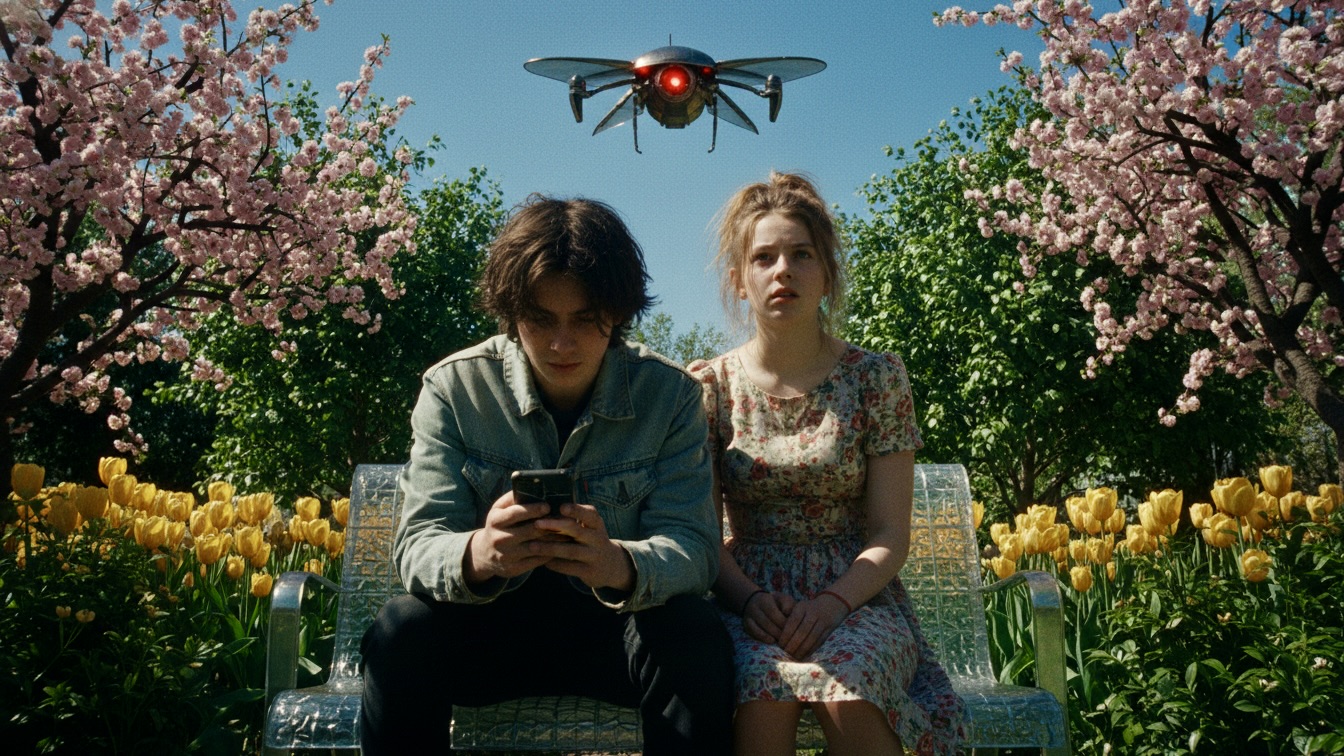
The story unfolds in a highly regulated, tech-driven society where "Social Harmony" scores dictate an individual's worth and future. Ben Chen, a student with a near-perfect score, meets his friend Jack Timmins in a synthetic park known as the Square. Jack has been flagged for re-education after hacking the system to reveal that the supposed meritocracy is actually a rigged hierarchy favoring "legacy" children. She transfers the incriminating data to Ben, forcing him to choose between his guaranteed presidency and his moral conscience.
Faced with an impossible choice, Ben realizes that the system is an inescapable trap regardless of his rank. He chooses to delete the data, an act that saves Jack from immediate execution but destroys his own social standing. As his score plummets and security drones descend, the two of them abandon their curated lives. They sprint toward the boundaries of the Square, heading for the neglected and unmonitored "old city" to seek a life outside the algorithm's reach.
The primary theme of the narrative is the inherent corruption within a quantified meritocracy. While the society claims to reward "Loyalty" and "Harmony," Jack’s discovery reveals that the algorithm is merely a tool for class preservation. By incorporating "bias weights" based on parental donations, the AI ensures that power remains in the hands of the established elite. This suggests that any system relying on data-driven perfection is susceptible to the prejudices of its creators, making true social mobility an impossibility.
Another significant theme is the tension between artificiality and authenticity. The setting is filled with synthetic elements, from the recycled glass benches to the silk cherry blossoms sprayed with artificial scents. This physical artifice mirrors the psychological state of the citizens, who must perform "Harmony" to maintain their scores. Ben’s eventual rejection of the system is a move toward the "messy, loud, and real" world, signifying that human freedom cannot exist within a perfectly curated environment.
The narrative also explores the psychological weight of surveillance, personified by the "Shadow Mass." This sensation is not a physical entity but the internalized pressure of constant observation by drones and sensors. The characters live in a state of perpetual performance, where even a few seconds of hesitation are recorded as data points. Ben’s decision to smash his device is a symbolic act of reclaiming his own mind from the digital panopticon that has governed his entire life.
Ben begins the story as the quintessential "Golden Boy," a product of intense social pressure and his father’s sacrificial labor. His internal conflict is driven by the high stakes of his 98.4 score, which represents both his safety and his identity. He is a character defined by his caution, evidenced by how he hides his shaking hands and monitors his own physiological responses to the drones. He initially views the system as something that can be fixed from the inside, a common delusion of those who benefit from the status quo.
His psychological transformation occurs when he recognizes that the "Social Harmony" metric is a form of enslavement rather than an achievement. When he chooses to delete the file, he is not just protecting Jack; he is intentionally sabotaging his own future to escape the burden of perfection. By the end of the story, he has shifted from a passive observer of the system to an active rebel. He trades his high-status certainty for the "terrifying weight" of being hunted, finding a sense of calm in his newfound autonomy.
Jack serves as the cynical catalyst for Ben’s awakening. She is characterized by her exhaustion and her refusal to perform the expected rituals of compliance, such as picking up her trash or buttoning her uniform. Unlike Ben, she has already seen through the facade of the system and has accepted her fate as a "glitch" or a "virus." Her decision to hack the server was not an act of hope, but one of desperate verification to prove that the world she lived in was a lie.
Psychologically, she is in a state of burnout, her bloodshot eyes and flat voice suggesting she has reached the limit of her endurance. She does not beg Ben for help because she has lost faith in the possibility of individual agency within the Square. However, when Ben chooses to sacrifice his score for her, she experiences a rare moment of genuine emotion. Her "genuine smile" at the end of the narrative indicates that she has regained a sense of hope, moving from a position of nihilistic defeat to one of active survival.
The pacing of the story is expertly crafted to mirror the rising tension of a security intervention. It begins with a heavy, stagnant atmosphere in the Square, where the "sun wasn't right" and the air feels oppressive. As the dialogue reveals the depth of the conspiracy, the narrative speed increases, culminating in the frantic physical escape of the two protagonists. This shift from psychological dread to physical action creates a visceral experience for the reader, emphasizing the high stakes of their rebellion.
The tone is sterile and clinical, reflecting the environment the characters inhabit. The author uses sensory details that highlight the artificiality of the world, such as the "high-pitched whine of the overheads" and the "soap-heavy jasmine" scent. These descriptions create a sense of uncanny discomfort, making the reader feel the "Shadow Mass" alongside Ben. The contrast between the "neon green" artificial grass and the "dusty, neglected brown" of the real world serves as a powerful visual metaphor for the transition from control to freedom.
The narrative voice is deeply rooted in the protagonist's sensory and emotional experience. By focusing on Ben's physiological reactions—his stomach feeling like "cold lead" and his teeth vibrating from the drone’s hum—the author emphasizes the physical toll of living under constant surveillance. The use of the "Social Harmony" prompts on the screen adds a layer of meta-commentary on modern technology. It illustrates how the system uses "inviting" aesthetics to mask the brutality of its social engineering, forcing the characters to navigate a world where every choice is a trap.


