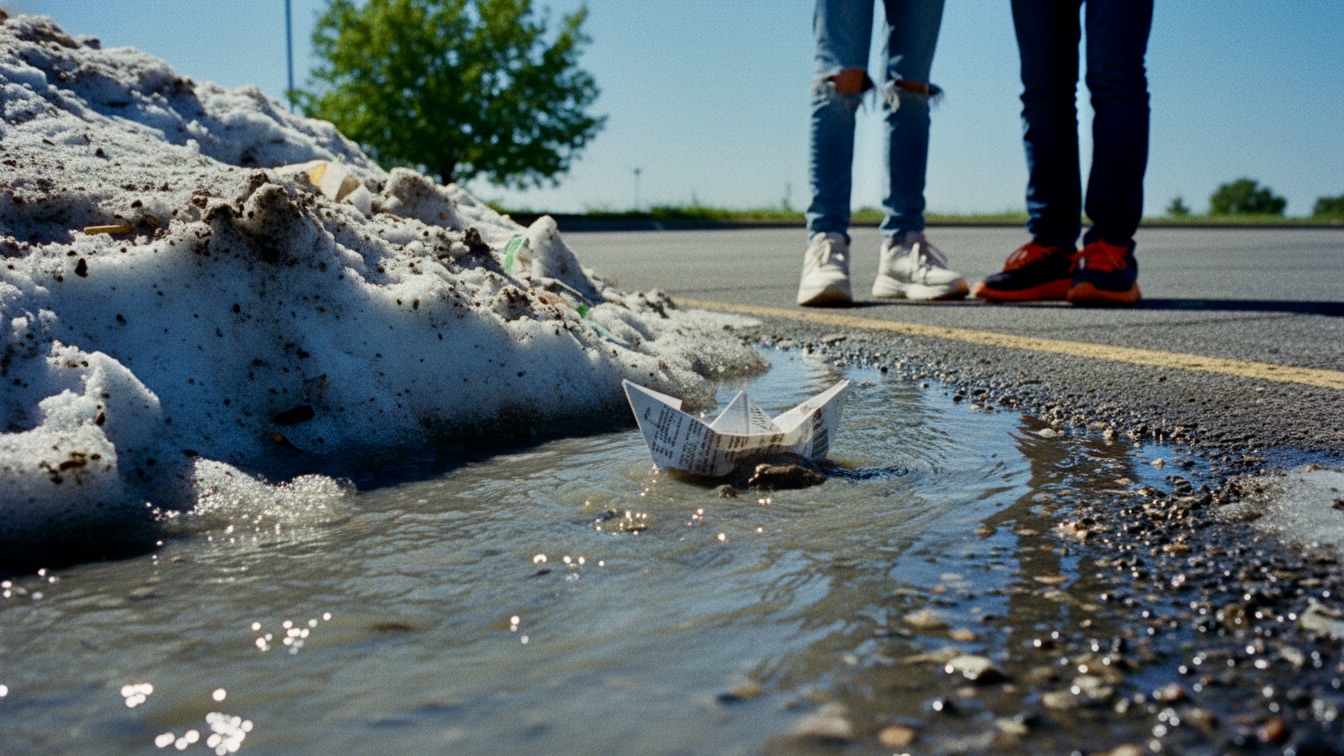
The chapter follows two young men, Max and Larry, as they stand in a bleak, slush-filled CVS parking lot during the late winter month of March. Max, feeling the weight of a life defined by mundane transactions, attempts to reconnect with his childhood by folding a paper boat out of a CVS receipt. He places the boat in a gutter stream of oily, salt-laden runoff, hoping to see it sail toward a storm drain. Larry, who has recently "rebranded" himself with expensive clothes and a cynical, status-driven attitude, watches Max with a mixture of boredom and disdain.
As the paper boat is slowly destroyed by the corrosive road salt and grime, the two engage in a tense dialogue about maturity and the loss of childhood magic. Larry dismisses Max’s nostalgia as "cringe," asserting that life is merely a series of events that happen until they stop. Their shared observation of a lost silver earring falling into the sewer serves as a silent climax, where neither chooses to act, signaling the finality of their emotional distance. Larry eventually leaves to meet a new friend at the gym, leaving Max alone to watch the puddle evaporate into a bitter, white salt stain on the asphalt.
The central theme of the story is the painful transition from childhood wonder to the cynical pragmatism of adulthood. This is most poignantly illustrated through the metaphor of the paper boat, which Max constructs from a symbol of modern consumerism—a CVS receipt. While Max seeks to find "something that isn't a transaction" in the mud, Larry has fully succumbed to a world where everything is a trade-off. Their friendship, once built on imagination and shared play, has been replaced by a cold evaluation of social "optics" and "leverage."
Entropy and decay serve as the atmospheric backdrop for this emotional erosion. The setting in March, described as the month where "winter’s corpse" begins to rot, mirrors the state of the boys' relationship. The salt that melts the ice also destroys the paper boat, just as the pressures of social climbing and maturity are dissolving the bond between the two protagonists. The story suggests that the "filth of the city" is not just on the ground but has seeped into the way people perceive one another, turning once-vibrant connections into gray sludge.
Another prominent theme is the performative nature of modern identity. Larry is no longer a person so much as a "brand," meticulously curated to fit in with a new, affluent crowd. He views his past self and Max’s current behavior through the lens of embarrassment, fearing that any display of genuine emotion will undermine his carefully constructed image. This highlights a psychological shift where the need to be perceived as "cool" or "detached" overrides the human instinct for empathy and play.
Max serves as the story’s emotional anchor, representing a psyche that is mourning the loss of innocence. He is acutely aware of the "low-stakes transactions" that define his life and feels a desperate need to find meaning in a world that feels increasingly flat and dirty. His decision to kneel in the slush is a symbolic act of rebellion against the sterile, mechanical nature of his environment. He is not merely making a boat; he is trying to prove that he still possesses the capacity for imagination and hope.
Psychologically, Max is experiencing a form of "stuckness," caught between the "civilizations" of his youth and the harsh reality of his late teens. He feels the "tightness" in his chest when Larry mocks him, indicating that he is still vulnerable to the opinions of his old friend. However, by the end of the chapter, Max reaches a state of somber realization. He understands that he cannot save the boat or the friendship, and his quiet observation of the salt stain suggests he is beginning to accept the permanence of the change.
Larry functions as the antagonist of the narrative, embodying the cold, ironic detachment that Max fears. He has undergone a profound psychological shift, moving from a child who "used to cry when they found a dead bird" to a young man who views boredom as a "luxury." His constant checking of his phone and his focus on "optics" suggest a deep-seated insecurity. He uses his new wardrobe and slicked-back hair as armor to protect himself from the perceived weakness of his past.
Larry’s cynicism is a defense mechanism designed to distance him from the pain of growing up. By labeling Max’s actions as "peak cringe," he validates his own choice to abandon their shared history. He is committed to the "bit" where nothing matters, a philosophy that allows him to ignore the loss of the silver earring and the disintegration of his oldest friendship. His departure at the end of the chapter is not an act of malice but one of indifference, which is ultimately more damaging to Max than an actual argument would have been.
The narrative voice is characterized by a gritty, melancholic realism that utilizes sensory details to evoke a sense of urban decay. The author uses vivid imagery, such as the "swirling, oily soup of road salt" and the "bruised purple" ink bleeding from the receipt, to create a visceral experience of the setting. These descriptions serve to ground the abstract themes of emotional loss in a tangible, physical world. The comparison of the puddle's color to a "screen that had been left on too long" effectively bridges the gap between the natural world and the digital exhaustion of the characters.
Pacing in the chapter is slow and deliberate, mimicking the sluggish movement of the runoff in the gutter. The narrative lingers on the small, insignificant moments—the folding of the paper, the movement of the earring, the evaporation of the water—to emphasize the characters' stasis. This slow pace forces the reader to sit with the discomfort of the dying friendship, making the eventual "finality" of Larry’s departure feel earned. The lack of a major "blowup" or shouting match reinforces the idea that some endings are quiet and cumulative rather than explosive.
The tone is one of profound disillusionment, underscored by a sense of inevitability. The author masterfully uses the metaphor of the salt stain at the conclusion to provide a haunting final image. As the water evaporates, the "ghost of the puddle" remains as a jagged blemish, suggesting that while the immediate conflict may pass, the damage to the soul leaves a permanent mark. This stylistic choice ensures that the story ends on a note of quiet despair, reflecting the reality of a world where "everything goes into the drain eventually."


