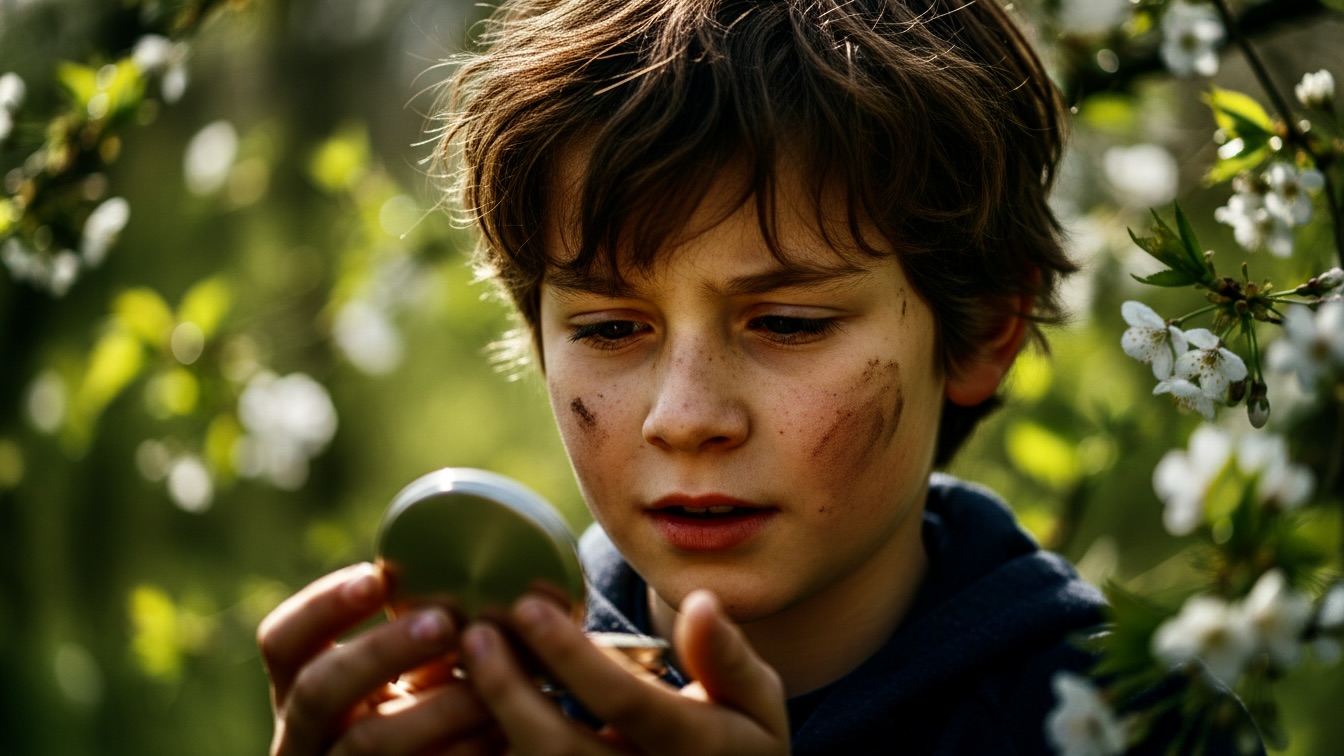
Toby ventures into a bleak, muddy forest during the transitional period between winter and spring. He is desperately searching for a silver compass that belonged to his father, an object that represents his last connection to a sense of stability. As he navigates the "messy" woods, he discovers a red rubber nose sitting atop a pile of slush, an anomaly that signals a shift from the mundane to the surreal.
A tall, menacing figure dressed in a tuxedo made of trash bags suddenly confronts Toby, claiming the nose is a prop for a "Spring Gala." This man is accompanied by two robotic, silver-headed clowns who juggle rusted clock parts and gears. The man mocks Toby’s distress, suggesting that the boy’s search for a home and a road is a concept of the past. He attempts to draft Toby into a theatrical performance where the boy is cast as a victim who disappears.
Toby manages to find his compass atop a massive heap of discarded household items, but he is forced to flee when the clowns turn aggressive. He hides inside a hollow log while the tall man searches for him, using a long, painted finger to probe the darkness. Once the performers vanish, Toby emerges to find the forest has undergone a magical transformation into a lush, blossoming spring. Despite the beauty of the new environment, the sound of a lingering giggle suggests that he is not yet truly safe or alone.
The central theme of the narrative is the psychological manifestation of grief and the fear of erasure. Toby describes the world as a "giant eraser" that is slowly rubbing out the things that matter to him, such as his toys and his mother’s jewelry. This metaphor highlights the protagonist’s struggle with "The Move," which serves as a catalyst for his sense of displacement. The loss of the compass is not just the loss of a tool, but the loss of his father’s guidance and the physical proof of his existence.
Another prominent theme is the intersection of performance and predatory behavior. The tall man and his mechanical companions treat Toby’s genuine terror as a theatrical act, effectively dehumanizing him for their entertainment. This reflects a world that feels indifferent or even mocking toward personal tragedy. By framing Toby’s life as a "play," the tall man strips the boy of his agency, turning his desperate search for home into a scripted tragedy for an unseen audience.
The story also explores the concept of liminality, both in nature and in the human psyche. The setting begins in the "ugly" part of spring, a muddy and gray middle ground where nothing is quite alive or dead. This mirrors Toby's internal state as he lingers between his past life and an uncertain future. The sudden, unnatural transition to a "perfect" spring at the end suggests that Toby has crossed a threshold into a different reality, one where the rules of the physical world no longer apply.
Toby is a young boy who is currently experiencing a profound sense of ontological insecurity. He is a character defined by his attachments to physical objects, which he uses as anchors to keep himself from being "erased" by the changes in his life. His decision to stay in the woods despite his fear demonstrates a deep-seated loyalty to his father’s memory. He is a brave child, but his bravery is born out of a desperate need to maintain his identity in the face of overwhelming loss.
Psychologically, Toby exhibits signs of hyper-vigilance, as evidenced by his intense focus on sensory details like the smell of old pennies or the sound of the mud. He is highly observant of the "missing" elements of his world, such as the sun and the birds, which suggests he feels abandoned by the natural order. When he confronts the tall man, he attempts to use "big words" to assert his rights as a citizen. This shows his desire for the protection of adult structures and rules that no longer seem to exist in this surreal forest.
The tall man serves as the primary antagonist and a personification of the "Uncanny." He is a figure of contradiction, wearing a tuxedo made of garbage and sporting a permanent, painted smile that contrasts with his glowing, unhappy eyes. His movements are jerky and non-human, suggesting he is an entity that merely mimics human behavior for the sake of a "performance." He represents the chaotic and often cruel nature of a world that views human suffering as a spectacle.
From a psychological perspective, the tall man functions as a gatekeeper or a predator who feeds on the "lost" status of others. He is threatened by Toby’s "talent for finding lost things," because his power relies on the boy remaining disoriented and compliant. He uses theatrical language to gaslight Toby, dismissing the boy’s reality of "the road" and "home" as outdated concepts. He is not merely a villain; he is a manifestation of the void that Toby fears, a being that wants to turn the boy into a character rather than a person.
The narrative voice is characterized by a blend of childhood innocence and gothic dread. The author uses vivid, often repulsive similes, such as the mud sounding like a "giant slurping a milkshake" or the air smelling like "old basement carpet." These descriptions ground the reader in Toby’s sensory experience, making the transition into the surreal elements feel even more jarring. The contrast between the "cold chocolate milk" mud and the "shiny shower curtain" smell of the nose highlights the intrusion of the artificial into the natural world.
Pacing in the chapter is expertly handled, beginning with a slow, heavy slog through the mud that mirrors Toby’s emotional exhaustion. As soon as the tall man appears, the pace quickens into a frantic, nightmarish sequence. The use of onomatopoeia, such as the Clack, Whir, Snap of the gears, creates an auditory landscape that is sharp and mechanical. This heightens the tension, making the reader feel the same sensory overload that Toby experiences as he is surrounded by the silver-headed clowns.
The tone shifts dramatically in the final paragraphs, moving from a claustrophobic horror to a deceptive, dreamlike beauty. The description of the trees covered in "popcorn" blossoms and the "velvet" grass provides a sense of relief that is immediately undercut by the final high-pitched giggle. This stylistic choice leaves the reader in a state of unease, suggesting that the "pretty" version of spring may be just as dangerous as the "messy" one. The author successfully uses the environment as a reflection of the protagonist's shifting psychological landscape.


