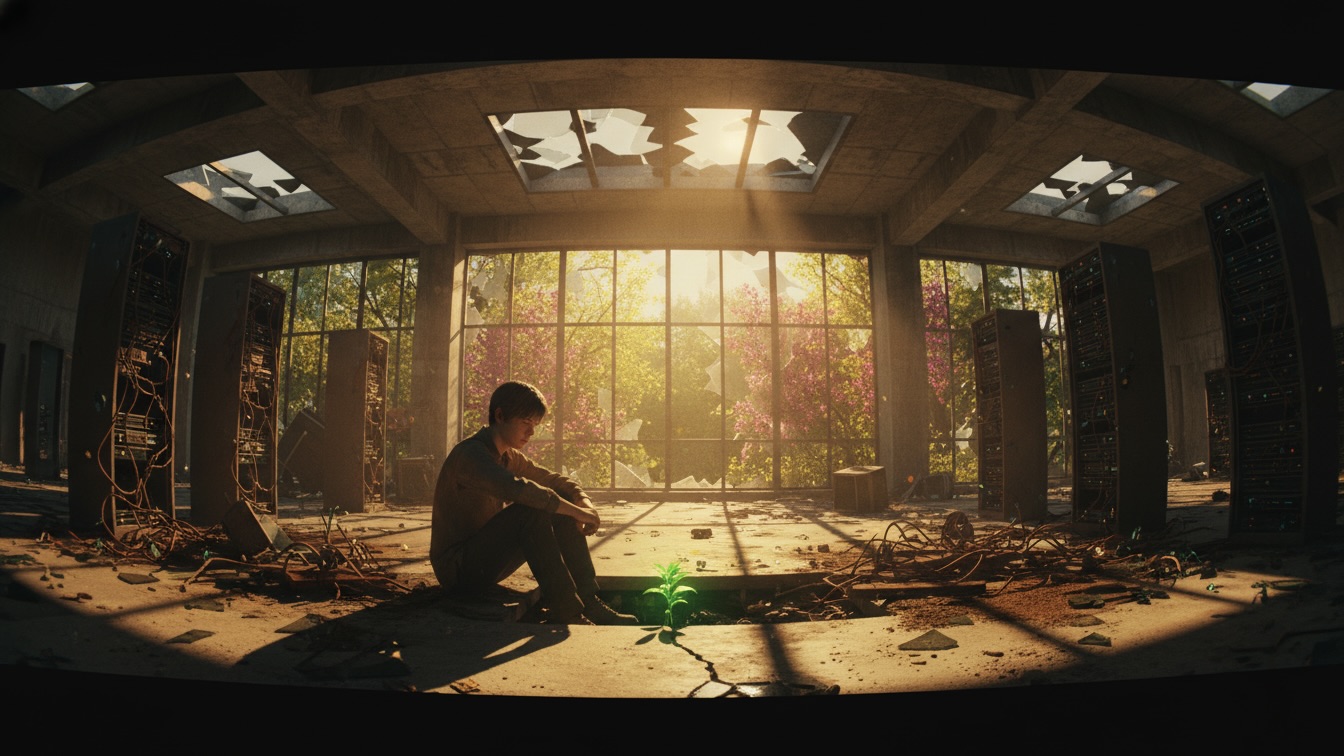
Ryan wanders through the ruins of Melgund Creek, a town where the physical decay of the world is masked by a flickering Augmented Reality overlay. His haptic suit is failing, and his battery is low, creating a sensory disconnect between the neon digital towers and the gray, rotting reality. His friend Tess, appearing as a shimmering digital goddess, warns him that he must find a connection node before a massive sunset "Update" occurs. If he fails to sync, his profile will be archived, effectively ending his existence in their hyper-connected society.
Inside a ruined library, Ryan discovers a small, living sprout growing through the floorboards. This tangible piece of nature contrasts sharply with the "Ancient Temple" skin his AR provides, prompting a moment of genuine awe. Despite Tess’s desperate pleas to prioritize his digital survival and social standing, Ryan decides to remove his goggles and embrace the physical world. He chooses to sit in the quiet, dusty reality as his headset finally dies, watching the true purple twilight instead of the artificial colors of the Feed.
The story explores the profound tension between a curated, digital lie and a harsh, decaying truth. Ryan notes that the "gray" of the real world is the truth, and while he initially finds it boring, he eventually discovers a profound sense of presence within it. The AR represents a refusal to mourn or acknowledge the death of the physical world, turning a library into a "DLC" temple. This suggests a society that has traded its ability to process grief for a permanent, flickering distraction.
The text also examines the commodification of identity within a digital landscape. Tess’s fear centers on the loss of "skins," "followers," and "history," revealing a world where existence is validated only through the "Feed" and digital visibility. To be "archived" is equated with death, suggesting that the characters have outsourced their sense of self to a corporate-controlled network. Ryan’s rejection of this system marks a reclamation of his intrinsic worth as a biological being, independent of his "sync" percentage.
Nature’s resilience serves as a powerful symbol of life that persists without the need for patches or updates. The sprout represents a "slow" time that stands in opposition to the frantic, battery-dependent urgency of the AR world. While the digital world requires constant maintenance and hardware upgrades, the plant simply exists, breaking through concrete to find light in the dark. Ryan’s choice to shield the plant indicates a shift from a consumer of digital assets to a guardian of the fragile, physical world.
Ryan is a young man suffering from a profound sense of dissociation and sensory fatigue. He describes his low battery as a "warning of the soul," suggesting that his internal life has become inextricably linked to his hardware. His physical discomfort, such as the nausea caused by digital motion sickness, hints at a body that is rebelling against its technological shackles. He is caught between the "divine" allure of the digital world and the "gross" authenticity of the real one.
His psychological arc is one of re-sensitization and the acceptance of vulnerability. He moves from hating the sharp, unfiltered edges of the real world to finding them "perfect" in their discomfort. By shielding the plant, he demonstrates a shift from a passive user to an active participant in reality. This act of protection reflects his own need for autonomy as he transitions into a world without a digital safety net, finally finding a state where he no longer feels like he is "lagging."
Tess represents the ultimate victim of the digital age, a person who has completely replaced her physical self with a curated avatar. Her theatricality and use of "divine" imagery suggest she has turned the AR system into a secular religion. She is terrified of the "real" world because it exposes her as "pale" and "tired," qualities that do not exist in her shimmering purple skin. Her identity is entirely performative, built on the fear of being "nobody" in a dying town.
Her motivation is driven by a desperate need for social validation and a fear of obsolescence. She speaks in the jargon of streamers and influencers, showing how her very thoughts have been colonized by the platform she inhabits. Even her moments of genuine concern for Ryan are filtered through the lens of digital status, as she views a living plant only as a "rare drop" or a "legendary item." She cannot conceive of a world where value is not measured in credits or followers.
The narrative employs a heavy use of sensory contrast to highlight the divide between the two worlds. The digital world is described with technical jargon like "haptic feedback," "anti-aliasing," and "low-res," creating a cold, mechanical atmosphere. In contrast, the physical world is defined by "wet dirt," "dust," and "cool, velvety" textures. This sensory grounding makes Ryan’s eventual choice feel earned and visceral, as the reader experiences the "ache" of the digital world alongside him.
The pacing of the story mirrors Ryan’s internal state, beginning with a frantic, twitchy energy and slowing down as he nears the library. The rhythmic "staccato" of the low battery warning creates a ticking-clock element that builds tension throughout the scene. However, the story purposefully de-escalates that tension in the final moments, replacing the "theatrical voices" with a profound, heavy silence. This shift in pace allows the reader to feel the weight of the "real sky" as it replaces the neon noise.
The tone is one of elegiac melancholy, mourning a world that has been covered up rather than repaired. The author uses the "corrupted save file" metaphor to describe the town, which effectively bridges the gap between the characters' digital obsession and their physical reality. This stylistic choice emphasizes that the world has not just decayed; it has been fundamentally broken by the very technology meant to enhance it. The final image of the "tiny, pathetic beep" of the dying goggles underscores the ultimate fragility of the digital kingdom.


