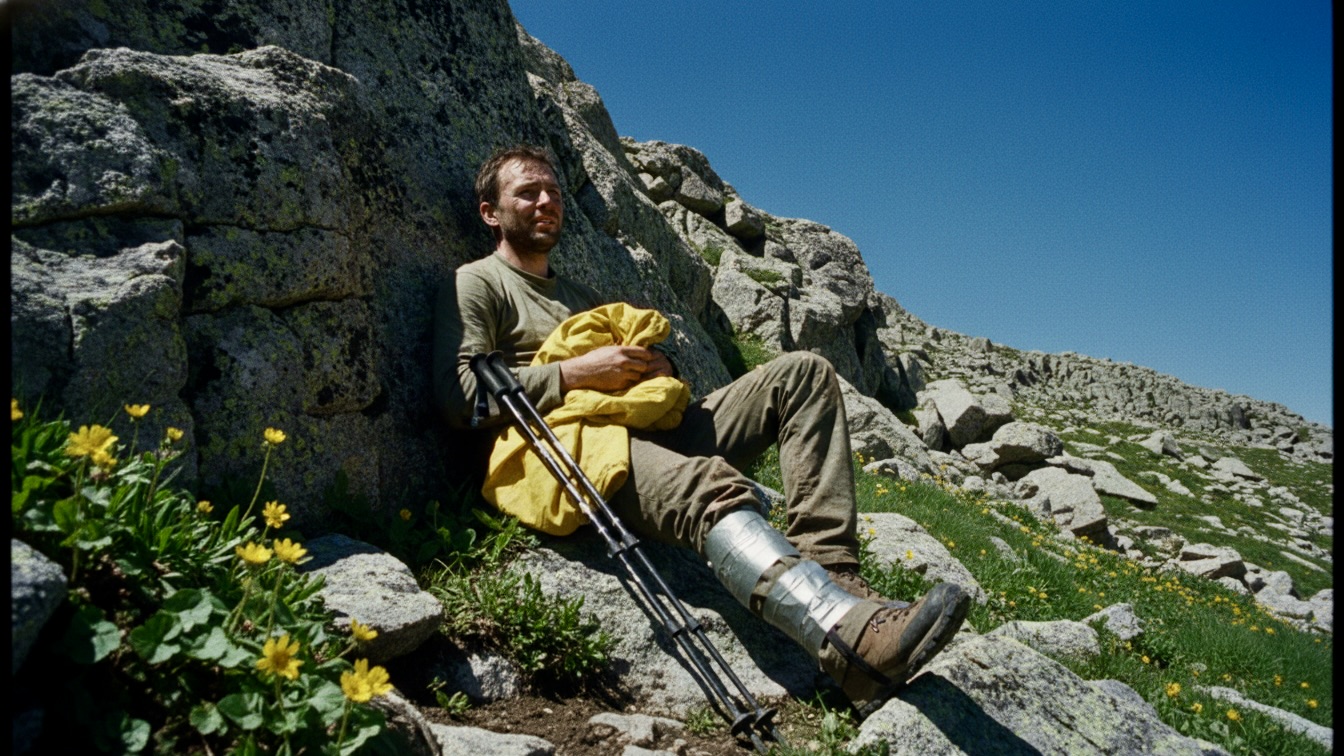
The narrative begins with a sudden and violent geological event as a mountain slope disintegrates beneath Paul, a hiker on a solitary mission. Unlike the cinematic portrayals of earthquakes, the landslide occurs without warning, plunging him into a chaotic "washing machine filled with knives" made of granite and dust. When the movement finally stops, Paul finds himself buried under debris with a catastrophic compound fracture in his left leg. The physical trauma is immediate and life-threatening, marked by a sickening misalignment of his limb and the loss of his vital water supply.
In the midst of his shock and blood loss, Paul begins to hallucinate the presence of his deceased husband, James. This phantom version of James is healthy and sardonic, reflecting the man as he was before cancer ravaged his body. James provides a psychological anchor, mocking Paul’s poor packing choices and demanding that he perform the agonizing task of resetting his own bone. During this process, Paul discovers that the Nalgene bottle containing James’s ashes has shattered, scattering the remains across the landslide debris.
The story follows Paul’s grueling descent toward a distant creek, driven by a mixture of survival instinct and a heated, hallucinatory argument with James about their past. Paul is forced to confront his avoidance of grief, his obsession with work, and the "museum" of a house he has kept frozen in time since the funeral. After a painful crawl and a controlled slide down the mountain, Paul reaches the water and finds his clarity returning. The hallucination vanishes, leaving him alone but determined to survive. The chapter concludes with the arrival of a park ranger drone, signaling his rescue and his newfound desire to continue living.
The primary theme of the narrative is the violent intersection of physical survival and emotional catharsis. The landslide serves as a physical manifestation of the "fracture" in Paul’s life, mirroring the internal collapse he experienced after James’s death. For a year, Paul has lived in a state of stagnant mourning, but the mountain forces him into a situation where he must choose between literal death and the agony of movement. The trauma to his leg acts as a catalyst, breaking the emotional paralysis that has kept him tethered to a house full of ghosts and unpaid medical bills.
Another significant theme is the indifference of the natural world toward human suffering. Paul notes the "aggressive blue" of the sky and the hawk circling indifferently above his broken body. This cosmic apathy highlights the insignificance of his personal tragedy in the face of geological time. The fact that James’s ashes are scattered by a "random geological event" rather than a planned ceremony suggests that closure is rarely a neat or controlled process. Nature does not care about Paul’s rituals; it only demands that he adapt or perish.
The story also explores the theme of reconciliation with the self through the medium of a "shadow" dialogue. James is not a literal ghost but a projection of Paul’s own will to live and his suppressed anger. By arguing with this hallucination, Paul is finally able to voice the resentment he feels regarding the debt and the "mess" left behind by terminal illness. This psychological projection allows him to process the guilt of being the survivor. The act of splinting his leg with duct tape and trekking poles becomes a metaphor for the makeshift way he must now reconstruct his life.
Paul is a character defined by a rigid, analytical mind that he uses as a shield against emotional vulnerability. As a software engineer, he views his own existence through the lens of technical systems, performing "system checks" on his limbs and describing his trauma as a "total crash." This clinical detachment is his primary coping mechanism, allowing him to manage the overwhelming horror of a compound fracture by treating his body like malfunctioning hardware. However, this same detachment has caused him to neglect his emotional reality, leading to a year of social isolation and professional overcompensation.
His internal conflict is rooted in a deep-seated sense of duty and the exhaustion that follows it. He has spent a year paying off "massive" hospital bills and maintaining a home that feels like a tomb, suggesting a man who prioritizes external obligations over internal healing. The landslide strips away his ability to hide behind his work or his "ergonomic chair." When he is forced to reset his bone, the "animal noise" he makes represents the breaking of his controlled, technical facade. It is the first time he truly feels the weight of his situation without the buffer of his professional identity.
By the end of the chapter, Paul undergoes a fundamental shift from passive endurance to active defiance. His decision to stand up and crawl despite the blinding pain is fueled by "pure, unfiltered spite," which is a more potent survival tool than hope. This spite is directed both at the mountain and at the version of James that accuses him of giving up. When the drone arrives, Paul’s realization that he "didn't want to die" marks the end of his year-long flirtation with emotional oblivion. He accepts the "massive hospital bill" of the future because he has finally reconnected with the value of his own heartbeat.
The pacing of the chapter is masterfully synchronized with the protagonist’s physical and mental state. It begins with a frantic, high-intensity sequence that mimics the suddenness of the landslide, using short, punchy sentences to convey disorientation. As Paul settles into the reality of his injury, the pace slows down, becoming agonizingly deliberate. This mirrors the "step-by-step" nature of his survival, where every inch of progress is a battle. The narrative expansion during his dialogue with James provides a necessary breath of air before the final, desperate crawl to the creek.
The tone is visceral and unsentimental, avoiding the typical tropes of a survivalist epic. The author uses harsh, industrial metaphors—"washing machine filled with knives," "thick celery snapping," and "robotic appendage"—to describe biological trauma. This choice of language reinforces Paul’s technical background and his attempt to compartmentalize pain. The sensory details are particularly sharp, focusing on the "sulfur and crushed quartz" smell of the mountain and the "chalky paste" of the dust. These details create a grounded, gritty reality that makes the hallucination of James feel even more jarring.
The narrative voice is a compelling mix of sardonic wit and raw vulnerability. The dialogue between Paul and the hallucination of James provides a dark humor that keeps the story from becoming overly morose. This banter serves a dual purpose: it provides exposition about their past life and highlights the psychological strain Paul is under. The contrast between the high-tech reality of the "automated park ranger drone" and the primitive struggle of a man dragging himself through the dirt creates a powerful closing image. It suggests that while technology can save Paul’s life, it cannot do the emotional work of repairing his spirit.


